

Since the outbreak of the U.S.–Israeli war on Iran, hundreds of oil tankers and cargo vessels have piled up at the entrance to the Strait of Hormuz, waiting in an open queue tied directly to the trajectory of the conflict. At the same time, several European countries most notably France and Italy have initiated separate negotiations with Tehran to guarantee safe passage for their ships.
Meanwhile, the number of vessels that have been targeted while attempting to cross the strait has risen to 16, according to open-source investigations.
With every crisis in this maritime corridor, the long-standing question of global energy and trade security resurfaces. The strait is widely considered one of the most sensitive chokepoints in the international economy.
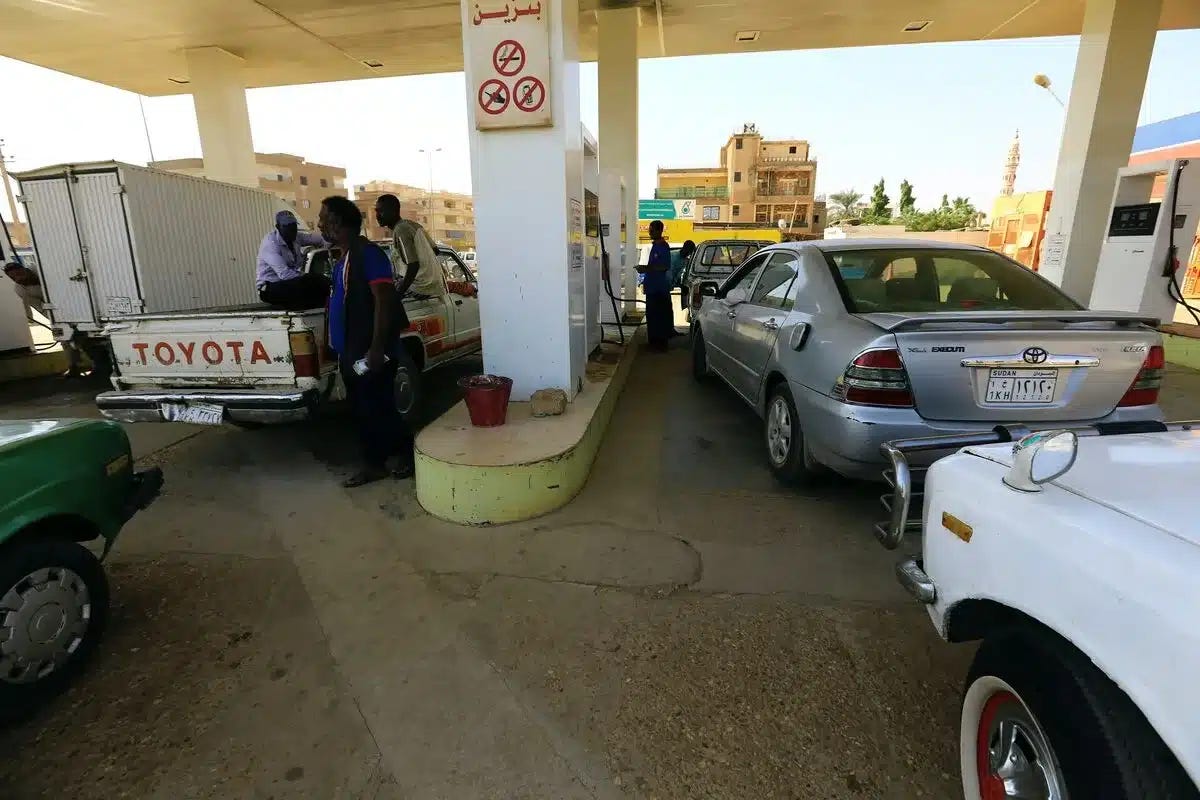
In Sudan, the effects of these tensions are emerging in a different form. In several cities—chief among them the capital, Khartoum—fuel lines have begun to stretch outside service stations. Supplies arriving through the Red Sea are closely tied to the stability of supply chains in the Gulf and to shipping costs. Any disruption in those chains quickly reverberates in local markets.
Sudan therefore finds itself navigating an exceptionally complex geography. Fuel routes pass through the Gulf and the Strait of Hormuz, while goods and commodities travel through the Bab al-Mandeb Strait before reaching Port Sudan from the Indian Ocean and the Gulf of Aden. As a result, any instability in the region ripples through Sudan’s ports and markets before gradually affecting the broader economy and food supply.
Hormuz: Oil and Fertilizers
When discussions turn to the possible closure of the Strait of Hormuz, attention usually focuses on oil. The narrow waterway that connects the Gulf to the Sea of Oman carries roughly 20 percent of the world’s oil supplies, making it one of the most critical chokepoints in global energy markets. As tensions in the Gulf have escalated, oil prices have jumped rapidly on global markets.
Major investment banks have raised their forecasts, with Goldman Sachs analysts estimating prices at around $110 per barrel, while JPMorgan has lifted the ceiling to about $130 if the strait remains closed.
These fluctuations reach Sudan quickly. The country relies almost entirely on imported fuel shipped through the Red Sea. Sudan’s diesel imports are estimated at roughly 60,000 to 70,000 tons per month—about 720,000 to 840,000 tons annually—most of which arrives through Port Sudan after passing through maritime routes from the Gulf. Any rise in global oil prices or disruption to tanker traffic therefore directly affects import costs and the country’s ability to secure energy supplies.
Yet oil is not the only commodity passing through the strait. Roughly one-third of global fertilizer trade also moves through Hormuz. Qatar is the world’s largest exporter of urea, while Gulf states account for around 45 percent of the global market for this essential agricultural input. Urea is a key nitrogen fertilizer with few viable substitutes for many crops and remains central to agricultural production across vast parts of the world.
As global markets have grown more volatile, the price of urea has jumped from around $450 per ton to more than $600 in just one week an increase exceeding 37 percent. Unlike energy markets, which maintain strategic reserves that can be tapped during crises, fertilizer markets lack similar mechanisms. As a result, any disruption to trade routes quickly translates into direct pressure on agriculture and food security.
Bab al-Mandeb: An Imminent Threat
Tensions in the Gulf do not stop at the Strait of Hormuz. In recent days, Al Jazeera quoted a senior Iranian military official warning that any strategic miscalculation by the United States could push another strait into a similar situation a clear reference to the Bab al-Mandeb Strait, the southern gateway to the Red Sea and one of the most vital maritime links between Asia and Europe.
The significance of this threat is tied to the military reality in Yemen. The Iranian-backed Houthi movement has previously carried out attacks on commercial vessels in the Red Sea, at times disrupting navigation and forcing international shipping routes to divert away from the corridor. These precedents have made Bab al-Mandeb part of the region’s pressure dynamics, where any escalation could quickly affect ship traffic through the strait.
For Sudan, Bab al-Mandeb holds direct importance. Many ships bound for Port Sudan pass through the strait before reaching Sudan’s coast. Fuel shipments from the Gulf follow the same route, as do commercial goods and food supplies. The two straits are not alternatives to one another; rather, they resemble the two blades of a pair of scissors, gripping Sudan between them.
Sudan: Three Factors Increasing Vulnerability
The potential closure of the Strait of Hormuz would not affect only one country. Major industrial economies depend—at varying levels—on energy supplies from the Gulf. Japan imports roughly 75 percent of its oil through this route, while China, India, and South Korea also rely heavily on it. These countries possess economic tools and reserves that allow them to absorb part of the shock if supplies are disrupted.
Sudan’s situation is markedly different for several reasons:
The first factor is the weakness of its foreign currency reserves. Fuel imports depend on hard currency, which has been scarce in Sudan’s economy for years. Any rise in global prices intensifies pressure on the import bill and reduces the government’s ability to secure supplies in time. Shifting to alternative routes or new suppliers requires financial capacity that is difficult to muster under current conditions.
The second factor is the ongoing internal war. The conflict that erupted in mid-April 2023 has drained state resources and weakened economic institutions. Managing the energy sector has become increasingly fragile at a time when the country urgently needs forward-looking policies and long-term planning.
Former Sudanese Energy Minister Adel Ali Ibrahim previously noted that war and corruption had weakened the fuel import and distribution sector, while private companies have expanded their influence within the industry.
The third factor relates to Sudan’s logistical geography. Most of the country’s imports arrive through Port Sudan on the Red Sea, the primary maritime outlet for a nation of Sudan’s size and population. The lack of alternatives means that any disruption to navigation in the Red Sea or in the maritime corridors leading to it immediately affects the flow of supplies.
Under these conditions, Sudan finds itself under dual pressure: an internal conflict draining its resources and regional crises shaping the trade routes on which it depends.
Fertilizers and the Agricultural Season
In the immediate calculations of the crisis, discussions tend to focus primarily on fuel. Sudan’s Ministry of Energy says current fuel stocks may last until the end of April 2026, while the finance minister has hinted at greater pressures on both supply and financing. These estimates reflect uncertainty in the energy market, yet they do not capture another issue of equal importance to Sudan’s economy.
That issue is fertilizers. Sudan is preparing to enter its summer agricultural season in the coming months, a period that depends heavily on the timely availability of production inputs. In remarks to Sudan Tribune, economic analyst Abdelazim Al-Mahal warned that the repercussions of tensions in maritime corridors will not stop at fuel but will also affect the prices of urea, fertilizers, and agricultural pesticides.
Global markets have already begun registering these pressures. Fertilizer prices have risen sharply in recent weeks amid escalating tensions in the Gulf, from which most nitrogen fertilizers originate. In a country like Sudan where large segments of the economy rely on agriculture any increase in the cost of agricultural inputs will directly affect production volumes in the following season. The pressure on farmers will eventually reach local markets months later, affecting food availability.
This agricultural dimension is particularly significant for Sudan, which imported about 450,000 tons of fertilizers annually before the war. During the conflict, imports dropped to roughly 50,000 tons to meet the needs of the agricultural sector.
These developments come at a time when Sudan is already facing high levels of food insecurity. Reports from the World Food Programme place the country among those most vulnerable to the most severe levels of hunger globally, alongside Yemen, the Democratic Republic of the Congo, Nigeria, Palestine, and Haiti.
A Missed Opportunity Amid Disaster
From another perspective, some economic analysts point to a different angle in the shifting patterns of global trade routes. Disruptions in navigation through certain corridors may push part of global shipping traffic to search for alternative routes through the Red Sea. In such a scenario, Port Sudan could gain greater logistical importance as a potential hub for redistributing goods to markets in East and Central Africa.
This possibility stems from Sudan’s geographic position along one of the most important maritime trade routes linking Asia and Europe. Yet transforming geography into economic gain requires effective infrastructure, capable port administration, and a stable political environment that encourages investment and trade.
Under current conditions, however, these prerequisites remain distant. The internal war and mounting economic pressures make it difficult for Sudan to capitalize on any opportunities created by shifts in global shipping routes.
