

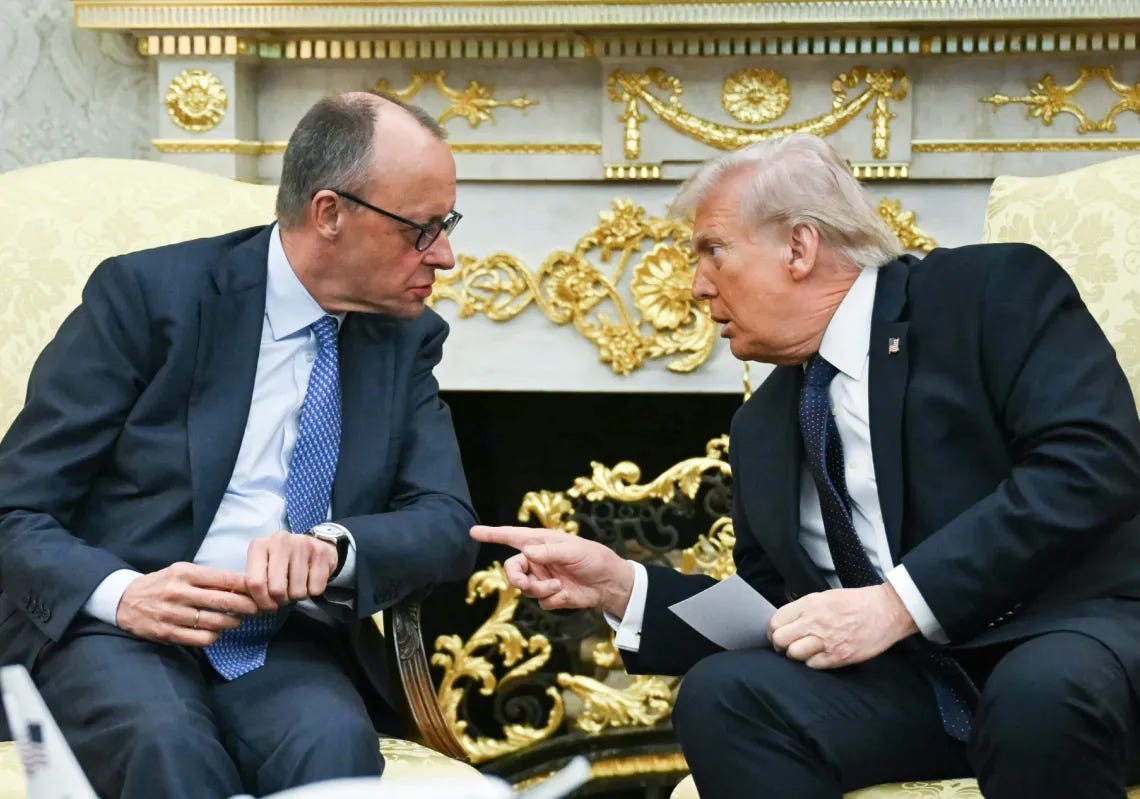
U.S.-European relations are currently experiencing one of their most sensitive periods of tension in years, driven by a widening divergence in approaches to the war against Iran. While Washington is moving to expand the scope of confrontation, European capitals appear more cautious, clinging to de-escalation and a return to diplomacy, and resisting full alignment with the pressure campaign led by U.S. President Donald Trump, who is seeking broad Western backing for the conflict that erupted in late February.
European positions have reflected this divide with striking clarity. Spain has firmly rejected the strikes, describing them as an escalation that threatens regional security and stability. France has prioritized the Ukrainian file, carefully avoiding direct alignment with U.S. policy. Meanwhile, the United Kingdom has taken an even more explicit stance, distancing itself from the war and stressing that this is not Britain’s fight, nor does it intend to be drawn into it.
These European positions have not gone unnoticed in Washington. Trump issued a blunt warning, suggesting that NATO could face a “very bad” future if it fails to support efforts related to opening the Strait of Hormuz. Secretary of State Marco Rubio also hinted that the United States might reconsider the nature of its relationship with the alliance after the conflict, a message widely interpreted as political pressure on European allies.
Despite efforts by NATO Secretary General Mark Rutte to contain escalating tensions with Washington by signaling a degree of support for the war and offering justifications for Europe’s delayed engagement the broader picture suggests that transatlantic relations have reached an unprecedented level of strain.
This growing tension is not merely a fleeting disagreement over the management of a regional crisis. It raises deeper questions about the current international moment: Why is Europe resisting full engagement in the war?
Could this approach reshape global alliance structures? And what alternatives is Europe exploring to safeguard its strategic interests independently of full reliance on the United States?
A Widening Transatlantic Divide
The divergence between Washington and European capitals has reached an extraordinary level. European reluctance is no longer limited to abstaining from direct military participation; it now includes restricting the use of European bases and airspace for U.S. operations.
France has barred Israeli aircraft from crossing its airspace to transport weapons, Italy has refused emergency landing permission for U.S. bombers in Sicily, and Spain has categorically rejected support for the war, asserting its independent stance and rejecting any lectures on its commitment to peace.
This European posture has presented the Trump administration with an unfamiliar challenge from within the Western camp itself, prompting a more confrontational rhetoric.
Trump questioned the military capabilities of major European powers, particularly France and the United Kingdom, and went further by calling for “courage” in seizing control of the Strait of Hormuz by force. These remarks quickly fueled anxiety in energy markets and heightened global tensions at an already fragile moment.
The divergence is not confined to political and military dimensions; it extends clearly to the economic sphere. While Washington particularly under Trump treats economic shocks as manageable and temporary, Europe views the war on Iran as a crisis with potentially long-lasting repercussions, imposing heavy costs on energy markets, supply chains, and overall economic growth.
Why Europe Refuses Full Engagement
Europe’s refusal to fully engage in the war can be attributed to five key considerations.
First, there is a fundamental divergence in how Europe and the United States perceive the conflict. Trump frames the war as a new round in deterrence and a means of reshaping the balance of power in the Middle East in favor of U.S. interests and its Israeli ally.
Europe, however, prioritizes the risks to its domestic stability ranging from disruptions in energy and food supplies to inflationary pressures alongside a public opinion already resistant to external military entanglements.
Second, European capitals view the U.S. decision to go to war as unilateral, taken without genuine consultation with allies. This has reinforced a conviction across Europe that it should not bear the political, military, or economic costs of a decision in which it played no role.
Third, ambiguity continues to surround the war’s objectives. The shifting rhetoric and unclear timelines and geographic scope raise fears in Europe that direct involvement could drag it into an open-ended conflict with unpredictable trajectories.
Fourth, Europe’s strategic interests in the Middle East are at stake. Direct involvement could undermine its political and economic presence in the region, exposing it to significant security and influence costs at a time of global instability.
Fifth, there is growing concern that NATO’s sovereignty and political legitimacy could erode if the alliance is drawn into the conflict. European states are keen to prevent NATO from becoming a default vehicle for unilateral U.S. operations that lack broad consensus.
Reshaping the Alliance Network
Accumulating indicators suggest that the transatlantic alliance, in the aftermath of this war, will not remain as it has been for decades. This does not necessarily signal a collapse in U.S.-European relations, but rather a profound internal recalibration of roles, balances, and leadership dynamics.
A central trajectory in this recalibration is Europe’s push to expand its strategic autonomy, particularly in critical areas such as energy and defense. This shift aims to reduce U.S. dominance over decision-making within the Western camp and move toward a more balanced—if still asymmetrical—partnership.
In parallel, Europe may adopt a more flexible approach within the alliance, avoiding automatic alignment with Washington across all issues. Instead, it is likely to pursue a selective policy guided by case-by-case interests. Coordination may persist on issues such as Russia and European security, while divergences may deepen on others, particularly Iran and the Middle East.
Europe may also open the door to new alliance networks and partnerships to secure its strategic and logistical interests beyond U.S. unilateralism. Early signs of this shift are visible in EU defense partnerships with countries such as Australia, Iceland, and Ghana, as well as growing military cooperation between London and Brussels.
In the Middle East, Europe may become more proactive in building regional partnerships with key actors, including Gulf states, Egypt, Turkey, and Pakistan. This reflects not only a desire to expand influence but also an effort to prevent the region from becoming either an exclusive sphere of U.S. dominance or a space for unchecked expansion by rival powers.
Breaking Free from U.S. Dominance: What Are the Alternatives?
Europe appears to be pursuing three main avenues to enhance its relative independence from U.S. decision-making.
The first is the development of a more robust and autonomous European defense capability. This includes increased military spending and expanded joint armament projects aimed at building a self-reliant security architecture.
France and Germany have also entered sensitive discussions on the future of European nuclear deterrence, alongside momentum behind joint defense initiatives and long-range missile development reflecting a growing realization that Europe’s strategic security cannot remain entirely dependent on Washington.
The second avenue is energy. Europe recognizes that political independence requires reducing vulnerability in energy supplies. This has driven efforts to diversify sources and suppliers, including partnerships with Algeria, Azerbaijan, and Canada, while reducing reliance on Russian energy and avoiding overdependence on U.S. supplies.
The third avenue is the revitalization of European diplomacy through a broader network of international partnerships. This includes rebuilding ties with the United Kingdom and expanding economic and defense relations with strategically significant regions, particularly the Middle East.
Europe is navigating this moment with a distinctly pragmatic approach: avoiding a costly war with Iran while also steering clear of a direct confrontation with the United States, despite mounting pressure from Trump.
Between these two poles, a new phase is emerging within the Western camp one in which transatlantic cohesion may no longer reflect its traditional solidity. What is unfolding is not merely a temporary disagreement over a regional conflict, but a deeper transformation that could gradually reshape the global alliance system.
The coming period may well produce new networks of alliances, with some Middle Eastern states becoming increasingly integrated into Western frameworks. Ultimately, the repercussions of the war on Iran are unlikely to remain confined to the battlefield or energy markets. They are poised to extend to the very structure of the international system, potentially redrawing the global geopolitical map in profound ways.
