

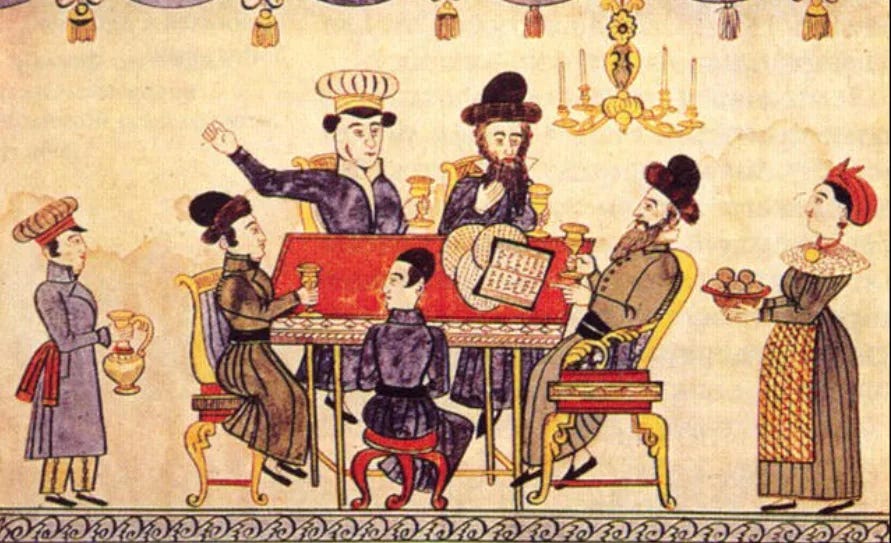
The Zionist project, in its earliest stirrings, was not merely a cold political scheme or a material settler movement. Rather, it rested on a deeper ontological foundation that harnessed art and literature as tools for constructing identity. Decades before the declaration of the “state,” early theorists had come to believe that art was not a luxury, but an ideological mission a conscience shaping the spirit of the age.
From this vision, Jewish artists drawing on a blend of religious heritage and influences from both Western and Islamic environments embarked on a battle over identity. They sought to liberate the Jewish persona from the disparaged image of exile, while projecting that very contempt onto the “other,” often depicted in paintings as the “Turkish man.”
These pioneers consistently bent the brush to serve the biblical narrative, revived Hebrew as a living, everyday language, and developed artistic movements that granted the Zionist project cultural and historical legitimacy. In this context, art functioned as a compass, redirecting belonging toward the “Promised Land” by entrenching a duality of persecution and longing.
As Peter Beinart noted in an interview with Noon Post, a powerful current argued that Zionism meant first creating a Hebrew-speaking culture before establishing a “state.”
The thinker Ahad Ha’am (1856–1927) is considered the spiritual father of this orientation. He believed that material settlement alone could not create a state unless the Zionist movement established a cultural center capable of unifying dispersed intellect and emotion. In his view, founding a single art school was a national goal more consequential than building one hundred settlements.
His words became a manifesto for artists such as Boris Schatz (1867–1932), who called at the Fifth Zionist Congress in 1902 for the establishment of an art school in Jerusalem, seeing art as a potent educational tool for promoting national consciousness.
The Trio of the Brush
In their book The Ideology of Zionist Art (Red Sea, 2024), academics Dr. Jamal Al-Rifai and Dr. Najwa Al-Masri examine, across 158 pages, the works of three artists born in the late 19th century who either attended or were influenced by the First Zionist Congress in Basel in 1897. Through their artistic features, they shaped the early face of Zionism:
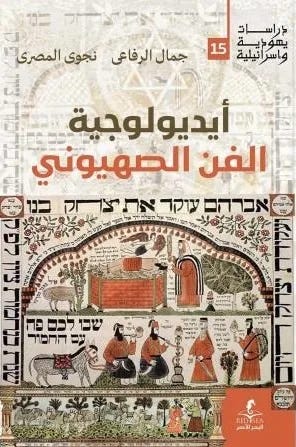
Moshe Shah Mizrahi (1870–1940): A Persian Jew who adapted the art of miniature painting to serve religious narratives.
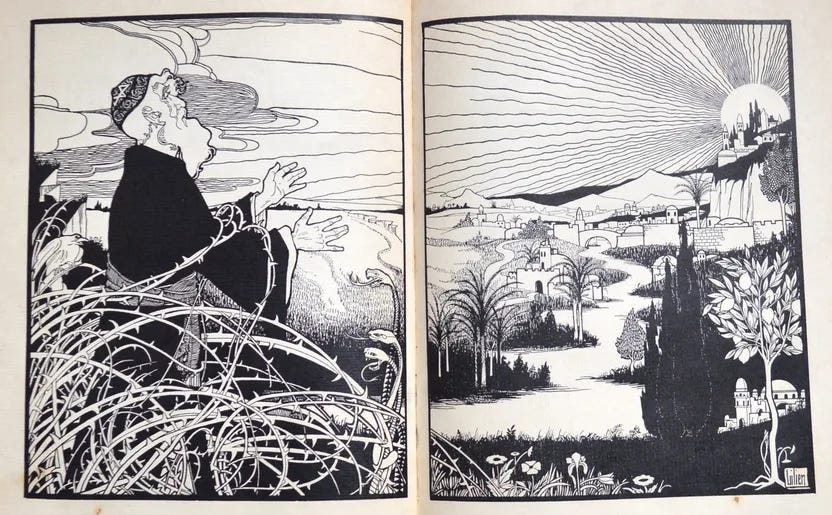
Ephraim Moses Lilien (1874–1925): The Austrian spiritual father of Zionist art, who built his philosophy on the impossibility of survival outside Palestine. He depicted the “ghetto” as suffocating darkness pierced only by the rising sun of a Zionist future. He co-founded the Bezalel School of Fine Arts in Jerusalem in 1906.
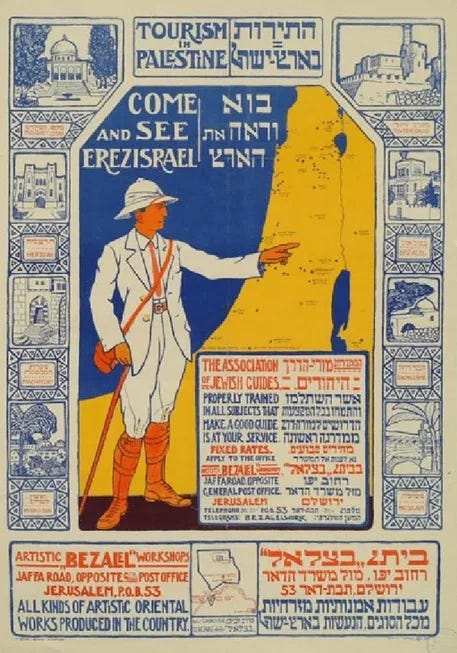
Ze’ev Raban (1890–1970): Considered a father of Jewish art due to his leadership role in the Bezalel School. Unlike his predecessors, much of his work consisted of posters. Among his most notable designs was a poster titled “Come and See Palestine,” commissioned by the Jewish National Fund to encourage Jewish investors to finance land purchases. Ironically, it explicitly used the name “Palestine,” undermining the Zionist claim that the land had not previously been known by that name.
Biblical Narratives
In a miniature inspired by Old Testament stories, Mizrahi depicts the sacrifice of Isaac a narrative central to Jewish culture as a representation of the covenant between the people of Israel and God.
The painting portrays four figures: Abraham, Isaac, Ishmael, and the servant Eliezer. Isaac appears as rational and devout, willingly carrying wood as he follows his father, the Prophet Abraham, who is depicted wearing the Jewish prayer shawl, the tallit. Though historically anachronistic, the shawl underscores the sanctity of the divine command to sacrifice the son, with Abraham holding a sword in preparation.
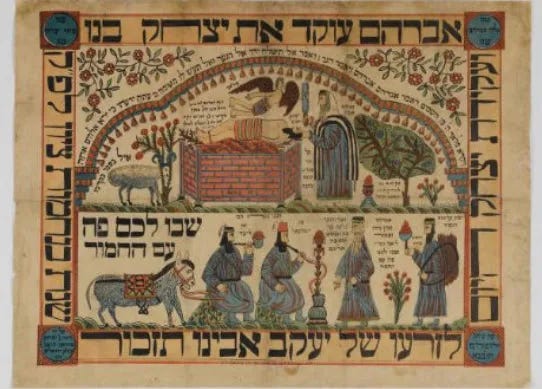
In contrast, Ishmael is dressed in Ottoman attire, wearing a red fez, holding a sword, and smoking a hookah imagery suggesting hostility or indifference. This portrayal aligns with biblical depictions of Ishmael as wild and uncivilized, projecting these attributes onto his descendants. Genesis 16:12 describes him as “a wild man; his hand will be against everyone.” The servant Eliezer is also dressed in Turkish clothing.
The four corners of the miniature contain inscriptions: “Answer us, O God of Abraham, answer us,” “Answer us in the merit of Isaac’s fear,” and “Here is the city, the holy city; Jerusalem will be rebuilt swiftly in our days, amen.” The artist signs his name in the final square, noting his residence in the holy city.
Politicizing the Sacred
Another of Mizrahi’s works, The Fall of Goliath, visually narrates the biblical story of David’s victory over Goliath. Goliath, symbolizing evil, appears as a towering giant dominating the scene, accompanied by numerous soldiers, while David is depicted as smaller in scale, emphasizing the triumph of faith over brute force.
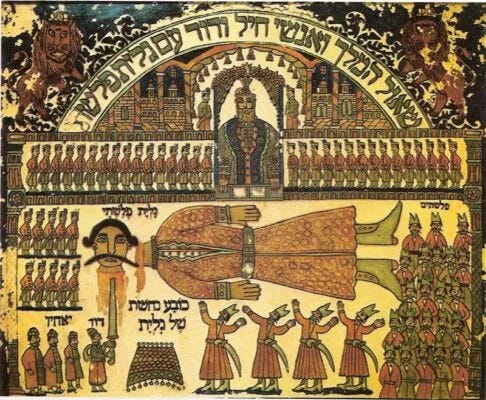
Again, Goliath’s soldiers are dressed as Ottoman troops, reinforcing the depiction of Jewish enemies in Turkish form. Mizrahi even portrays them performing the Sufi whirling dance, circling Goliath’s body as the axis of their movement.
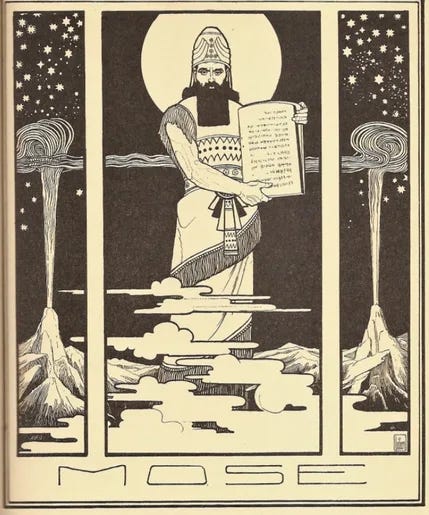
Meanwhile, Theodor Herzl, the founder of political Zionism, appears in a work by Lilien standing on a balcony overlooking the Rhine, depicted as a biblical prophet holding a tablet suggesting that his message rivals the sanctity of Moses and that Zionist teachings are inseparable from Judaism.
Lilien frequently contrasted the harshness of Jewish life in European ghettos with the radiant motif of sunlight symbolizing hope in a new homeland flowing with “milk and honey” and freedom.
Under the biblical verse “Your eyes shall behold Zion,” he created From the Ghetto to Zion, employing chains and darkness to represent oppression in exile, contrasted with the luminous promise of the barren Promised Land awaiting cultivation. This duality of light and darkness symbolized liberation akin to the Exodus from Egypt.
In another work titled Zion, Mizrahi depicts the Star of Zion above the Dome of the Rock, accompanied by the phrase “Here lies the Temple.” Surrounding the composition are biblical verses emphasizing Jerusalem’s sacred status: “Open to me the gates of righteousness… Zion shall be redeemed with justice… If I forget you, O Jerusalem, let my right hand forget.”
An Ambiguous Methodology
Despite the book’s originality and the importance of its subject, as well as its effective use of artistic examples, its methodology remains unclear, particularly regarding the criteria for selecting the featured artists.
While it analyzes major works by three prominent Zionist artists a Persian, an Austrian, and a Polish figure it essentially introduces the formative phase of art employed in service of the Zionist project. The book mentions other contemporaneous artists, such as the German Else Lasker-Schüler, but offers little discussion or explanation for their exclusion.
Perhaps the authors focused on leading pioneers rather than attempting a comprehensive survey, especially since they position their work as an extension of Egyptian artist Saad Al-Khadem’s seminal study Art and Zionist Colonialism (1974).
It is also possible that recurring ideas led them to select more prominent examples. Nonetheless, clarifying the criteria for artist selection remains necessary.
The book does not limit itself to analyzing paintings; it also examines posters, caricatures, and book and magazine covers. However, it suffers from some repetition in chapter introductions and would benefit from greater factual precision.
Its chapter on political caricature is less successful, focusing on a later 20th-century period unrelated to the formative phase of the Zionist project, instead addressing Arab–Jewish conflict and hostility toward Gamal Abdel Nasser.
Revisiting the legacy of these pioneers in shaping ideological art allows us to understand the cultural architecture that continues to cast its shadow over the region today. What began as Mizrahi’s miniatures or Raban’s propaganda posters evolved over decades into a cohesive visual and literary narrative seeking to monopolize representations of civilization while portraying the surrounding environment as either primitive or inherently hostile.
Cultural Zionism succeeded in transforming the struggle from one of geography and borders into a battle over perception, language, and memory echoing Ahad Ha’am’s early calls to prioritize cultural institutions over physical settlements.
Deconstructing these aesthetic veneers and reading them within the context of occupation remains essential. Art, once envisioned as the conscience of the age in Zionist thought, was consciously deployed as an instrument of erasure and exclusion.
