

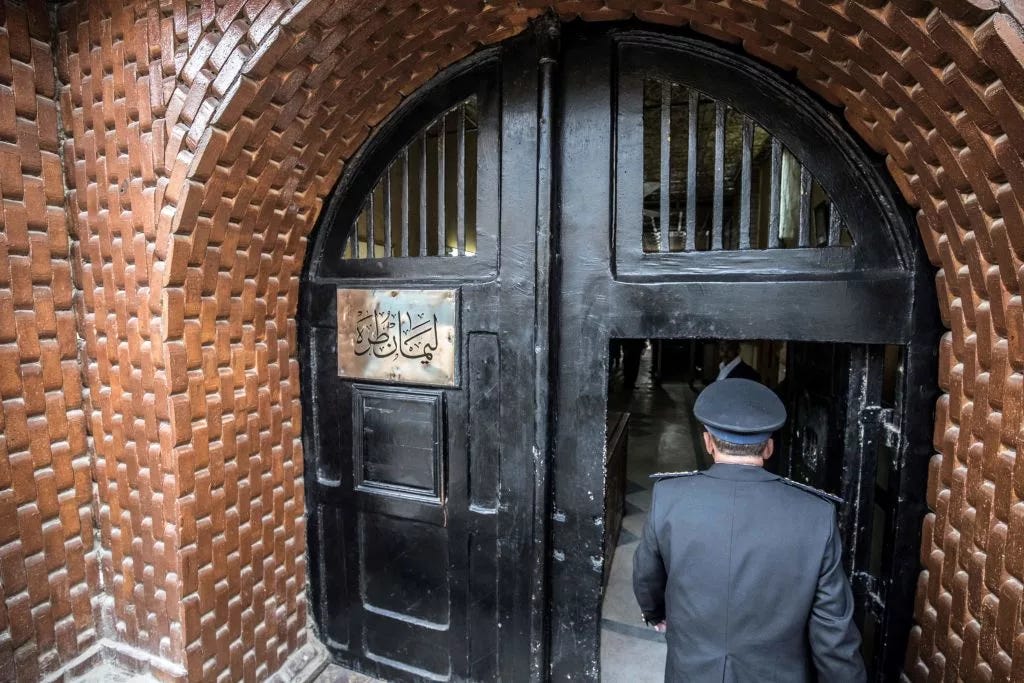
A new report from the El-Shehab Center for Human Rights has revealed the death of political detainee Ibrahim Ahmed Abdel Rahman, known as “Abu Tasbeeh,” at the age of 60, inside Gamasa Prison. His death followed a long struggle with illness and medical neglect.
Detained since 2014, Ibrahim’s health deteriorated significantly after he developed a critical bile duct blockage later diagnosed as cancer.
Despite his clearly worsening condition and urgent need for treatment, he was denied timely medical care and was only transferred to Mansoura Hospital during his final days passing away quietly behind prison walls.
Ibrahim’s case is not an isolated incident. According to the center’s November 2025 report, three additional detainees died in custody due to similar medical neglect. These numbers paint a bleak picture of Egypt’s detention system, where illness often serves as a slow death sentence in cells stripped of even the most basic healthcare services while families and human rights advocates continue to call for justice, to no avail.
In a related development, the “Not Subject to Expiry” campaign by the Egyptian Initiative for Personal Rights (EIPR) released a report titled “Medical Release: A Right Denied!” documenting prison healthcare conditions between September 2024 and September 2025.
The report asserts that medical negligence in Egyptian prisons has evolved from administrative failure into a deliberate tool of punishment claiming the lives of political dissidents under the guise of fate. Despite official promises and optimistic declarations, the humanitarian crisis deepens, leaving detainees to face disease alone behind locked doors.
20 Deaths in One Year Due to Medical Neglect
The “Not Subject to Expiry” campaign documented 20 deaths in custody between September 2024 and September 2025, directly linked to medical negligence. These fatalities occurred in various detention centers, notably Badr 1 Prison (3 cases), Tenth of Ramadan Prison (4 cases), Tenth of Ramadan Police Station No. 2 (2 cases), Zagazig First Police Station (1 case), Borg Al-Arab Prison (1 case), and Al-Mustaqbal Prison in Ismailia (1 case). Behind each number lies a name and a life extinguished without a chance for treatment or survival.
Testimonies collected by the campaign reveal harrowing stories of detainees abandoned in pain without medication, with fatal delays in hospital transfers. In some cases, denial of treatment was used as a form of punishment.
The report stresses that the crisis stems not from lack of resources, but from the absence of oversight, transparency, and the medical system’s subordination to security authorities stripping doctors of their independence and turning healthcare into a privilege that can be withheld.
In the same vein, Journalists Without Chains published a report in June 2025 titled “Prisons Without Keys: How Egyptian Cells Destroy Lives and Hope,” highlighting the grim reality endured by thousands of political detainees since 2013.
According to the report, at least 1,160 individuals have died in detention over the past decade 74% due to deliberate medical neglect. Meanwhile, more than 60,000 people remain behind bars, including journalists, human rights defenders, women, and minors many without fair trials.
A Blatant Violation of Law and Treaties
All the reports converge on one conclusion: the medical negligence occurring inside Egypt’s prisons—whether through intent or disregard—constitutes a crime against humanity. It flagrantly violates the Egyptian Constitution and international human rights treaties to which the country is a signatory.
Article 55 of the Egyptian Constitution mandates that “any person arrested, detained, or whose freedom is restricted shall be treated in a manner that preserves their dignity. They shall not be tortured, terrorized, coerced, or physically or psychologically harmed.”
It also requires that all detention occur in facilities appropriate for human and health standards, with accessibility guaranteed for persons with disabilities. Violations are deemed criminal offenses.
On the international front, Article 10 of the International Covenant on Civil and Political Rights and the UN’s Nelson Mandela Rules set clear standards: denying prisoners their right to healthcare is punishable. The conditions in Egyptian prisons represent a grave breach of these principles and fall far short of any notion of justice or humanity.
Cries for Help Met with Silence
Political prisoners in Egypt, along with their families, continue to raise urgent alarms over the willful medical neglect threatening their lives. These pleas, however, fall on deaf ears, as security authorities maintain a wall of silence, leaving illness to silence the voices of dissent one by one.
Among the most striking cases is that of former presidential candidate Dr. Abdel Moneim Aboul Fotouh, who remains in critical condition in Tora’s Al-Mazraa Prison. Despite suffering four consecutive angina attacks within three months along with other chronic illnesses and advanced age he has not been transferred to a hospital or placed under specialized care.
He remains in solitary confinement under conditions described as a form of indirect torture, where each day becomes a battle for survival.
The suffering continues with Marwa Ashraf Arafa, a young translator held in pre-trial detention for over five years. In October 2025, she appeared in court struggling to breathe and suffering complications from a pulmonary embolism yet still received no medical attention.
Similarly, human rights lawyer Hoda Abdel Moneim has endured multiple severe health crises, including a blood clot in her leg, kidney failure, a heart attack, and a recent diabetes diagnosis. Despite having served her initial sentence, she remains imprisoned. Her appeals, like those of many others, echo unanswered in a vacuum of neglect and indifference.
Relentless Abuses Backed by Grim Statistics
The figures compiled by human rights organizations paint a stark contrast to the Egyptian government’s claims of prison reform and improved detention conditions. Far from the rhetoric of reform and presidential initiatives, the documented statistics point to a continued policy of repression and systemic neglect telling a vastly different story than the one presented to the public.
From September 2024 to September 2025, 48 detainees died in custody 20 of them directly due to medical neglect. In 2024 alone, 11 deaths were recorded, 5 of which were linked to inadequate care. In 2025, 37 detainees died, including 15 from preventable medical causes underscoring a sharp rise in health-related fatalities in detention.
The Nadeem Center for the Rehabilitation of Victims of Violence documented 77 cases of medical neglect in the first half of 2025 alone. These ranged from deprivation of basic healthcare to severe deterioration of detainees’ health.
The center noted that the actual number is likely much higher, as access to many prisons remains severely restricted. May saw the highest number of cases (22), followed by April and June (20 each), highlighting an alarming and escalating health crisis behind prison walls.
A Systemic Weapon of Suppression
The growing body of evidence makes clear that illness in Egypt’s prisons is no longer incidental or bureaucratic failure it has become a weapon. Medical neglect is wielded as a silent form of punishment against political opponents and dissenters, turning prisons into slow-motion execution chambers under the pretense of divine will and legal fate.
In this context, denial of healthcare becomes a calculated strategy employed by security services a way to eliminate dissidents without resorting to executions that might provoke international backlash. Behind these locked doors, detainees face both illness and the silence of the state.
Their cries and those of their families go unheard, while the cells remain enduring witnesses to a persistent human tragedy that defies law, morality, and hope alike.