

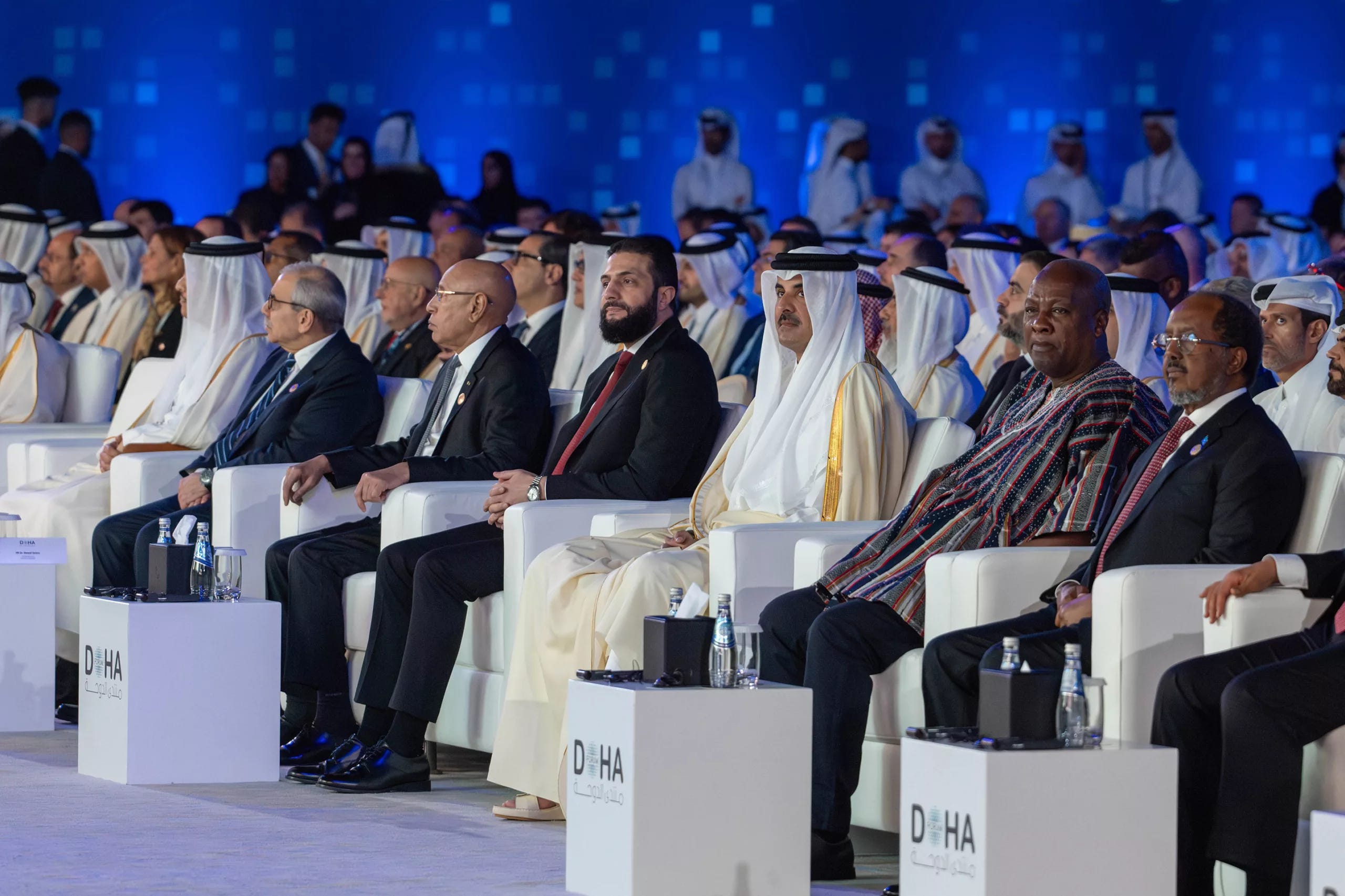
Amid fast-moving geopolitical shifts that are eroding the foundations of justice and human rights where power often prevails over peace and stability Qatar hosted the 23rd edition of the Doha Forum under the theme: “Building Shared Futures: Transitioning from Promises to Reality.”
Over the course of Saturday and Sunday, December 6–7, more than 6,000 participants and 471 speakers from around 160 countries convened in Doha. The gathering brought together heads of state, top officials, and global influencers from the worlds of politics, economics, and technology.
Founded by Sheikh Hamad bin Khalifa Al Thani in 2000, the Doha Forum has evolved into a leading international platform for open dialogue. It raises profound questions about the future of the global order and addresses the key threats to international peace and security championing diplomacy and dialogue over war and confrontation.
This year’s edition carried urgent political and moral messages, chief among them a call to transform the principle of “justice in action” from rhetoric into tangible outcomes. The forum underscored the need to link conflict resolution with efforts to bridge the growing North–South divide and promote inclusive development that guarantees equal opportunity in a world where no one is left behind.
Timing Is Everything
The Doha Forum convened at a particularly volatile moment in the Middle East, against the backdrop of profound geopolitical upheaval. At the heart of these tensions lies the deepening humanitarian catastrophe in Gaza, alongside stalled efforts to revive political negotiations based on the Sharm El Sheikh agreement. The escalation of Israeli violence, paired with the absence of a credible path to sustainable solutions, continues to fuel the crisis.
Meanwhile, Syria remains engulfed in humanitarian and security challenges. Repeated assaults and a fragile political landscape have exacerbated civilian suffering and prolonged the country’s instability coinciding with the first anniversary of the fall of the Assad regime.
These turbulent conditions have made regional and international cooperation an urgent priority. There is a pressing need to de-escalate tensions, re-establish peace, and center justice and human development as essential pathways to safeguard the region’s future. These are the very principles that forum participants sought to amplify framing justice as the gateway to lasting, comprehensive stability.
In Search of Missing Justice
At the core of this year’s forum was its theme: “Building Shared Futures: Transitioning from Promises to Reality” a mission statement that encapsulates the forum’s determination to move justice beyond lofty ideals and into the realm of actionable policy aimed at peacebuilding, human rights protection, and equitable development.
In his opening speech, Qatar’s Prime Minister and Minister of Foreign Affairs, Sheikh Mohammed bin Abdulrahman Al Thani, noted that justice is increasingly absent from the framework of international law. In today’s world, he argued, interests frequently trump principles, and the rule of law is being displaced by brute force.
He emphasized that the proliferation of global crises is not due to a lack of resources or expertise, but rather to a deficit in accountability and the continuation of unresolved conflicts. This, he warned, jeopardizes international peace and security.
The accumulation of tensions has shown that merely managing crises with minimal effort or relying on fragile, short-term agreements that fail to address root causes is no longer viable. Left unaddressed, injustices metastasize, growing more complex and extending beyond their original geographies.
Only fair and just solutions, he stressed, can deliver sustainable peace, end cycles of violence and division, and transform justice from a collective aspiration into a universal right.
The Danger of Impunity
The forum issued a clear warning: the absence of accountability is one of the most dangerous dysfunctions in today’s international system. Nowhere is this more painfully evident than in the Arab world, where the Palestinian people endure flagrant violations of international law, and Sudan remains mired in brutal violence, massacres, and humanitarian catastrophe.
These grim realities highlight that justice is not a political luxury it is an existential requirement for regional stability and the protection of societies from collapse.
The forum cautioned against the continued handling of crises through power-based logic and the practice of shielding aggressors from consequences. Doing so undermines the legitimacy of the international system, turning it into a collection of broken promises with no real enforcement mechanism.
This failure strips the system of its ability to protect the vulnerable and halt the bloodshed.
Perhaps the forum’s most powerful message was that genuine peace cannot be imposed from the top down or manufactured through symbolic gestures. Instead, it requires global, collective efforts rooted in human dignity and rights. Without inclusive justice that vindicates victims and holds perpetrators accountable, peace will remain fragile and humanity will remain trapped in cycles of pain and conflict.
Gaza: The Heart of the Conversation
Gaza took center stage at the Doha Forum. It dominated the discussions, with experts and global leaders addressing the delicate moment surrounding the ceasefire and the urgent need for genuine international engagement.
Qatar’s Foreign Minister stressed that a ceasefire is meaningless without a full Israeli withdrawal from Gaza and the restoration of stability. He underscored the role of mediators in keeping dialogue alive and pushing for just outcomes that alleviate civilian suffering.
Discussions also addressed the second phase of the truce agreement, which is expected to include a comprehensive Israeli withdrawal, the formation of a transitional authority in Gaza, and the deployment of international forces to stabilize the situation.
Turkish Foreign Minister Hakan Fidan warned that failure to implement this next phase would be a devastating indictment of the international community. Security and freedom, he argued, must be guaranteed for all in the region if any lasting settlement is to succeed.
Beyond Gaza, the forum reiterated the need to halt settler violence in the West Bank and begin reconstruction efforts in the Strip. European and international voices called for renewed commitment to the two-state solution as the only realistic path to lasting peace.
UN officials added that the continued suffering of Palestinians exposes the failings of the global order. They called for an end to arms transfers to Israel and the enforcement of fair accountability mechanisms to restore the primacy of human rights.
Syria’s New Chapter
In previous editions of the Doha Forum, the Syrian issue was centered on the people’s resistance to repression and the call to prioritize the national interest over authoritarian rule. Today, the narrative has shifted significantly. Syria is undergoing a new political chapter following the fall of the previous regime, with urgent demands to address the heavy legacy of war and humanitarian trauma.
Syrian President Ahmad Al-Sharaa shared his national vision during a panel discussion, emphasizing that the country is on the right path toward rebuilding the state and regaining its regional standing.
He called for the lifting of sanctions, stabilization of internal affairs, and protection of Syria’s sovereignty from ongoing Israeli violations calling on the international community to support Syria’s right to self-determination and territorial integrity.
Marking a year since the regime’s collapse, Al-Sharaa stressed the importance of inclusive governance and responsible reform. He pledged democratic progress with upcoming elections, economic revitalization, and social stability. His central message: Syrian unity is essential to safeguarding the country’s future, and justice and accountability are the keys to healing national wounds and overcoming divisions.
Empowering the Global South
Forum participants affirmed that the future of development in the Global South must begin with investing in people. Empowering youth, supporting cultural and artistic innovation, and advancing health and education were identified as foundational pillars for building resilient, opportunity-rich societies.
Innovation and advanced technologies featured prominently, especially in discussions on addressing development gaps. Artificial intelligence, speakers noted, could revolutionize education and healthcare delivery and help the Global South overcome infrastructure challenges and narrow the digital divide.
Speakers called for equitable international partnerships involving governments, private sectors, and humanitarian organizations. The aim: to leverage southern resources domestically, promote local manufacturing, and create knowledge-based, creative economies.
Investing in the Global South, they emphasized, is not merely an economic strategy it is a moral imperative that could uplift millions and foster a more balanced, humane world.
Justice Is the Bedrock of Peace
Ultimately, justice remains the foundation of lasting peace. Stability cannot be built on empty promises or geopolitical double standards. The ongoing neglect of the suffering in Palestine, Syria, and Sudan has exposed the hypocrisy of certain Western powers that prioritize their strategic interests over human rights.
That is why forums like this are so vital. They serve as engines of moral and intellectual clarity pushing justice to the forefront of global debate and demanding accountability. Only when international laws truly reflect human dignity and rights, rather than remaining slogans on paper, can we speak of a more just and sustainable world order.
