

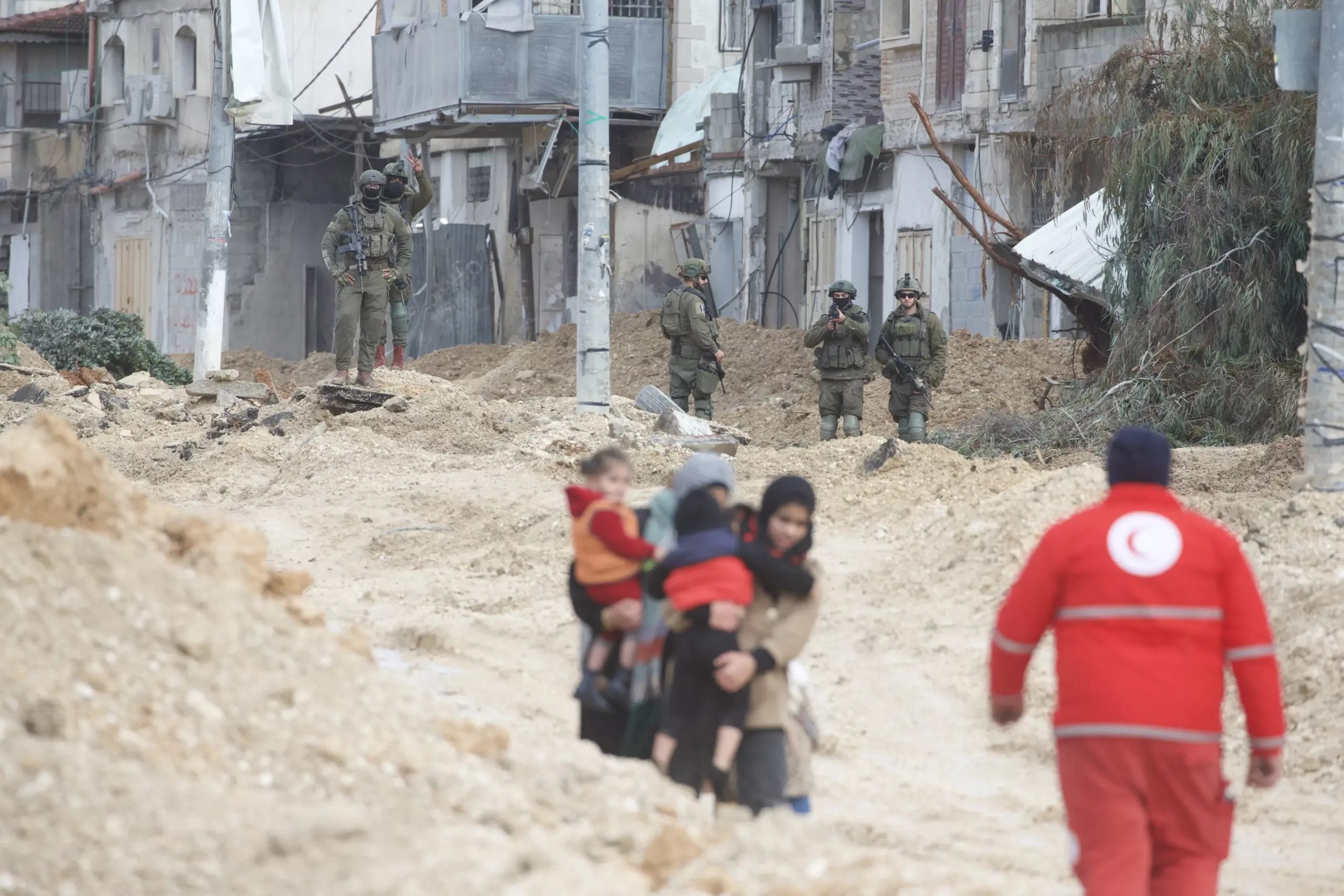
On the morning of Tuesday, January 21, 2025, 65-year-old Sarah awoke to strange noises piercing the sky over Jenin refugee camp. Loudspeakers mounted on drones blared messages in Arabic, urging residents to evacuate the camp immediately via the “Awda Junction” in the northwest.
At first, Sarah assumed it was just another psychological warfare tactic something she and other West Bank residents had grown used to from Israeli forces, especially since it came just two days after a humanitarian truce was announced between Gaza’s resistance factions and the Israeli government.
But what she thought was a bluff turned out to be the prelude to disaster. The following morning, the drones returned, flying low and repeating evacuation orders from 9 a.m. to 5 p.m., declaring in Arabic: “Evacuate your homes.
If you don’t, you will be held responsible. We will destroy the camp.” The drones circled homes, hovered at windows, and stirred panic among residents.
“I thought we’d be gone a day or two, then come back,” Sarah said, recounting how she was eventually forced out under the watch of armed soldiers. “We left in the clothes we were wearing. I didn’t even take my medication.
It was so hard. When you have children or someone with a disability, your only thought is their safety.
As we walked toward the Awda Junction, soldiers nearby fired in the air, maybe to intimidate us… but we kept walking. I haven’t returned since.”
Sarah was not alone. In a report published on November 20, 2025, Human Rights Watch documented that more than 32,000 Palestinians were forcibly displaced from three West Bank refugee camps Jenin, Tulkarem, and Nur Shams between January and February of that year. Israeli authorities have continued to block their return.
The 105-page report, titled “All My Dreams Are Gone: Israel’s Forcible Displacement of Palestinians in the West Bank,” states that the three camps were nearly emptied of their populations, in what is now the largest mass displacement in the West Bank since 1967.
Ten months later, the camps remain largely deserted, with tens of thousands still displaced, unable to return despite the cessation of military operations.
Operation “Iron Wall”: A Timeline of Expulsion
Codenamed “Iron Wall” by the Israeli military, the operation began on January 21 with a full-scale assault on Jenin camp, later extending to Tulkarem on January 27 and Nur Shams on February 9. All three invasions followed an eerily similar pattern: identical tactics and machinery, and the systematic terror-driven expulsion of thousands of residents.
Jenin: The Starting Point
The attack on Jenin began with overwhelming force: Apache helicopters firing live rounds, armed drones, armored vehicles, military bulldozers, and hundreds of soldiers storming in from multiple directions.
“It was around noon,” recalls 44-year-old Fatima. “We heard a drone firing at people. We hid inside, clueless about what was happening. Then people started shouting outside, saying we had to leave immediately.”
The evacuation orders came intermittently via drones with loudspeakers directing people to the Awda Junction. Sarah described being forced out under armed surveillance: “When we arrived at the junction, it was filled with soldiers.
There was a makeshift checkpoint. I wasn’t allowed to pass until they scanned my eye. Others were pulled aside we didn’t know why or where they were taken.”
Tulkarem: A Replay of Fear
Six days later, on January 27, the operation swept into Tulkarem camp with the same terrifying script: ground forces, drones, tanks, bulldozers, and forced evacuations under live fire.
Leila, 54, was cooking lunch at her home in the northeastern part of the camp when the raid began. “We knew they were coming we followed the updates on Telegram. Then, suddenly, they broke the door down… about 25 soldiers entered with a dog. It felt like another Nakba.”
“They were screaming, smashing everything. Some wore masks, others carried large guns and grenades,” she continued. “They forced us out. My pregnant daughter asked for milk and baby clothes. One soldier told her, ‘You no longer have a home here… you have to leave.’”
Leila’s daughter, four months pregnant, collapsed during the chaos and later lost the pregnancy. When Human Rights Watch interviewed Leila in March, she was still in mourning. She described Caterpillar D9 bulldozers clearing rubble from a neighborhood already ravaged by previous assaults.
By 5 p.m., Israeli forces had taken control of nearly every camp entrance. Residents documented the destruction via Telegram, with images and videos later verified by human rights organizations.
Nur Shams: The Final Blow
On February 9, Nur Shams became the third and final target. The military repeated the same pattern raids, mass expulsions, and sweeping destruction this time in full view of the world.
One witness recalled how soldiers blew open a door with an explosive device before storming the neighborhood. “My husband, our 14-year-old daughter, and I were inside, paralyzed with fear,” she said. “We saw them use heavy machinery to break through the garden wall before ordering us to evacuate.”
Tragically, the explosion used in the raid killed 21-year-old Rahaf Al-Ashqar and left her father critically wounded.
Systematic Ethnic Cleansing
Nadia Hardman, senior refugee and migrant rights researcher at Human Rights Watch, summed up the early months of 2025 as follows: “Israeli authorities uprooted more than 32,000 Palestinians from their homes in West Bank camps illegally, without allowing return.
While the world focused on Gaza, crimes were being committed in silence in the West Bank: war crimes, crimes against humanity, and ethnic cleansing. These demand an uncompromising investigation and accountability.”
The organization’s findings are based on 31 testimonies, satellite imagery, demolition records, and verified footage. In the first six months of the operation, 850 structures were destroyed. Bulldozers seemed less interested in buildings than in erasing memory itself.
UN reports mirrored these observations: shattered roads, armored vehicles stationed long-term, military barriers redrawing maps by force, and bulldozers tearing through homes and histories.
This was not just a violation—it was a direct assault on the Fourth Geneva Convention, which explicitly states: “The Occupying Power shall not deport or transfer parts of its own civilian population into the territory it occupies.”
Evacuation Under Fire
Israeli forces stormed the camps without any structured evacuation plans. Soldiers fired live rounds, while drones thundered overhead. Snipers watched from rooftops as civilians fled.
In Jenin, evacuation routes were vague; in Tulkarem and Nur Shams, they were confusing, often lethal. Human Rights Watch documented incidents of people being shot while attempting to escape.
Those who fled were met with nothing. Many crammed into relatives’ homes, others into mosques, schools, or charity shelters without tents, food, or medicine. The regime that uprooted them abandoned them to fend for themselves.
The Largest Displacement Since 1967
Human Rights Watch emphasized that this was not just a military campaign it was the most extensive displacement of Palestinians since the 1967 war. Israeli claims of “restructuring” and “opening access routes” were mere linguistic veils. In reality, people not just structures were being erased.
The camps remained sealed for six months. Those who attempted to return were shot at. A handful were allowed back only briefly to retrieve essential items before being expelled again.
What unfolded was not temporary or random; it was a calculated plan to depopulate the camps and repurpose the land as part of a broader project to reshape the West Bank into an expanding settlement zone, erasing Palestinian presence.
A Call for Accountability
Based on irrefutable testimonies and evidence, Human Rights Watch concluded that the Israeli military’s actions formed a cohesive campaign of apartheid and persecution. The scale of the violations placed high-ranking Israeli officials under international legal scrutiny for “command responsibility” a charge that does not expire or allow for excuses.
The report named key political and military figures including Benjamin Netanyahu, Israel Katz, Bezalel Smotrich, Major General Avi Blot, Herzi Halevi, and Eyal Zamir as individuals who should be prosecuted for crimes against humanity.
It also called for tangible actions: targeted sanctions, arms embargoes, suspension of preferential trade agreements, bans on settlement products, and enforcement of ICC arrest warrants. These, the organization said, would send a clear message: the world will not turn a blind eye to blatant injustice.
Nadia Hardman concluded with a grave appeal: “Governments worldwide must act urgently to halt the escalation of repression in the West Bank and impose sanctions on Netanyahu, Katz, and others complicit in serious crimes against Palestinians.”
Her words were not just a plea for justice but a wake-up call to a world dangerously asleep, as a humanitarian collapse unfolds in plain sight.
The Burden Returns to Governments
What Human Rights Watch documented may not surprise close observers. Since the outbreak of war in October 2023, Israeli forces have killed nearly a thousand Palestinians in the West Bank, expanded the use of administrative detention, intensified illegal settlement activity, and increased settler violence. Torture and abuse of detainees have also escalated.
Forced displacement and other forms of systematic repression are part of a broader apparatus of apartheid and persecution, the organization argues. This body of evidence can serve legal action against Israel in international forums.
It strengthens the Palestinian case before the International Criminal Court and the International Court of Justice. Some countries also possess laws enabling them to prosecute war crimes extraterritorially.
In the end, these intersecting legal and diplomatic channels could form a powerful international pressure network exposing Israel’s actions and restoring Palestine’s place on the global agenda.
Ultimately, the responsibility returns to Arab and Islamic governments. They no longer need more evidence. If the will exists, they can reclaim their long-abandoned role in defending the Palestinian cause.
The final question remains: Will this moment be seized or will betrayal become a permanent feature of the current generation of regimes?
