

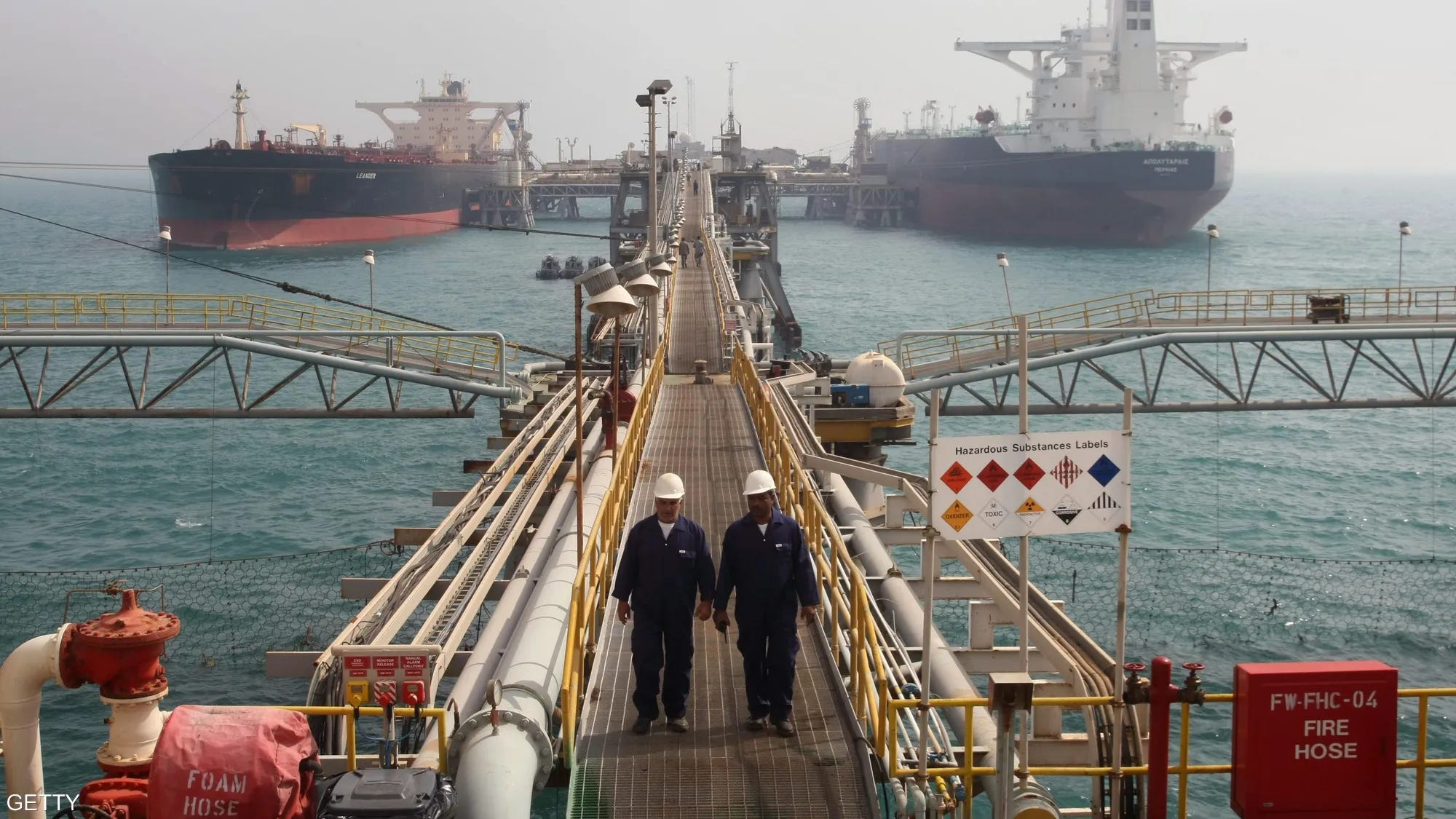
Iraq’s oil industry has not suffered a direct strike since the outbreak of the confrontation between the United States and Israel on one side and Iran on the other. Yet the country appears as though it has lost the wealth beneath its soil, after traffic through the Strait of Hormuz through which roughly 20 percent of global oil trade passes ground to a halt.
The chokehold quickly reached Basra, where most of Iraq’s oil fields and export terminals are concentrated, forcing Baghdad to cut production and sending government revenues downward. The episode reveals the fragility of a rent-dependent economy that relies more on “the barrel passing through water” than on the oil itself.
How Did the Chokehold Reach Basra?
With the outbreak of war in late February, Iran effectively halted navigation through the Strait of Hormuz. Hundreds of tankers carrying Gulf crude were left stranded near the passage or inside regional ports, while Tehran declared it would open fire on any vessel attempting to cross.
For Iraq—whose exports flow largely through Basra’s southern terminals the move amounted to severing a vital artery. In less than a week, the country effectively lost three-quarters of its export capacity.
The stages of the decline unfolded as follows, according to information reported by Reuters citing officials in Iraq’s Ministry of Oil.
What Happened When Storage Tanks Filled Up?
As exports stalled, Iraq ran into an old problem: limited storage capacity. On March 3, the Ministry of Oil said the production cuts would not affect refinery operations. Officials, however, acknowledged that storage tanks at southern ports had reached “critical levels.”
A Reuters report cited analysts at JPMorgan as expecting the closure of Hormuz to force Iraq to halt supplies amounting to 3.3 million barrels per day by the eighth day of the conflict, since the country possesses only about three days of storage capacity compared with 14 days for Kuwait, for example.
According to the same report, losses could climb to 3.8 million barrels per day by the fifteenth day of the shutdown and to 4.7 million by the eighteenth day.
Storage is not the only obstacle. Despite expansion in recent years, Iraq’s refining capacity does not exceed 1.3 million barrels per day, according to the U.S. Energy Information Administration. Before the crisis, output from southern fields stood at around 4.3 million barrels per day.
This means refineries can absorb less than one-third of production even under the best conditions. Moreover, most Iraqi refineries produce heavy fuel oil in quantities exceeding domestic demand while failing to generate sufficient gasoline and diesel.
In times of crisis, refineries are expected to temporarily absorb surplus crude. Yet the heavy quality of the oil and the need for refineries to operate continuously make them a limited outlet for excess production.
In addition, storage capacity at refineries is restricted. Any prolonged halt in exports would therefore force companies to gradually shut down wells—a process that has already begun, with production at the Rumaila field cut by 700,000 barrels per day, West Qurna-2 by about 460,000, and Maysan by 325,000.
A Salary-Based State Under Pressure from Lost Barrels
The severity of the crisis becomes clearer when it moves from the oil fields to the public treasury. Official data from the Ministry of Oil show that petroleum exports accounted for more than 90 percent of Iraqi government revenue in 2023.
A 2025 report by the International Monetary Fund goes further, noting that the non-oil tax base is “extremely low,” and that oil revenues will continue to represent more than 90 percent of government income through 2030.
The report warns that rising spending and sluggish non-oil revenues have pushed the oil price required to balance the budget to roughly $84 per barrel in 2024, up from $54 in 2020.
In a country where the number of public sector employees and pensioners reaches several million, any major gap in cash flow threatens the government’s ability to pay salaries, complete projects, or avoid accumulating arrears.
The financial shock, however, does not occur overnight. Iraq entered the crisis with foreign reserves at the central bank worth tens of billions of dollars, and the 2025 budget had not yet been fully exhausted.
Nevertheless, the IMF predicted in June 2025 that declining oil prices and high spending would lead to “financing constraints,” forcing the government to scale back or postpone nonessential expenditures.
If export disruptions continue for more than a few weeks, those reserves could be depleted quickly. Iraq would then face difficult choices: drawing from savings funds such as the Development Fund for Iraq, increasing domestic and foreign borrowing, or cutting wage and benefit bills all options fraught with social and political risks.
Why Is Iraq Less Able to Maneuver?
A quick comparison with other Gulf producers shows that the problem lies not only in the Strait of Hormuz but also in the structure of Iraq’s economy and logistics.
Saudi Arabia, for example, typically exports about 7.2 million barrels per day but possesses the East-West pipeline, which carries crude from eastern fields to the Red Sea port of Yanbu with a capacity of up to 5 million barrels per day. In 2019, the line was used to move 7 million barrels per day after natural gas liquids pipelines were repurposed.
Yet Yanbu’s loading capacity does not exceed 1.5 million barrels per day, limiting flexibility—alongside the security risks present in the Red Sea.
The United Arab Emirates, for its part, operates the Abu Dhabi-Fujairah pipeline, which transports 1.5 million barrels per day to the port of Fujairah on the Gulf of Oman.
Kuwait also maintains storage capacity sufficient for about fourteen days, according to JPMorgan estimates. While it relies on the ports of Shuaiba and Ahmadi, it can also benefit from floating storage and its state-owned tanker fleet.
Iraq, by contrast, has no active alternative pipelines. The Kirkuk-Ceyhan pipeline to Turkey with a capacity of roughly one million barrels per day has remained idle since March 2023 due to an arbitration dispute.
Despite a preliminary agreement in September 2025 to resume operations, implementation has stalled amid disagreements between Baghdad, Erbil, and international oil companies.
The proposed Basra-Aqaba pipeline through Jordan has yet to begin construction. Iraq also lacks a large tanker fleet and external storage facilities, unlike Saudi Arabia and the UAE.
Financially, Saudi Arabia and the UAE possess vast sovereign reserves that allow them to temporarily offset export losses, while Iraq remains burdened by a dual deficit and limited surpluses.
The result is that Iraq finds itself trapped in a double bottleneck: a single maritime outlet and near-total fiscal dependence on oil revenues while its neighbors maintain alternative routes and financial buffers that provide far greater room to maneuver.