

Day by day, the conclusion emerging from the U.S.-Israeli war against Iran is becoming increasingly entrenched: its repercussions are no longer confined to its immediate parties. Instead, they have expanded to a broader level, reshaping the entire global geopolitical landscape.
This war has not only produced new realities on the ground but has also compelled various powers to reassess their policies toward both allies and adversaries, guided by narratives that diverge from those that prevailed before its outbreak. Europe appears to be at the forefront of regions likely to be profoundly affected by these reverberations.
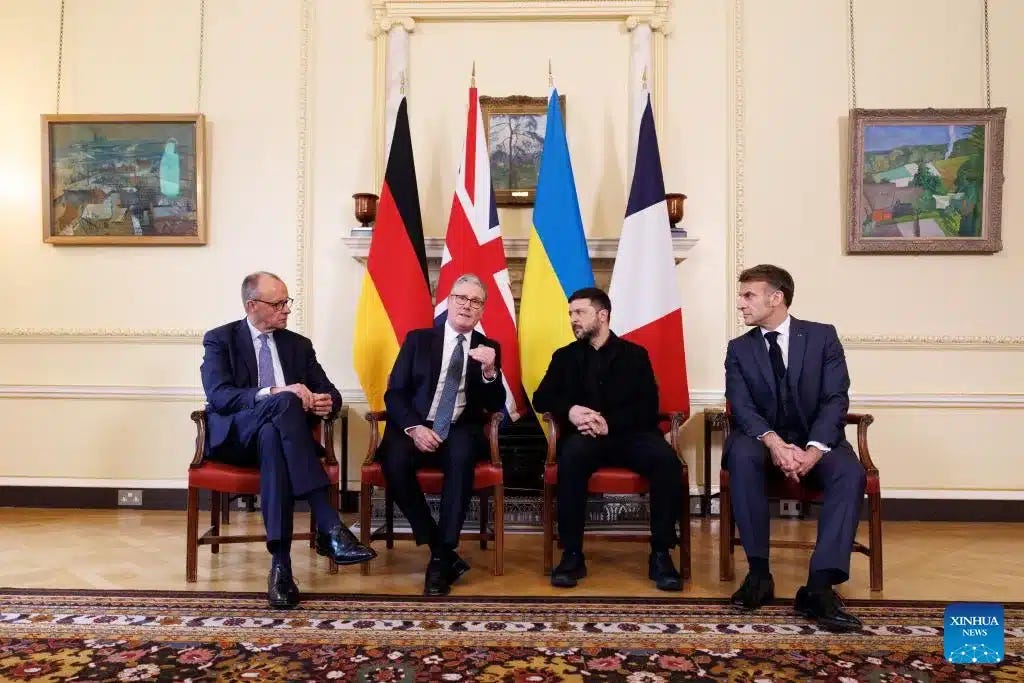
In this context, Ukrainian President Volodymyr Zelensky’s remarks were both revealing and striking. He issued a direct warning to Europe, asserting that the continent would remain incapable of building a credible deterrent force against Russia so long as it remains captive to its traditional alliances and outdated security structures.
Any serious project aimed at establishing a European force capable of balancing Moscow, he argued, cannot be realized without Ukraine and Turkey, alongside Britain and Norway.
During his interview with Alastair Campbell on The Rest Is Politics podcast, conducted on Thursday, April 9, Zelensky was not merely seeking a new positioning for his country within Europe as part of the solution rather than a security burden. He also appeared to be pressing firmly on Europe’s long-standing open wound particularly in light of Donald Trump’s return to the White House, accompanied by a more dismissive American discourse toward European capabilities and a clearer exposure of the continent’s limited military weight and strategic autonomy.
Accordingly, Zelensky’s remarks cannot be read simply as a description of an urgent military need or an attempt to exploit the current situation to secure a foothold for his country. Rather, they represent an effort to push Europe toward reconsidering the very structure of its alliances one of the logical consequences of the ongoing war.
His statements also open the door wide to thinking about new security arrangements that transcend traditional frameworks and grant Kyiv and Ankara a central role in any future configurations not only to confront Russian pressure on the eastern front, but also to address the long-term repercussions of the American stance in terms of support, logistics, and transatlantic commitments.
An Important Context
It would be misguided to treat Zelensky’s statements in isolation from the broader context in which they were made. They coincided with an active round of international diplomacy he recently led, which included visits to several Middle Eastern countries. This movement went well beyond routine protocol, reflecting a clear Ukrainian attempt to reposition itself strategically on the map of security and influence within the European sphere and its connected regional circles.
The tour, which resulted in the signing of defense cooperation agreements with Saudi Arabia, Qatar, and the United Arab Emirates, along with discussions of security understandings with Syria and Turkey, was not merely routine diplomacy. Rather, it appeared to be part of a broader Ukrainian effort to transform the military expertise Kyiv has accumulated over years of war into a tool of influence and partnership.
Through this trajectory, Zelensky sought to present his country not as a state merely in search of support, but as a capable actor contributing to the construction of a broader security network—one that links Europe with Turkey and the Gulf, and breaks Ukraine out of the confines of the narrow traditional Western framework.
This diplomatic activity comes at a highly significant regional and international moment shaped by the U.S.-Israeli war against Iran a conflict that, to varying degrees, has exposed the fragility of Europe’s position within Western strategic decision-making. Washington has appeared increasingly inclined to sideline European capitals, distancing them from meaningful influence over decisions of war and peace.
Amid this landscape, Zelensky’s tour and subsequent statements appear as a conscious attempt to fill an expanding vacuum. The Ukrainian president was not addressing Moscow alone as his primary concern, but Europe itself at a moment when it is grappling with eroding presence, declining influence, and shaken confidence in its capacity for independent action.
Thus, his remarks carried implications far deeper than a mere call for new alliances. They opened the door to critical questions about the future of the European bloc, the limits of its strategic autonomy, and its position on the map of influence in a world whose balances are being reshaped by wars and new alignments.
Europe’s Dilemma
The ongoing war, with the severe tests it has imposed on power balances, has revealed the extent of fragility now characterizing the European position. It has laid bare the limited actual capabilities of European states despite their heavy military and historical legacy. In the midst of this turbulent scene, Europe has appeared relatively distant from the center of action observing developments from the margins of influence rather than actively shaping them.
This impression is reinforced by Europe’s inability, thus far, to decisively conclude the confrontation with Russia in Ukraine after four years of fighting. It is also evident in its limited presence in the Middle East, where the United States continues to hold the primary levers of influence, as well as in the erosion of European influence across Africa—once one of the most prominent arenas of traditional European reach.
The issue extends beyond military or political decline to encompass an economic structure that now appears increasingly fragile and exposed to international disruptions. The Ukrainian war, followed by the Gaza war and the confrontation with Iran, has entrenched a new reality in which European economies are highly sensitive to geopolitical tensions—particularly due to disruptions in energy markets, supply chains, and mounting pressures on growth and stability.
In this context, Zelensky’s remarks resemble a strategic alarm bell directed at European capitals: any project to build a European force capable of rivaling Russia will remain incomplete unless it draws upon Ukraine’s accumulated combat and land warfare experience, Turkey’s significant military weight and geostrategic maritime position, and the strategic depth and specialized capabilities of Britain and Norway.
Thus, this message combining warning and incentive cannot be separated from a broader attempt to redraw the map of alliances within the European sphere, reassess existing partnerships, and potentially pave the way for deeper political revisions regarding the conditions that have long governed the integration of influential powers into or around Europe.
Reassessing the Map of Alliances
Since Donald Trump’s return to the White House in January 2025, the international system has entered a state of acute political fluidity, disrupting the traditional structure of Western alliances and prompting many capitals to reconsider long-held assumptions.
This was echoed by Canadian Prime Minister Mark Carney during his remarks at the Davos Forum, where he spoke of the decline of the old rules-based global order in favor of a new international landscape governed by raw power considerations.
The recent war involving Iran has further intensified European concerns, particularly given Washington’s disregard for Europe in the decision to go to war, alongside an increasingly critical American tone toward European capabilities. This has affected Europe’s self-image and deepened doubts about its true position within the Western equation, leaving a heavy imprint on its political imagination and prompting a more serious reassessment of its alliance network.
Against this backdrop, Europe has already begun knocking on new doors most notably China’s. In the current moment of instability, Beijing has emerged as an economically and politically attractive destination for Washington’s allies not only in Europe but across broader regions extending from South America to Asia.
Since the beginning of this year, there has been a noticeable uptick in European engagement with China, taking on an ostensibly economic character but laden with clear diplomatic and strategic implications. This reflects a growing European effort to reevaluate its relationship with China in light of profound shifts reshaping the global order.
This trend has been embodied in a series of closely timed visits by European leaders to Beijing in the early weeks of the year, signaling a rising conviction within Europe that China is no longer merely a major trading partner, but an indispensable actor in shaping global political and economic balances and perhaps even an indirect lever in dealing with Washington.
However, Europe’s efforts to diversify partnerships and reduce dependence on the United States are unlikely to stop at China. Other powers are also poised to play a greater role within the European sphere, foremost among them Turkey, which some assessments suggest could assume a more influential role within NATO particularly in light of recurring U.S. threats to reconsider or reduce its commitment to the alliance.
Europe is also likely, out of pure pragmatism, to expand its engagement with Gulf states and influential actors in the Middle East and Africa whether to reclaim part of its declining influence or to safeguard vital interests beyond complete alignment with the American orbit.
A growing conviction appears to be taking hold within European thinking: the United States at least under the Trump administration can no longer be relied upon as the dependable ally it once was in safeguarding the Atlantic sphere or preserving Western balances.
Hence, the search for alternative pathways to enhance European autonomy and restore geopolitical momentum is gaining urgency, making the construction of new political and security partnerships a defining feature of European policy in the coming phase.
Beyond Europe’s Internal Constraints
In its effort to restore its international standing, Europe may turn to a range of mechanisms to strengthen partnerships with non-European powers such as China, Gulf states, and countries in the Middle East and Africa. These mechanisms may take multiple forms, from economic agreements and security arrangements to political coordination a path that some European capitals have already begun pursuing in recognition of the scale of transformations reshaping the international system.
Yet the more complex challenge lies not merely in expanding partnerships beyond Europe, but in integrating powers located on Europe’s periphery into the European sphere itself. This issue has long been a source of intense debate within the continent, particularly regarding Turkey and Ukraine, whose potential accession to the European Union has remained politically and strategically divisive.
In light of recent developments and the broader reassessment of European alliances, the idea of incorporating countries outside the EU’s full institutional framework such as Turkey and Ukraine—may reemerge as a viable option. This could occur alongside more closely integrated roles for Britain and Norway, positioning these arrangements as potential responses to Europe’s current phase of strategic repositioning.
However, given enduring European reservations, alternative approaches may prove more feasible. Rather than waiting for formal EU accession, Europe may move toward more flexible frameworks such as establishing a broader security alliance that includes both European and non-European states offering a parallel or alternative path to overcome the political complexities that continue to constrain both the European Union and NATO.
From this perspective, the recurring inclusion of countries outside the formal European institutional framework should not be seen merely as a theoretical expansion of partnership, but as an indication of a potential new approach one aimed at constructing a more expansive and flexible security and strategic space that transcends traditional models of European integration while responding to the pressing demands of the current geopolitical moment.
