

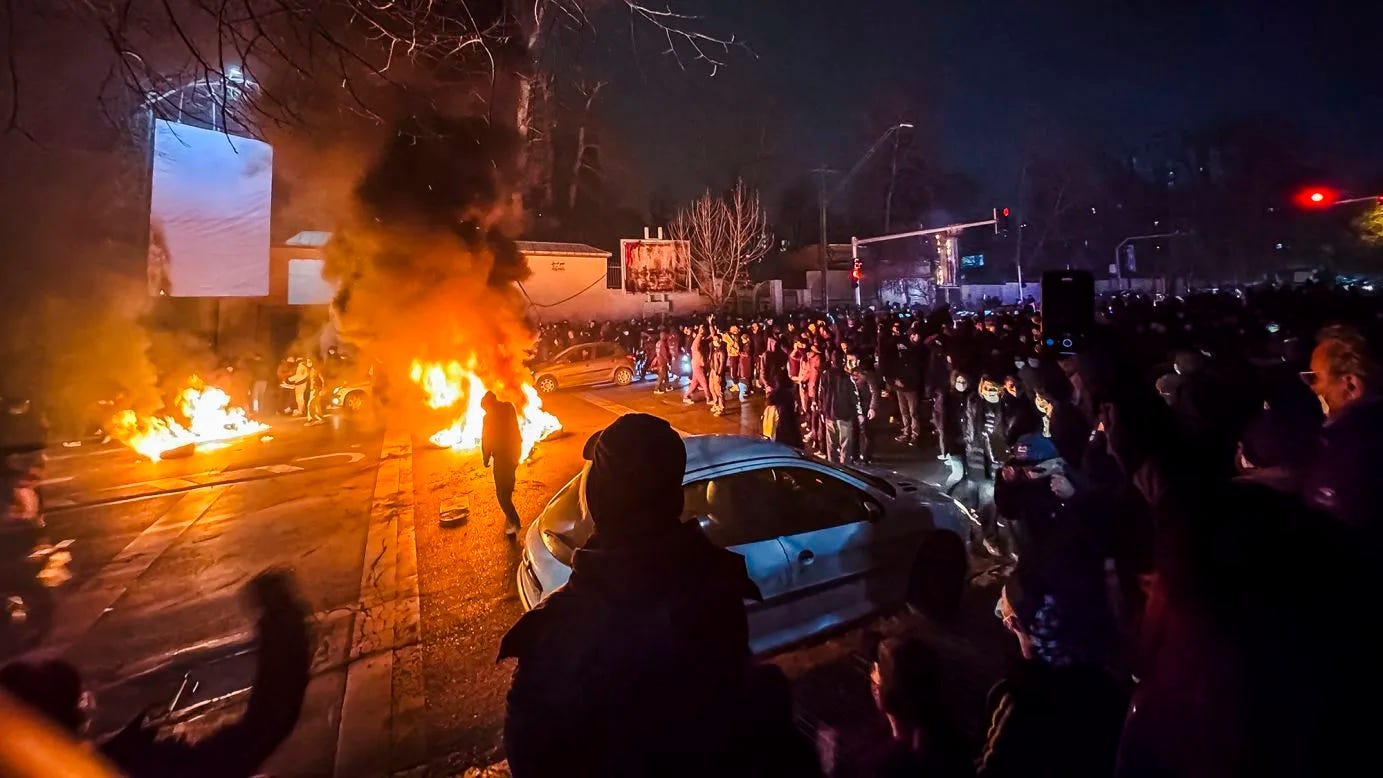
As anti-government protests sweep across all 31 provinces of Iran within just a few weeks, multiple reports suggest that Tehran has turned to allied Iraqi and Lebanese militias to help suppress the growing unrest.
Since late 2025, Iran has witnessed a wave of large-scale demonstrations fueled by economic collapse, soaring living costs, and the freefall of the national currency. What began as an outcry over deteriorating living conditions quickly escalated into politically charged demands challenging the rule of the Supreme Leader.
Clashes between protesters and security forces have so far left at least 490 demonstrators dead and over 10,600 detained within two weeks, as authorities respond with a brutal crackdown. Amid rising violence, emerging reports indicate that Tehran may be drawing on foreign allies to assist in putting down the protests.
Iraqi Militias
Opposition media outlets and intelligence sources have reported that Iran has deployed loyal Iraqi Shiite militias to reinforce its security apparatus.
According to a report by Iran International, Iraqi militias affiliated with Iran’s Islamic Revolutionary Guard Corps (IRGC) began recruiting fighters in early January 2026 to support Iranian forces in their efforts to quell the unrest.
The report states that roughly 800 Iraqi fighters have been sent to Iran so far, primarily from Kataib Hezbollah, Harakat al-Nujaba, Liwa Sayyid al-Shuhada, and the Badr Organization all components of the Popular Mobilization Forces (PMF).
The fighters reportedly entered Iran via border crossings in the provinces of Diyala, Maysan, and Basra, under the guise of religious pilgrimage trips to visit shrines in the city of Mashhad.
Once inside Iran, the combatants assembled at a military base in Ahvaz, a city in southwestern Iran under the authority of the Supreme Leader’s office, before being deployed to various regions to help suppress the escalating protests, the report added.
This is not the first time such reports have surfaced. In previous waves of unrest, demonstrators claimed to hear Arabic dialects among security personnel cracking down on protests fueling suspicions of non-Iranian involvement.
Speculation intensified following a secret, brief visit to Baghdad by Esmail Qaani, commander of the Quds Force, between January 6 and 8, 2026. During the visit, Qaani reportedly held closed-door meetings with leaders of several armed factions.
While official reports claimed the visit aimed to “resolve internal disputes” among Iraqi militias over a domestic judicial initiative to disarm them, the timing coinciding with Iran’s mass protests has raised questions about other, undisclosed objectives.
These developments come as Washington steps up pressure on Baghdad to curb the influence of Iran-aligned militias and dismantle their networks, arguing they undermine Iraqi sovereignty.
Hezbollah’s Involvement
The reports are not limited to Iraqi groups. Intelligence sources cited by Western media suggest that members of Lebanon’s Hezbollah have also crossed into Iran. Approximately 850 foreign fighters are believed to have infiltrated the country to support the crackdown, including operatives from Hezbollah and Quds Force-linked units.
A report by Fox News confirmed that Hezbollah fighters entered Iran alongside Iraqi militiamen to bolster security forces confronting the nationwide uprising.
This aligns with a formal warning from the US State Department, which expressed deep concern over reports that the Iranian regime was deploying “terrorists from Hezbollah and Iraqi militias” to repress peaceful protests.
In a post on X in Persian, the US State Department stated:
“The regime has spent billions of Iranian people’s money on terrorist proxies. Using these forces against its own citizens would constitute yet another grave betrayal of the Iranian people.”
Official Silence
Despite growing media coverage of foreign militia involvement, none of the governments concerned have issued a clear denial or confirmation. Iran, for its part, continues to accuse so-called “rioters” of receiving support from foreign powers such as the United States and Israel, while remaining silent on allegations of its own use of foreign paramilitary forces.
According to Iran International, Iraqi government officials are aware of the mobilization of fighters into Iran but have opted not to comment publicly to avoid political embarrassment.
Meanwhile, leaders of Iraqi factions have issued veiled denials and vague remarks distancing themselves from any direct involvement. Hussein Al-Okabi (also known as Al-Shihani), a senior figure in the political wing of Asaib Ahl al-Haq, stated that Iraqi factions remain committed to fundamental principles, foremost among them the religious authority in Najaf and Baghdad’s sovereignty in matters of war and peace.
Similarly, Hadi Al-Saadi, another senior Asaib Ahl al-Haq commander, said Iran is fully capable of managing its internal crises and deterring external threats without needing Iraqi intervention. He stressed that Iraqi factions have not historically functioned as automatic extensions of Iran’s deterrence apparatus unless Iraq’s own security is at risk.
If reports of Iraqi militia involvement in repressing Iranian protesters are accurate, it could further inflame public outrage against a regime accused of spending national resources on foreign militias only to bring them home to crush its own people.
In Iraq, the involvement of Iraqi fighters in killing Iranian civilians could spark domestic backlash and further embarrass a government already under intense American pressure to rein in and dismantle the militias.
As demonstrators across Iran continue to defy the security crackdown, all eyes remain on the ground for any concrete evidence confirming or disproving direct Iraqi or Lebanese involvement in suppressing the uprising.