

A new escalation by the Islamic State (ISIS) is unfolding in Syria, marked by a series of attacks carried out by its sleeper cells across different parts of the country. The latest occurred on March 6 and 7, when three Syrian soldiers were killed in the al-Bab and Khanasser areas of Aleppo’s countryside. These operations follow a wave of attacks in February, which saw more than 15 assaults within just ten days seven of which were claimed by the group, targeting Syrian security installations, checkpoints, and personnel.
The spark for this escalation came on February 21, when ISIS spokesperson Abu Hudhayfah al-Ansari released a 30-minute audio message reviewing the group’s operations across its various areas of activity, with a clear focus on Syria. In the recording, he called for intensified attacks against what he described as the “apostate secular Syrian regime.”
The audio, published by al-Furqan Media, was the first of its kind in over two years. In it, the spokesman recharacterized the Syrian government, arguing that the country is transitioning from Iranian to Turkish and American influence.
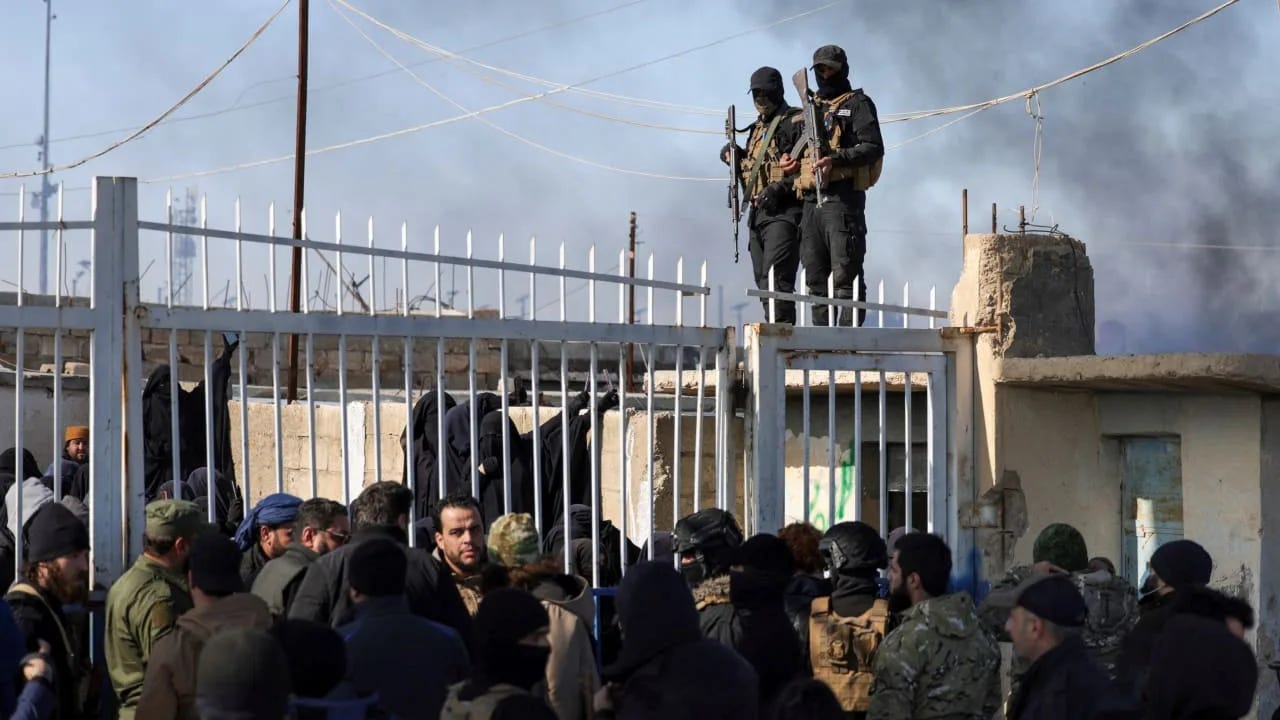
This message coincides with Syrian authorities dismantling the al-Hol camp, removing the widows and women of ISIS fighters, and closing a file that had for years been central to the group’s propaganda, which it used to incite attacks against the Syrian Democratic Forces (SDF).
An Obsession with al-Sharaa
On February 24, ISIS claimed responsibility for an attack on the al-Sabahiya checkpoint west of Raqqa, carried out by its cells and resulting in the killing of four Syrian security personnel. Notably, the statement released by the group’s Amaq News Agency prominently featured an image of Syrian President Ahmad al-Sharaa and his wife, alongside U.S. coalition commander Brad Cooper and his wife an unprecedented move, as women rarely appear in ISIS communications.
This fixation on President al-Sharaa is not new. It reflects a continuation of the group’s propaganda campaign, which has persisted since the launch of the “Deterrence of Aggression” operation in 2024 that culminated in the fall of the Assad regime and al-Sharaa’s rise to power. Over the past two years, Syria and al-Sharaa himself have taken center stage in ISIS media, alongside intensified activity across its auxiliary platforms on Facebook and Telegram.
The rivalry between Jabhat al-Nusra later rebranded as Hay’at Tahrir al-Sham (HTS) under al-Sharaa and ISIS is longstanding. It dates back to the moment Abu Bakr al-Baghdadi declared the so-called “caliphate” and al-Sharaa (then Abu Mohammad al-Jolani) refused to pledge allegiance. The dispute escalated into a fierce war, initially in eastern Syria before spreading to Idlib, where ISIS was ultimately dismantled. Today, ISIS continues to invoke this old conflict in an attempt to reignite tensions and incite hostility against al-Sharaa.
Factors ISIS Is Banking On
The rural areas of Aleppo and Syria’s Jazira region have become the primary theater for ISIS cell activity, echoing patterns seen during SDF control. While the operational rhythm remains similar, the target has shifted: Syrian government forces are now the primary focus, particularly as Damascus has recently expanded its control to roughly one-third of the country. This comes amid clear fragility in the security landscape, with military and security institutions still in formation.
A second factor is the operational shift among ISIS fighters, who have moved from the Syrian desert toward urban centers following the fall of the Assad regime in December 2024. The group increasingly relies on hit-and-run tactics and assassinations a method it has employed since its territorial defeat in March 2019.
Analysts also point to Syria’s economic deterioration as fertile ground for recruitment. ISIS propaganda has exploited Syria’s joining of the international coalition against ISIS in November 2025, using it to attack the authorities particularly when addressing individuals with jihadist leanings within the new Syrian army, urging them to defect and join its ranks.
Another critical factor, analysts argue, is the issue of justice and revenge against figures of the former Assad regime. A year after its fall, many Syrians still demand accountability. Amnesty decisions affecting former officials may push some seeking retribution to view ISIS as a tool especially if the state fails to deliver justice.
Additionally, the escape of ISIS members from detention facilities previously controlled by the SDF, such as al-Shaddadi prison, along with breakouts from al-Hol camp in Hasakah, may help reactivate the group’s networks.
Factors Favoring the Syrian State
Despite the recent surge in ISIS operations following al-Ansari’s call, these attacks represent continuity rather than a shift particularly in the recently “liberated” Jazira region. The operations follow familiar patterns but intensified during Ramadan, a period in which ISIS has historically increased activity due to its religious symbolism tied to conquest and victory.
Several factors favor the Syrian authorities in curbing ISIS activity. Chief among them is the Sunni support base enjoyed by the current leadership under interim President Ahmad al-Sharaa. Syrians’ desire to restore normalcy and avoid new conflicts has become dominant, making stability a top priority. This reduces the likelihood of ISIS regaining strength as it did in 2014, especially given vastly different domestic and international conditions today.
ISIS also lacks any meaningful popular support in Syria. On the contrary, many Syrians view the group as responsible for setbacks suffered by the revolution, citing its past collaboration with the Assad regime against opposition factions, as well as the widespread abuses it committed between 2013 and 2017.
Indeed, cases of personal revenge against former ISIS members have been documented, particularly in Deir ez-Zor, where returning operatives have been targeted by individuals affected by the group’s past actions.
Drying Up ISIS Funding
With Syrian state control over the Jazira region and the closure of the al-Hol camp file in February, authorities have effectively neutralized one of ISIS’s most important financial resources. The group had long exploited the camp to raise funds under the slogan of “supporting chaste women in captivity” referring to the widows of its fighters detained there since 2017.
Al-Hol held symbolic significance for ISIS supporters after its defeat in Syria and Iraq. While funds did reach women inside the camp, much of the money was redirected to finance the group’s operations. Previous efforts by the international coalition and the SDF to block financial transfers largely failed due to weak oversight across Syria.
Another major blow to ISIS finances is the Syrian state’s control over oil fields in the Jazira region and its ban on makeshift oil refineries. Previously, ISIS extracted revenue by extorting oil investors, imposing monthly “taxes” under threat of violence.
This system extended beyond investors, involving indirect coordination with some local SDF leaders in Deir ez-Zor a pattern that persisted unofficially for years. With state control now established, much of this revenue stream has disappeared.
However, challenges remain, particularly in curbing financial extortion carried out by ISIS cells under labels such as “royal cost” or zakat, which have long been imposed on wealthy individuals in Deir ez-Zor.
An Old Expertise
Syrian intelligence emerging from the security apparatus of HTS has developed considerable experience in confronting ISIS cells, as demonstrated in Idlib. However, scaling this expertise to a country the size of Syria is far more complex.
International cooperation could play a crucial role, particularly Syria’s membership in the global coalition and Turkish intelligence support, which recently contributed to dismantling an ISIS cell in Damascus on March 5. This followed more than 40 security operations across the country targeting ISIS networks.
One of ISIS’s greatest challenges in recent years has been recruitment. With the fall of Bashar al-Assad, the group lost a key propaganda tool it had used to attract sympathizers driven by resentment toward the regime. Today, a government perceived as representative and enjoying a degree of popularity, particularly among Sunnis stands in contrast to ISIS narratives, alongside strong youth enlistment in the Syrian army.
According to sources cited by Noon Post, ISIS has resorted to recruiting minors for attacks in Deir ez-Zor, paying as little as $100 an indicator of the group’s current weakness.
Field data suggests it is highly unlikely that ISIS will regain direct territorial control as it did in 2014. Instead, it relies on decentralized “security provinces” to sustain itself, seeking to prolong instability and exploit security weaknesses to recruit supporters and boost morale.
While a return to territorial control is unlikely, the threat remains real. Confronting ISIS requires a comprehensive strategy that goes beyond traditional security measures. This includes vetting the military to exclude ideologically sympathetic elements, strengthening intelligence cooperation, and intensifying efforts to track and disrupt financing networks.
Equally important is countering extremist ideology through religious engagement and addressing socio-economic vulnerabilities particularly in rural areas such as the Jazira, Aleppo countryside, and Homs. Combating poverty and achieving social justice remain the most effective guarantee against recruitment and the spread of extremism.
