

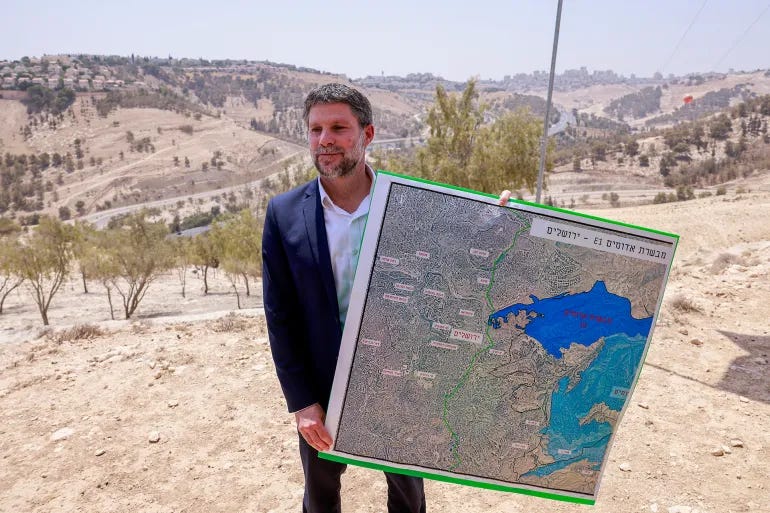
On February 15, 2026, the Israeli occupation government approved a new measure effectively legalizing the expropriation of vast tracts of land in the West Bank and transferring them into the ownership of what it calls the “State of Israel” by ending the land registration status that has remained in place since 1967.
The government of Benjamin Netanyahu voted in favor of a plan introduced by Finance Minister Bezalel Smotrich, Justice Minister Yariv Levin, and Defense Minister Israel Katz to revive what is termed the “settlement of rights” process in Area C, the portion of the West Bank under full Israeli control.
This systematic land seizure is but one measure in a series of decisions taken in the preceding week to tighten Israel’s grip on the West Bank and bury any remaining prospect of a Palestinian state. This report examines the context, underlying objectives, and potentially devastating impact of the move on Palestinians.
The Roots of the Freeze Since 1967
Following its occupation of the West Bank in 1967, Israel imposed a military order freezing land registration there.
Large swaths of territory remained without formal title settlement, leaving Ottoman and Jordanian archives as the only reference for proving ownership.
Under the 1995 Oslo Accords, the West Bank was divided into three zones: Area A under full Palestinian control; Area B under Palestinian civil administration and Israeli security control; and Area C under complete Israeli authority, comprising roughly 60 percent of the territory.
This arrangement rendered much Palestinian land vulnerable to official manipulation, with parcels often reclassified as “state land” when owners failed to produce documentation dating back decades prior to the occupation.
The current government’s decision ends the decades-long registration freeze, enabling for the first time since 1967 the issuance of formal land titles in the name of the occupying state.
The Decision and Its Implementation
The plan authorizes Israel to declare designated parts of Area C as zones for the purported “settlement of rights” process, effectively on behalf of settlers.
During the declaration period, anyone claiming ownership of a plot must present official documentation. Failure to do so or failure to participate in the process results in the land being registered as property of the “State of Israel.”
The registration process appears deliberately structured to strip Palestinians of their rights. Authorities require decades-old documentation and certifications that many cannot produce, particularly given the confiscation or destruction of records during the 1967 war and subsequent occupation.
According to the Israeli organization Peace Now, these requirements are “harsh and opaque,” making it nearly impossible for Palestinians to prove ownership and potentially enabling Israel to annex as much as 83 percent of Area C.
The group described the move as a “massive land grab” that would formalize Israeli control over roughly half of the West Bank.
The Infrastructure Behind the Plan: Figures and Facts
The decision is not merely declaratory but backed by substantial resources, signaling an intent to accelerate what critics describe as a colonial fait accompli:
Allocated Budget: The government earmarked an initial 244 million shekels (approximately $79 million) for 2026–2030. The funds are not designated for direct settlement construction, but rather to finance a bureaucratic apparatus of surveyors, lawyers, and land registrars.
Human Resources: Approval was granted for 35 new positions distributed strategically among the Ministry of Justice (responsible for land registry), the Israeli Mapping Center (MAPI), the Ministry of Defense, and the so-called Civil Administration. The distribution reflects a deeper administrative integration of the West Bank into Israel’s state institutions.
2030 Target: The government set a public goal of registering 50 percent of unregistered land in Area C within the coming decade, with an interim target of 15 percent within five years (by 2030).
Long-Term Horizon: Explanatory notes indicate that surveying and registering all of Area C could take up to 30 years. The procedure for a single plot takes roughly 18 months underscoring what critics say is Israel’s intention to entrench permanent sovereignty.
The Underlying Objectives
While the government markets the measure under the banners of “transparency” and “dispute resolution,” critics argue it amounts to creeping annexation and systematic expropriation without a formal declaration.
Registering land in the name of the Israeli state facilitates settlement construction permits, infrastructure development, and the sale of land to settlers and settlement-linked corporations.
It also preempts future negotiations over ownership and provides Israeli forces with grounds to demolish homes and confiscate land on the basis of unproven ownership. Palestinians, meanwhile, are barred from selling their land without special permits.
Smotrich described the decision as “part of a settlement revolution to strengthen control over all parts of our land,” while Katz labeled it a “necessary security measure.”
The move also carries domestic political calculations. Netanyahu faces elections in late 2026 and depends heavily on the settler right for support. Relaunching land registration offers a tangible victory to his far-right base, which frequently decries “bureaucratic obstacles” to settlement expansion.
Impact on Palestinians
Palestinians in Area C own agricultural lands, grazing fields, and vital water sources. Losing the ability to prove ownership threatens their livelihoods and risks pushing them into densely populated enclaves as settlements expand with generous state backing.
More than 300,000 Palestinians live in Area C and are directly affected by the decision, alongside pastoral communities reliant on open grazing areas.
Settlement expansion is likely to intensify demolitions and displacement, as seen in the village of Umm al-Khair, where demolition markers were placed on a football field and settler flags raised around it.
The measure will further fragment geographic continuity between Palestinian communities, undermining the viability of a future Palestinian state.
Economically, lands registered in the name of the Israeli state are often developed into agricultural-industrial zones owned by settlers, creating additional barriers to Palestinian development.
Excluding the Palestinian Authority from the registration process strips it of one of its last remaining administrative prerogatives. Analysts describe the step as paving the way toward its gradual dismantlement and the consolidation of Palestinians into ever-narrower enclaves.
The Broader Context
The February 15 decision cannot be understood in isolation. On February 8, the Israeli security cabinet approved seven additional measures aimed at de facto annexation:
Repealing a Jordanian law prohibiting the sale of land to non-Palestinians, allowing settlers to purchase property within Palestinian cities.
Eliminating the requirement for special permits to buy land, removing oversight by the Civil Administration and facilitating property acquisitions.
Publishing previously confidential land registry records, enabling settlers to identify landowners and exert pressure to purchase or seize property.
Reviving a land acquisition committee to secure reserves for settlement expansion.
Extending Israeli authority into Areas A and B in matters related to water, antiquities, and environmental regulation allowing for home demolitions in those areas.
Placing Rachel’s Tomb in Bethlehem under full Israeli authority.
Transferring authority over building permits in Hebron from a Palestinian municipality to the Israeli Civil Administration.
Smotrich, a leading figure of the hardline settler movement, declared that the measures “bury the idea of a Palestinian state,” while the Yesha Council of settlements hailed them as recognition that “the Land of Israel belongs to its people.”
Taken together, these steps suggest that the February 15 decision forms part of a comprehensive strategy to impose Israeli sovereignty over the West Bank creating facts on the ground that are difficult, if not impossible, to reverse.