

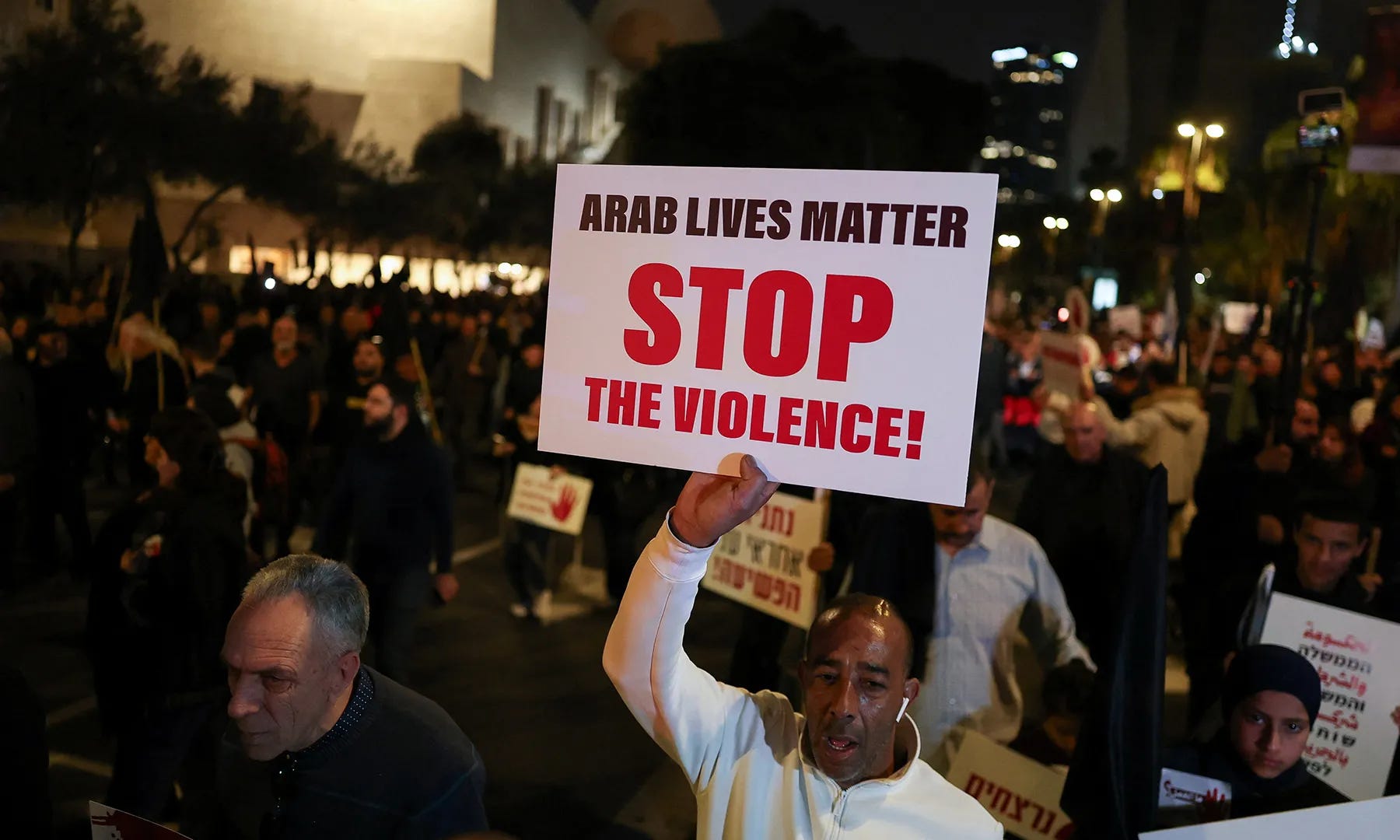
Since late January 2026, Palestinian citizens of Israel have launched an unprecedented wave of protests against a surge in organized killings that have rocked their towns and cities.
Tens of thousands have marched through cities like Sakhnin, the Triangle, the Galilee, and even Tel Aviv, brandishing black flags and chanting in Arabic: “Oh [Itamar] Ben Gvir, you poor fool Arab blood is not cheap,” in direct accusation of Israel’s far-right National Security Minister’s role in enabling the violence.
The movement was sparked by a record spike in killings about 25 Palestinians were murdered in the first month of 2026 alone in areas legally under Israeli jurisdiction but long subject to systemic neglect and discrimination.
A Bloody Record
The year 2025 was the deadliest ever for Palestinian communities in Israel, with 252 victims in 218 incidents surpassing 2024’s toll of 230. Gun violence has become an almost daily occurrence, eroding any sense of safety and leaving residents feeling abandoned by the very state meant to protect them.
Firearms are the weapon of choice in most of these killings, a fact that underscores the alarming proliferation of illegal arms in these communities. Statistics reveal that Palestinians in Israel are murdered at rates dramatically higher than their Jewish counterparts: in 2024, the ratio of Palestinian to Jewish murder victims was approximately 14:1 (220 vs. 58).
Palestinian citizens make up roughly 21% of Israel’s population of over 10 million. Yet many say they are treated as second-class citizens subjected to systemic neglect, poverty, and targeted violence.
Roots of the Crisis
Observers trace the crime wave to decades of state neglect and structural discrimination. Many Arab towns inside Israel suffer from rampant poverty, crumbling infrastructure, and decaying services conditions ripe for criminal syndicates to flourish.
Rather than confronting the problem, critics say the Israeli police have allowed criminal gangs to operate with impunity in Palestinian neighborhoods. According to the Abraham Initiatives a nonprofit monitoring crime among Palestinian citizens of Israel organized crime has metastasized due to an absence of law enforcement and a culture of impunity.
A particularly damning revelation is that an estimated 90% of illegal weapons in circulation originate from Israeli military and police stockpiles either stolen or deliberately leaked.
The combination of poverty, widespread weaponry, and intentional inaction has created a deadly ecosystem. While Palestinians plead for protection, Israeli police are routinely accused of turning a blind eye or worse, colluding with the gangs.
Official data is damning: in 2023, only about 8% of murder cases involving Palestinian victims led to indictments, compared to 55% among Jewish victims.
Gangs Filling the Vacuum
In the absence of law enforcement, powerful criminal families have seized control. Yedioth Ahronoth newspaper has reported extensively on six of the most notorious:
Abu Latif Family (Galilee) – Four brothers lead a force of around 200 armed men. Their dominance is so extensive that Shin Bet once recommended canceling municipal elections in Rama village, citing state impotence.
Jarushi Family (Ramla & Lod) – Their turf wars, especially with the rival Masrati family, have transformed neighborhoods into battlegrounds, leaving dozens dead—including women and children.
Hariri Family (Wadi Ara) – Led by Nasser Hariri, even from prison, the gang commands about 300 armed members and engages in extortion and violent clashes with the rival Bakri clan in Nazareth.
Karja Gang (Harish) – Engaged in loan-sharking and extortion, it controls large swaths of the city through armed enforcers.
Abu Mot Gang (Baqa al-Gharbiyye) – Its leadership has been picked off one by one in a bloody power struggle.
Suhaib Al-Asmar Gang (Umm al-Fahm) – Despite their leader’s imprisonment, the gang’s 120 members continue to terrorize the city.
These crime syndicates have amassed billions through violence and coercion, turning entire neighborhoods into war zones.
Extortion and Economic Strangulation
In the past year, gang activities have escalated from drug and weapons trafficking to blatant extortion. Business owners now face a dire choice: pay monthly “protection” fees or risk being shot or bombed.
One merchant in Nazareth recounted making a modest profit about $9,700 a month until anonymous callers demanded $2,700 monthly in extortion payments. After refusing, his store was riddled with bullets. He eventually shut down to protect his family.
Others in Nazareth and cities across northern Israel have shared similar tales. In one striking case, Al-Noor Bakery in Sakhnin was repeatedly attacked and looted. Staff were injured, and customers traumatized. The owner eventually shuttered the business, saying, “Nothing on Earth is worth a single drop of blood.”
Such violence has sparked a new exodus. Business owners and skilled professionals are increasingly contemplating emigration to escape a society being strangled by fear.
Official Complicity?
Given Israel’s extensive surveillance apparatus, many Palestinians ask: how could crime spiral so far out of control unless the state allowed it?
The prevailing belief is that Israel is intentionally allowing this violence to fester. The aim: to weaken and control Palestinian society under the guise of “internal chaos.”
Reports by Times of Israel and Channel 13 have revealed that many crime bosses double as informants for Shin Bet, Israel’s internal security agency granting them de facto immunity.
In 2021, a senior police officer reportedly admitted that “most crime lords in the Arab community are Shin Bet agents,” and thus untouchable.
Despite official denials, grassroots activists and victims point to evidence of collusion. Activist Muhammad Taher Jabareen from Umm al-Fahm asserts that Israeli police have accepted bribes from gangs and knowingly allowed weapons to flood Arab neighborhoods.
He asks: “How can they claim to be the region’s strongest security force and not know where the guns are coming from?”
Many believe that state inaction is not just negligence it’s strategy. In 2021, the Israeli government proposed legislation granting police sweeping new powers to raid Palestinian homes in the name of “fighting crime” a move rights groups said would legalize repression.
As one activist put it: “They plant crime in our towns, admit their spies are involved, and then use the chaos to justify more crackdowns. This is colonialism in its ugliest form.”
For protesters, the blame lies not just with the criminals but with the entire Israeli state apparatus that, they argue, created the perfect storm for their rise.