

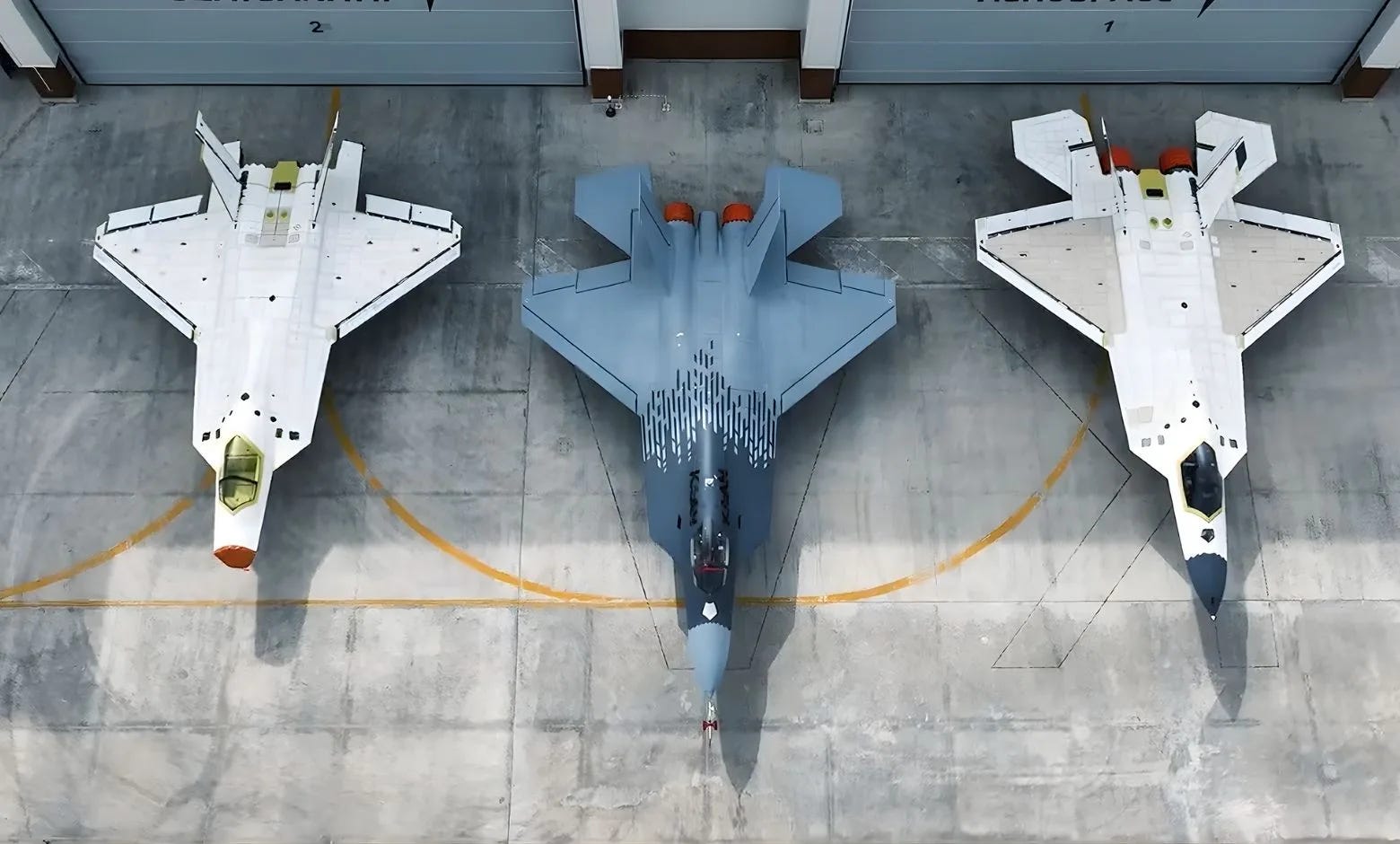
On February 21, 2026, Turkish Aerospace Industries (TAI) marked the second anniversary of the maiden flight of its fifth-generation fighter, KAAN, with the release of a commemorative image and video.
The footage revealed three distinct prototypes of the national combat aircraft: the jet that first flew on February 21, 2024 (P0); the prototype designated to shoulder the main flight-test campaign (P1); and the “iron bird,” a full-scale structural test article designed for ground and static testing, known as TBST-P.
Such a scene had not been witnessed before. It underscored the project’s rapid acceleration and its evolution from a single demonstrator into a multi-prototype program operating in parallel, supported by a broad and expanding industrial base.
From Concept to Name — and Then to Flight
KAAN began as the National Combat Aircraft project, launched in 2016 by Turkey’s Presidency of Defense Industries after the United States removed Ankara from the F-35 program.
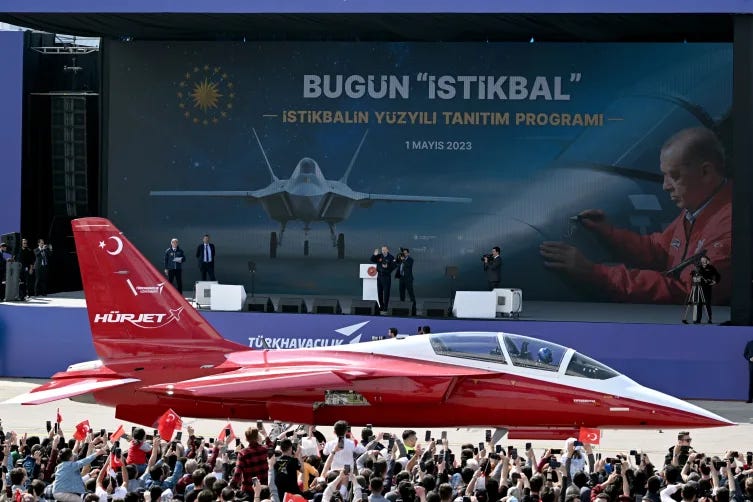
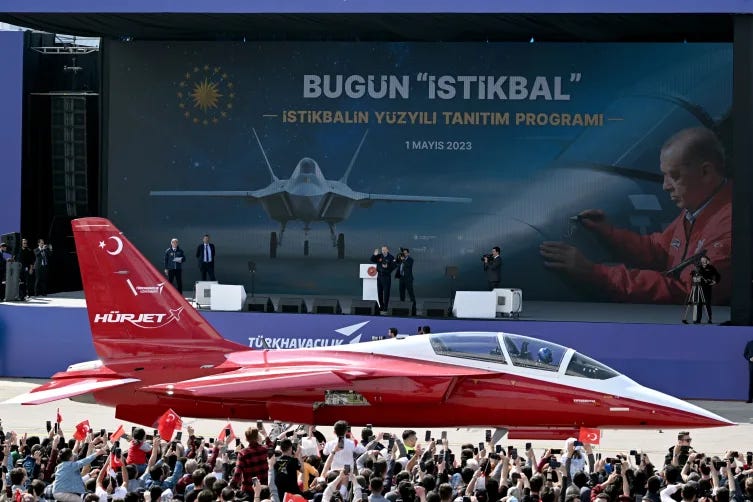
On May 1, 2023, President Recep Tayyip Erdoğan unveiled the aircraft’s name during the “Century of the Future” event, explaining that “KAAN,” meaning “Supreme Ruler,” was chosen to emphasize Turkish roots and national independence in decision-making.
Behind the scenes, technical preparations were advancing steadily at TAI’s facilities. In February 2024, the first prototype, P0, completed structural assembly and endurance tests, followed by the installation of its landing gear.
On February 21, 2024, the aircraft made its maiden flight, lasting 13 minutes and reaching an altitude of 8,000 feet at a speed of 230 knots confirming the airframe and flight systems were functioning in harmony and marking the formal entry into the flight-test phase.
A second test flight followed on May 6, 2024, lasting 14 minutes and reaching 10,000 feet, allowing engineers to gather critical data to refine stability and onboard systems.
The program relies heavily on leading Turkish defense firms, including Aselsan (radar and electronic warfare systems), Roketsan (missile development), and TUSAŞ Engine Industries (TEI), which is responsible for developing the indigenous engine, alongside aerospace and systems companies such as TAI and Havelsan.
Three Prototypes — Dividing Roles, Parallel Testing
The image released by TAI in February 2026 shows three platforms operating simultaneously:
P0, serving as a technology demonstrator, continues flight tests to expand altitude and speed envelopes.
P1, the first fully equipped prototype, will focus on systems validation and combat capability testing.
TBST-P, or the “iron bird,” is a full-scale structural and systems test article outfitted with control systems, engines, and avionics to conduct rigorous ground trials without risking flight prototypes.
The presence of these three platforms side by side signals a transition from reliance on a single aircraft to a multi-variant testing program reducing development time and cost while enabling continuous design refinements.
Compared with the initial P0 version, the new prototypes display significant improvements. The airframe has been redesigned, and engine air intakes optimized to enhance aerodynamic efficiency and stealth characteristics, particularly in reducing radar cross-section.
The landing gear design has also been modified to increase internal volume, accommodating internal weapons bays without compromising stealth.
According to Haluk Görgün, head of Turkey’s Presidency of Defense Industries, the milestone reflects the maturation of a vast industrial ecosystem comprising more than 300 companies across 20 Turkish cities and employing over 5,000 personnel making the project a central driver of the country’s technological infrastructure.
Technical Specifications — The Language of Numbers
KAAN is designed as a multi-role air superiority fighter, exceeding several Western and Eastern counterparts in certain specifications, particularly in cost efficiency and payload capacity.
The overall development cost of the program is estimated at $10–12 billion a highly competitive figure compared with the €60–65 billion cost of developing the Eurofighter Typhoon and the approximately $1.7 trillion lifecycle cost of the F-35 program. Unit cost is projected between $80 million and $110 million.
Technically, KAAN stands out in payload capacity, capable of carrying 10–12 tons of weapons, surpassing the F-35’s 8.16-ton payload.
The fighter is equipped with the advanced “TOLGAR” helmet, offering exceptional situational awareness, and the MURAD AESA radar developed by Aselsan, enhancing electronic warfare and sensor fusion capabilities.
According to official specifications, KAAN measures approximately 21 meters in length, with a wingspan of 14 meters and a height of six meters.
It is powered by two GE F-110 engines, each generating 29,000 pounds of thrust. The aircraft can reach speeds of Mach 1.8 at altitudes up to 55,000 feet and maneuver at +9g/-3.5g.
Two internal weapons bays enable it to carry air-to-air and air-to-ground munitions without affecting radar signature. It also features “supercruise” capability, allowing sustained supersonic flight without afterburners.
Together, these specifications highlight Ankara’s ambition to field a fighter capable of achieving air superiority and executing ground-attack missions effectively in complex electronic environments.
Ambitious Timelines Between Testing and Production
According to TAI CEO Mehmet Demiroğlu in January 2026, flight testing of P0 is ongoing, while three additional flight prototypes are under construction. P1 is expected to conduct its maiden flight in June 2026.
P2 is scheduled for rollout before the end of 2026, followed by P3 in early 2027, bringing the total number of test aircraft to six.
Demiroğlu indicated that the first operational fighters—equipped with F-110 engines—are now expected to enter service in 2029 rather than 2028 due to the intensity of testing. The initial production batch is projected to include between 20 and 40 aircraft.
Transition to the indigenous TF35000 engine is planned for 2032—a pivotal milestone toward full strategic autonomy. The engine remains the project’s most sensitive component, as it is currently the only major imported element.
According to TEI leadership, the TF35000 is undergoing critical design review and is scheduled for its first test run in 2026 before integration into KAAN in 2032.
For now, the program relies on GE F-110 engines already in Turkey’s inventory. However, adopting a domestic engine would grant Ankara greater freedom to export the aircraft to third countries without U.S. ITAR restrictions.
Indonesia offers a case in point. In January 2026, Jakarta signed a $15 billion framework agreement to purchase KAAN, opting to wait for the variant equipped with the indigenous engine an indication of interest in a configuration free from U.S. export constraints.
The timeline is corroborated by other reports, including TRT Haber, which noted that P0 is expected to resume flights by June 2026 and that new platforms may fly later this year or early next year. The first production aircraft are anticipated to enter service in 2029, with the indigenous engine integrated by 2032.
This aligns with the Defense Ministry’s broader vision of a long-term program spanning 2029 to 2035 to achieve full fifth-generation capability.
Strategic Significance and Upcoming Challenges
The simultaneous appearance of three KAAN prototypes signals a shift from proving flight capability to achieving industrial maturity and combat systems validation. For Turkey, the program carries multiple strategic implications:
Restoring air sovereignty: Following its removal from the F-35 program, KAAN provides a domestic alternative, ensuring the Turkish Air Force fields an advanced stealth aircraft capable of air superiority and ground attack missions, fully integrated with national systems.
Technology transfer and industrial growth: The project establishes a broad technological base and trains thousands of engineers and technicians, benefiting other platforms such as the Bayraktar Kızılelma unmanned combat aircraft and the Hürjet trainer.
Political independence and export potential: Progress on KAAN enhances Turkey’s ability to export the aircraft to allied nations without restrictions, as illustrated by preliminary agreements with Indonesia. Regionally, KAAN could emerge as a competitor to aircraft such as the F-35 and China’s J-35, potentially reshaping the strategic balance.
Yet significant challenges remain. Developing the indigenous engine on schedule is paramount, alongside securing sustained financial support to navigate years of intensive testing. Seamless integration of advanced electronic systems and resilience against political and diplomatic pressures will also be critical.
Turkey must also build advanced training and maintenance infrastructure and convince pilots of the merits of transitioning to an unproven domestic platform.