

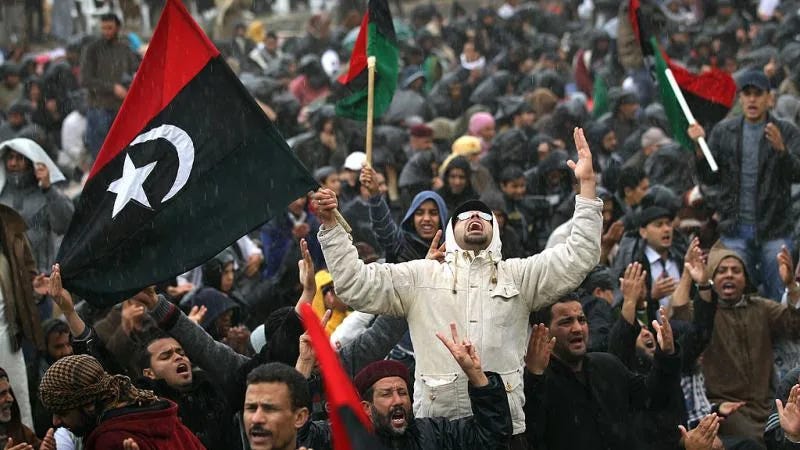
Libyans are marking the fifteenth anniversary of the February 17 Revolution of 2011 amid a political, security, and economic landscape far more complex than the one that existed on the eve of its outbreak. The state whose citizens once took to the streets demanding the establishment of institutions, the rule of law, and guarantees of security, justice, and freedoms now faces a decisive historical test: either embark on a serious national path to repair the fractures and accumulated decline that have weakened its foundations, or continue in a cycle of division and erosion that threatens what remains of the state itself.
The Libyan revolution erupted in a region charged with upheaval, propelled by the winds of change that first swept through neighboring Tunisia to the west and then Egypt to the east. At the time, the public wager was clear: close the chapter on the rule of Muammar Gaddafi, who had held the country in an iron grip for decades, and begin building a civil, democratic state founded on peaceful transfers of power, separation of authorities, and the protection of rights and freedoms.
Yet the transition did not unfold in accordance with the aspirations Libyans had imagined. Instead of consolidating state institutions and entrenching the principles of good governance, the country entered a prolonged and open-ended transitional phase marked by competing claims to legitimacy, rival centers of power, and a multiplicity of political and security authorities.
Nearly a decade and a half after the revolution’s launch, the longed-for national project remains unrealized. The state itself has not even recovered its previous form despite the authoritarianism that once marred it in terms of centralized cohesion and unity of decision-making.
In this context, the anniversary appears less an occasion for celebration or mourning than a moment for sober assessment. It places elites, political forces, and the broader public alike before a historic responsibility that transcends zero-sum logic and the pursuit of dominance. What is required is the reconstruction of an inclusive national compact rooted in consensus, restoring the concept of the state as a unifying framework above factional and regional considerations.
An Extraordinary Anniversary
This year’s commemoration coincides with an exceptional development that has lent it a different dimension and unprecedented intensity. Just days before the anniversary, Libyans were stunned by the killing of Saif al-Islam Gaddafi on the third of this month in the western city of Zintan. The incident, shrouded in ambiguity, reportedly occurred while he was alone, without escort or protection.
For years during his father’s rule, Saif al-Islam was seen as a figure who articulated reformist rhetoric from within the regime. With the outbreak of the revolution, however, he ultimately aligned himself with the ruling authority, placing himself in direct confrontation with the popular movement and the regime’s opponents.
Subsequently, he was indicted by the International Criminal Court on charges of incitement to commit crimes against humanity, further complicating his political and legal standing.
At the same time, a segment of Libyan public opinion viewed the younger Gaddafi as a potential actor in reshaping the political landscape, particularly after he announced his candidacy in the presidential elections scheduled for December 2021 polls that were later postponed indefinitely.
His killing, especially in such circumstances, has scrambled calculations for several actors and added yet another layer of complexity to an already fragile political scene. The incident carries symbolic weight and political messages that extend beyond the individual to the very nature of the conflict and the future balance of power within the state.
Notably, the timing of the incident came just one day after Masad Boulos, adviser to the US president on Arab and African affairs, announced that he had met in Paris with senior officials from western and eastern Libya, including Ibrahim al-Dbeibah, national security adviser to the prime minister of the Government of National Unity, and Lt. Gen. Saddam Haftar, deputy commander of forces in the east.
According to official statements, the meetings focused on Libyan efforts to formulate a framework leading to institutional unification and long-term stability, within an approach aligned with the broader peace agenda adopted by US President Donald Trump.
The convergence of these diplomatic moves with the assassination has fueled a torrent of speculation, intensifying questions about the nature of the next phase and adding fresh ambiguity to an already beleaguered political reality.
The Curse of Division
Political and military fragmentation remains the defining feature of Libya’s crisis a veritable curse that has cast a long shadow over the country for fifteen years, driving it into a quagmire of institutional disintegration and competing claims to legitimacy.
Since the revolution, nine governments have administered the country’s affairs in the east and west, reflecting the fragility of the political structure and the absence of executive stability.
Two of these governments emerged from political dialogue processes led by the United Nations Support Mission in Libya: the Government of National Accord headed by Fayez al-Sarraj (2015–2021) and the Government of National Unity led by Abdul Hamid Dbeibah since 2021.
Since 2015, Libya has been locked in an open struggle between two rival governments. The internationally recognized Government of National Unity, based in the capital Tripoli, administers the western region. The other, appointed by the House of Representatives in early 2022 and currently headed by Osama Hammad, is based in Benghazi and exercises authority over eastern Libya and most southern cities.
Despite this, serious attempts have been made to end fragmentation by turning to the ballot box in hopes of unifying decision-making authority. With UN backing, the National Transitional Council organized elections on July 7, 2012 at the time seen as a gateway to institutional unity and elected legitimacy.
Yet that moment proved short-lived, soon overshadowed by deteriorating security and the growing influence of armed formations, plunging the country into renewed violence.
A similar attempt in 2014 produced a new House of Representatives, but the General National Congress refused to cede power amid escalating polarization between east, west, and south. Libya thus reentered a prolonged cycle of political division whose repercussions persist to this day, despite sustained UN and international efforts to bridge the rift.
Parallel initiatives under the banner of “national reconciliation” sought to narrow differences between rival parties. Most, however, failed to achieve meaningful breakthroughs, focusing instead on elite-level settlements that redistributed power among competitors without addressing the deeper roots of the crisis namely, profound societal division. As a result, these tracks lost direction, and hopes for rebuilding trust and forging durable unity dissipated.
Weapons Proliferation and the Militarization of Politics
Despite early debates over arming the revolution, the deviation from its original objectives gradually turned Libya into an open arena for displays of force among competing groups and factions. As efforts to build unified security institutions faltered, weapons became the dominant language of dispute resolution, entrenching the logic of dominance and weakening prospects for national consensus.
Attempts by the governments of Abdul Rahim al-Keib in 2012 and Ali Zeidan in 2013 to collect weapons and subject them to centralized civilian authority ultimately failed.
This allowed revolutionary brigades to retain their field influence and integrate into political processes through alliances with major parties, creating a complex overlap between political and military spheres and pushing the country deeper into institutional and security chaos.
Amid escalating violence, the United Nations Support Mission in Libya facilitated dialogue between the House of Representatives and the General National Congress, culminating in the signing of the Skhirat Agreement in Morocco in 2015. The accord sought to halt the cycle of violence and curb unchecked militarization by unifying executive authority under the Presidential Council of the Government of National Accord.
Yet the House of Representatives’ rejection of the agreement plunged the process into a new impasse and entrenched governmental division. Field Marshal Khalifa Haftar and the House maintained authority in the east, while the Presidential Council of the Government of National Accord insisted on its legitimacy from Tripoli, allied with the High Council of State established under the agreement.
Rather than marking a decisive turning point toward institutional unity and demilitarization, the Skhirat Agreement became another waypoint in the trajectory of division, cementing dual legitimacy and preserving weapons as a central factor in political life, thereby obstructing the state’s reclamation of its monopoly on force.
Resource Struggles and Shadow Deals
Some observers argue that successive political initiatives failed because they overlooked the core of Libya’s crisis: the economy and, above all, oil resources. These have become the epicenter of the conflict and the object of fierce competition among rival factions seeking to secure the greatest share of wealth as a source of real power.
Chronic mismanagement of state resources—particularly oil—has contributed to political deadlock and the persistent inability to ease internal tensions. The failure to build a unified, transparent national framework for managing this strategic asset has kept the conflict alive, recasting it less as a clash of political visions than as a struggle over resources.
Economic considerations have thus come to dominate political discourse, producing informal understandings among rival actors that resemble tacit bargains conducted behind closed doors. Oil fields and ports remain effectively under the control of Haftar’s forces, while the National Oil Corporation operates under the authority of the Tripoli-based government an arrangement that reflects divided decision-making over the state’s most vital economic artery.
This undeclared power-sharing not only weakens prospects for a comprehensive settlement but entrenches division as a profitable status quo for certain beneficiaries. Division shifts from being a crisis to overcome to an objective in itself, transforming the conflict from a political contest over authority and legitimacy into one of influence and economic control.
External Interventions: The Central Dilemma
Despite Libya’s internal complexities and structural crises, many view foreign intervention and competing agendas as the heaviest burden on its trajectory. The subordination of national decision-making to regional and international interests has curtailed sovereignty and turned Libya into an arena for rivalries that transcend its borders.
Foremost among these actors are the United States and Britain, followed by France, all of which regard Libya as a strategic and economic opportunity not to be squandered, whether in terms of energy resources or its geopolitical position at the heart of the Mediterranean and North Africa.
On the ground, the country appears informally partitioned into spheres of influence aligned with the priorities of various allies. In the east, Haftar’s positioning intersects with the interests of Saudi Arabia, the United Arab Emirates, and Egypt.
In the west, Turkey has emerged as the most influential actor in the political and military equation. In the southeast, Russia maintains a presence, particularly on the military level.
This international and regional jostling has transformed Libya into a theater for settling scores and exchanging messages among competing powers. The result has been the perpetuation of division and the derailment of any internal initiative that conflicts with external calculations.
Libya’s political process remains hostage to balances imposed from beyond its borders, trapped in a cycle of recurring crisis without a clear horizon for resolution.
A Revolution Reduced to Symbols
In sum, fifteen years after its eruption, little remains of Libya’s revolution beyond its symbolism the flag and the anthem while its political project has eroded under the weight of polarization, institutional fragmentation, and weapons proliferation.
The experience of the past decade has revealed a revolution that lost its unifying compass, shifting from a moment of hope for a modern civil state into a complex trajectory shaped by narrow calculations and shifting power balances. The need now is for a comprehensive reassessment that draws inspiration from the founding generation of the Libyan state, who, at a pivotal historical moment, succeeded in uniting geography and will despite scarce resources and daunting challenges.
Today, Libyans stand at a crossroads. Rebuilding the state demands political courage each party must reconsider its approach, privilege mutual concessions over zero-sum dominance, and accept stepping back in order to reclaim the nation as a whole.
The question remains: Have political actors absorbed the lessons of the past years sufficiently to begin correcting course, or is the country still headed toward a higher perhaps far costlier price before it can finally close the chapter of division and embark on genuine reconstruction?
