

The idea of modern state sovereignty did not emerge in a vacuum. Rather, it crystallized from the chaos of Europe’s bloodiest and most tumultuous wars. In 1648, the Peace Treaties of Münster and Osnabrück brought an end to three decades of religious conflict, establishing a new order in international relations built on the principle of absolute state sovereignty over national territory and internal affairs.
To uphold this principle, states agreed to a mutual non-interference pact and to treat one another as equals, regardless of size or strength. Political allegiance shifted from the Church to the state a transition many viewed as the symbolic burial of religion, the key driver of Europe’s devastating religious wars.
Today, the Peace of Westphalia is widely regarded as the founding moment of modern international law a governing framework for inter-state relations that protects sovereignty and bases interaction on treaties and agreements.
Yet this system, for much of its early existence, was exclusive to Europe. It would later be used to justify colonialism and to divide the world into “civilized” and “barbaric” nations.
As geopolitical rivalry shifted from Europe to the Global South, the Westphalian order failed to prevent the outbreak of the First and Second World Wars. The solution, then, was to transition from a “might makes right” order to one based on “lawful power,” giving rise first to the League of Nations and then to the United Nations.
Law, When Convenient
A wave of legal frameworks followed, imposed by the so-called civilized world: international humanitarian law, human rights law, and a string of treaties backed by the UN Security Council, armed with the veto power, and endorsed by the General Assembly. These legal mechanisms came cloaked in moral rhetoric but were applied with striking selectivity.
Thus, the Global North retained control over the Global South, with conflicts framed through the lens of international law. Its statutes aligned neatly with power dynamics, morphing law into a tool of politics rather than an arbiter over it.
At pivotal moments, this legal system showed strength enforcing decisions with the backing of powerful states. At other times, it was rendered toothless, reduced to expressions of “deep concern” by a series of UN Secretaries-General who appeared to have been appointed more to worry than to act.
But this dynamic is no longer confined to North-South relations. Increasingly, conflicts between Southern states have been shaped by legal systems that serve the interests of great powers. Consider, dear reader, the failure of the international justice system over the past decade illustrated by examples both familiar and distant.
In Yemen, for instance, airstrikes began targeting civilians in 2015 with Western backing or silence. Despite extensive documentation of thousands of civilian deaths, systemic starvation, and a naval blockade using Western-made weapons the international legal system offered little more than reports of condemnation. Even those investigative teams were later disbanded under political pressure.
In Myanmar, remember the 2017 genocide against the Rohingya? Seven hundred thousand people displaced, entire villages wiped from the map. What did international law do? It referred the case to international courts, abandoned the victims in refugee camps, and quietly walked away from justice because, in this case, justice was never the point.
Or take Afghanistan not the US-led invasion, but the chaotic withdrawal after two decades of occupation. No accountability for the primary perpetrators behind thousands of civilian deaths. A nation left in total economic and societal collapse.
And Gaza how could you not know Gaza? Genocide, displacement, starvation, hospital bombings and burnings, entire families annihilated, civilians systematically targeted. A political and public discourse openly advocating for ethnic cleansing. Use of internationally banned weapons. And what did the law do?
Two years of “concern,” paralyzed UN Security Council sessions, threats leveled against the International Criminal Court, and a stalled International Court of Justice process. When either court dared whisper terms like “illegal occupation” or “possible genocide,” their words failed to resonate beyond the walls of the courtroom. Their rulings dissolved at the door.
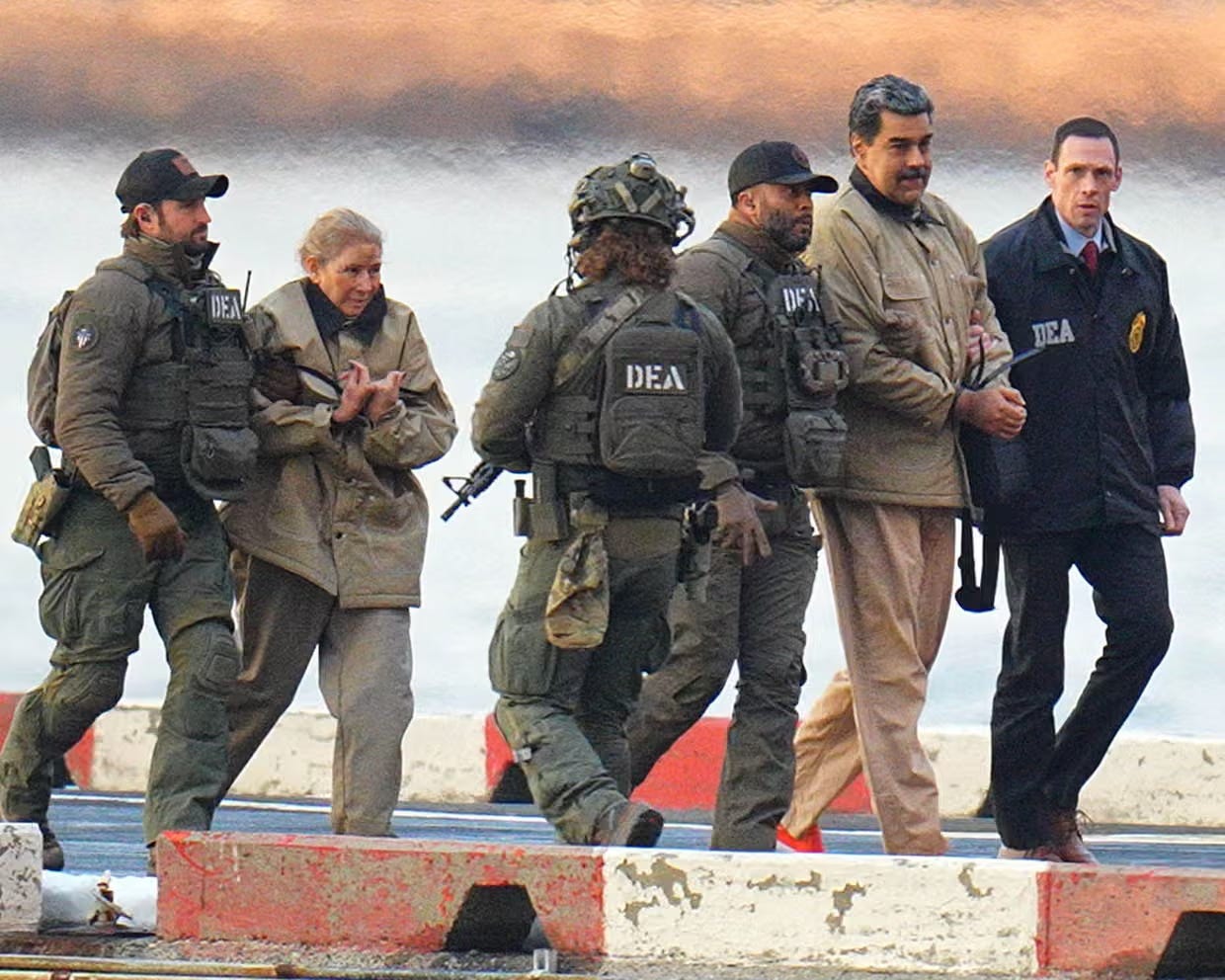
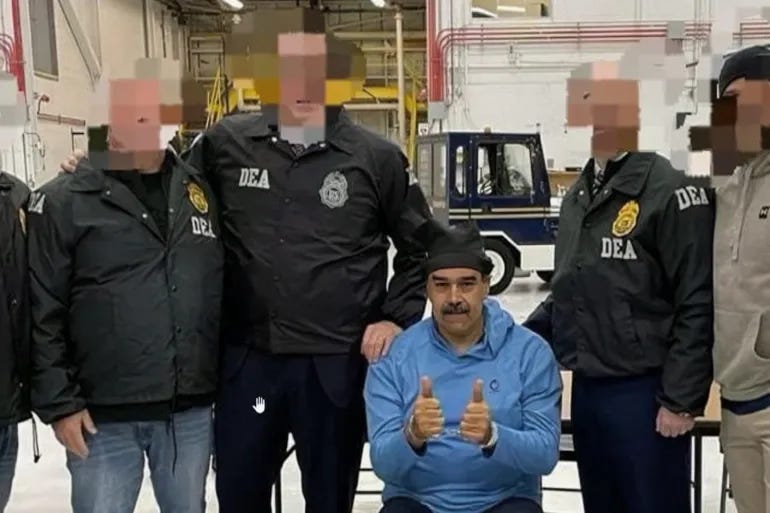
Now, with all this in mind, you can likely predict how international law and justice will respond to the military abduction of Venezuelan President Nicolás Maduro—snatched from a military compound in his own country, by force, and taken to New York for interrogation and trial on charges of drug trafficking and terrorism. The fault lines in international justice are clear to see.
When Force Advances, Law Recedes
On January 3, 2026, the U.S. Department of Defense’s Delta Force launched a precision military operation in the heart of Venezuela. The strike targeted a port, the presidential palace, and the defense minister’s residence. Maduro and his wife were abducted from the capital and flown to New York, where the president now faces trial.
This operation described as “surgical” for its precision brazenly violated multiple principles of international law and the UN Charter. Chief among them is Article 2 of the UN Charter, which prohibits the use of force against the territorial integrity or political independence of any state, unless explicitly authorized by the Security Council or carried out in self-defense.
The abduction essentially, the extrajudicial arrest of a sitting head of state also violates the doctrine of full immunity granted to heads of state and official representatives, whether or not they are accused of crimes. International conventions maintain that kidnapping contravenes the foundational principle of sovereign immunity.
Notably, the crimes Washington accuses Maduro of drug trafficking, gang violence, even selling oil to U.S. adversaries do not meet the international threshold for war crimes, genocide, or involvement in armed conflict. The use of force and the breach of sovereign immunity in this context constitutes a stark violation of international law.
The legal justifications typically required to authorize force such as Security Council mandates or documented self-defense claims were absent. No extradition procedures were followed. This was an unsanctioned, unilateral act of military aggression.
The operation extended beyond the abduction: it was also an assertion of U.S. control over Venezuela’s political future. President Donald Trump openly stated his intent to “reshape” the country a direct infringement on a nation’s right to self-determination, protected under international law.
In bombing ports and government sites, the U.S. violated international humanitarian law principles regarding the protection of civilian infrastructure and the principle of distinction. According to the Geneva Conventions and their First Protocol, disproportionate civilian casualties—32 Venezuelans killed—also amount to a grave breach.
These killings may also constitute extrajudicial executions in violation of the International Covenant on Civil and Political Rights. They undermine the right to life outside the context of legitimate armed conflict and defy UN principles on the use of force.
What the U.S. has done could become a new template: a model of international justice in which powerful states abduct foreign leaders with impunity, under the shield of Security Council vetoes. Today it’s Venezuela; tomorrow it could be Ukraine, Iran, Syria, or Taiwan each targeted under similar pretexts, with no real accountability in sight.
Eichmann or Noriega: How the U.S. Justifies Its Violations
The abduction of Maduro has been described as a dangerous legal precedent, but was it truly unprecedented?
In 1960, Israeli Mossad agents kidnapped Adolf Eichmann, a senior Nazi officer, from Argentina. Despite Argentina’s protest to the Security Council, Eichmann’s trial in Israel proceeded. The charges—crimes against humanity, genocide were universally recognized, and his lack of legal immunity was widely accepted.
Even so, the legality of Eichmann’s abduction remains contentious to this day.
In contrast, the charges against Maduro—based on U.S. domestic indictments—do not carry the same global consensus or legal standing. Nor do they justify military intervention, even if framed as preemptive defense, as U.S. Ambassador to the UN Mike Waltz attempted by citing Article 51 of the UN Charter, which permits self-defense in the event of an armed attack.
Moreover, Maduro retains his head-of-state immunity, regardless of U.S. and European claims about the legitimacy of his presidency. As long as other nations recognize him, his status—and protections—remain intact.
The clearest historical parallel is the U.S. invasion of Panama in 1989. Then-President Manuel Noriega was forcibly taken to the U.S. for trial on drug trafficking charges, following an invasion that killed thousands and devastated Panama’s infrastructure. Washington had already withdrawn recognition from Noriega, but the Security Council rejected the self-defense rationale. Still, the invasion went unpunished.
The UN General Assembly overwhelmingly condemned the action, citing Article 2 of the UN Charter but it could neither stop the trial nor hold the U.S. accountable.
So, while Maduro’s abduction may not be a legal first, it sets a dangerous precedent: not a legal one, but a coercive one. It builds on an old transgression that was never punished, turning it into a replicable pattern.
In an era when international law is more developed than ever strengthened by the Rome Statute and doctrines of sovereign immunity and individual accountability this makes the Maduro case uniquely perilous.
Ultimately, dear reader, this dizzying ride through the history of international law and its violations may offer a sobering reality check: ideals don’t govern the world. Power does.
Power creates the law. It bends the law. It buries or elevates it at will. Law is but a tool amplified by money, media, and yet more power. This is how the world is ruled, how the weak are managed. Without power, all that’s left are stories. Nothing more.
