

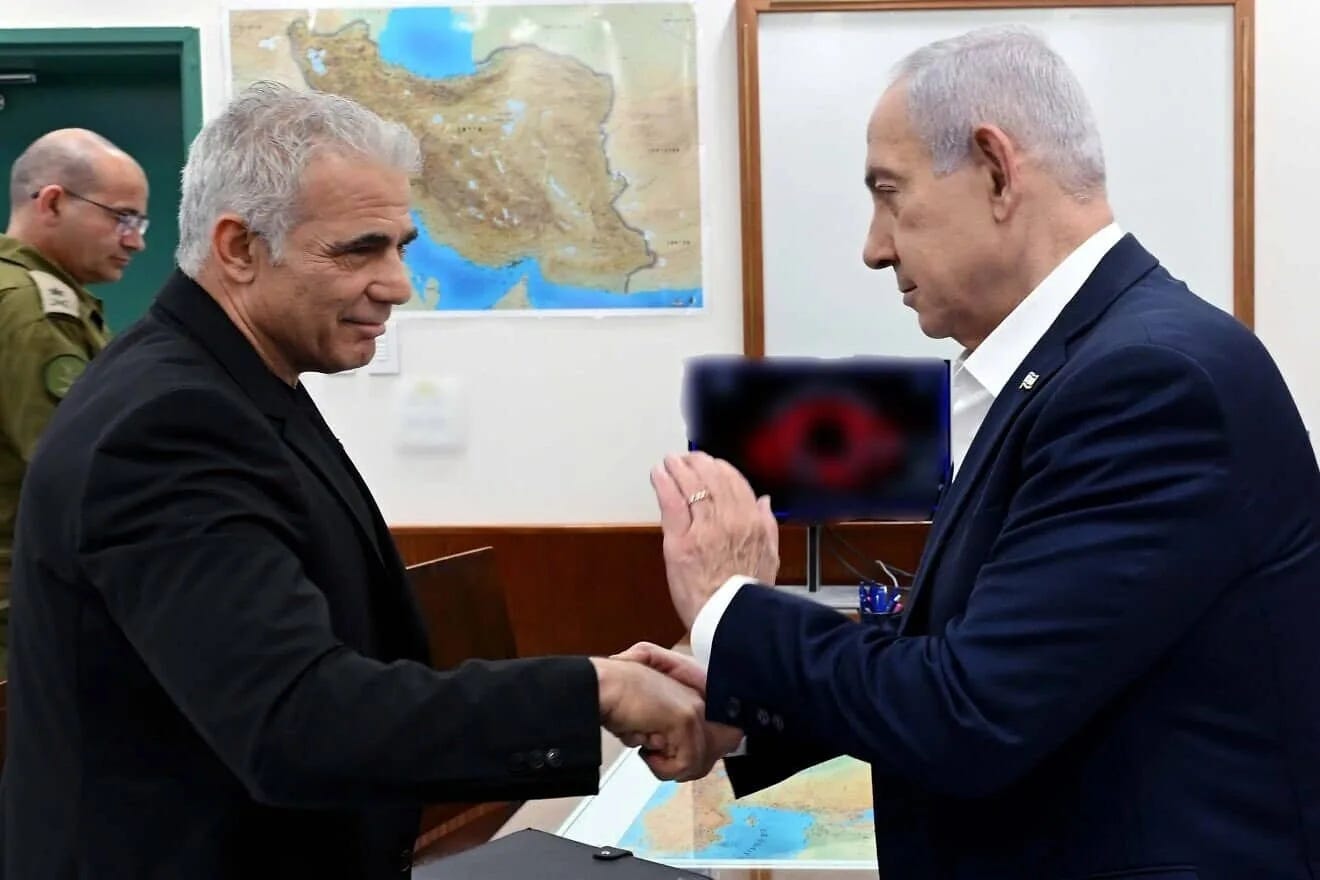
Two years after the launch of Israel’s war on Gaza marked by deep internal divisions and protests demanding a prisoner-exchange deal a new war erupted with Iran in late February 2026. This time, the Israeli opposition’s position appeared to turn 180 degrees.
Political rivals who had bitterly clashed over the management of the Gaza war quickly lined up behind the occupation government led by Benjamin Netanyahu in confronting Iran. What lies behind this alignment and the appearance of a manufactured consensus?
Consensus Through Marketing an “Existential Threat”
For years, Israel’s political system has framed Iran as an existential enemy one that unites society and provides cover for military aggression. The opposition has been no exception.
With the onset of the attack, opposition leader Yair Lapid declared from the Knesset that political disagreements would enter a “deep freeze” until the conflict ends. He pledged to work in international forums to explain what he described as the “necessity of striking Iran,” adding that “despite my rivalry with Netanyahu, Tehran must be attacked with full force.”
In another statement, Lapid wrote that there is “no coalition or opposition” when it comes to striking Iran, and that everyone stands behind the army.
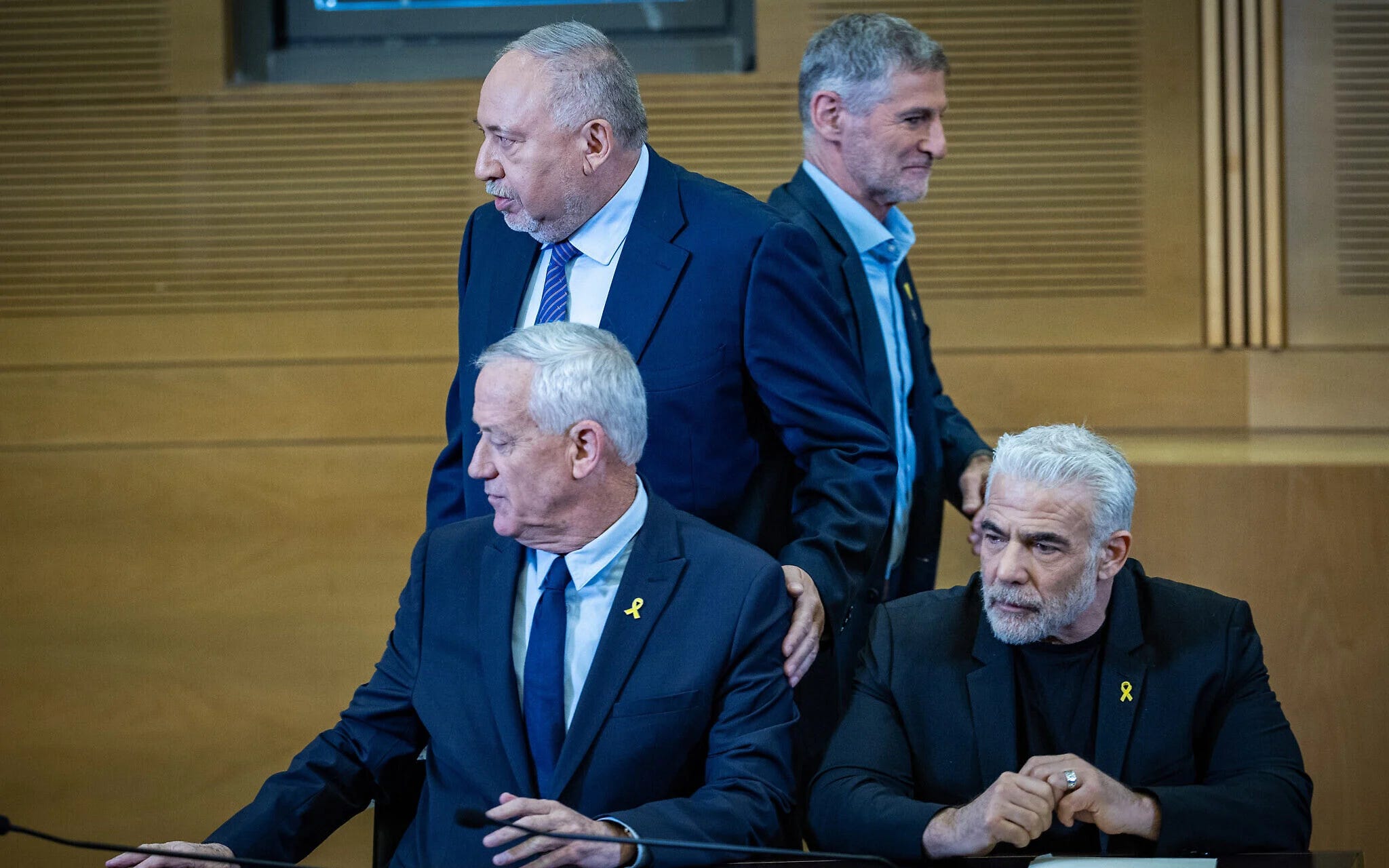
Former Prime Minister Naftali Bennett a prominent rival to Netanyahu in the upcoming fall 2026 elections joined the chorus, announcing his “full support for the army, the government, and the prime minister,” asserting that “the entire nation stands behind you until the Iranian threat is destroyed.”
Two leading figures in the National Unity bloc, Benny Gantz and Gadi Eisenkot both of whom joined the government after October 7 and later resigned also invoked “unity,” saying “everyone stands together” in what they called a “just war,” rhetoric that effectively grants the government domestic cover.
Even left-wing leader Yair Golan offered full backing to the army, while calling for clearly defined objectives to prevent the operation from devolving into another round of escalation.
This time, dissent was largely confined to Arab parties in the Knesset, which condemned the attack as reinforcing “American imperialism” and demanded shelters for Palestinians in the Negev who lack adequate protection.
A report by the Stimson Center observed that framing the Iranian threat as existential narrows public debate and forecloses alternatives such as diplomacy, making military retaliation appear “self-evident.”
The report further noted that such consensus offers political and security advantages to both government and opposition, transforming the Iran file into a “unifying principle in national security doctrine” that justifies military spending and confers broad legitimacy on any leader.
What Does Netanyahu Gain?
1. Restored Legitimacy and Leadership
War offers Netanyahu the opportunity to don the mantle of the “sole leader capable of protecting Israel” a narrative he has long cultivated.
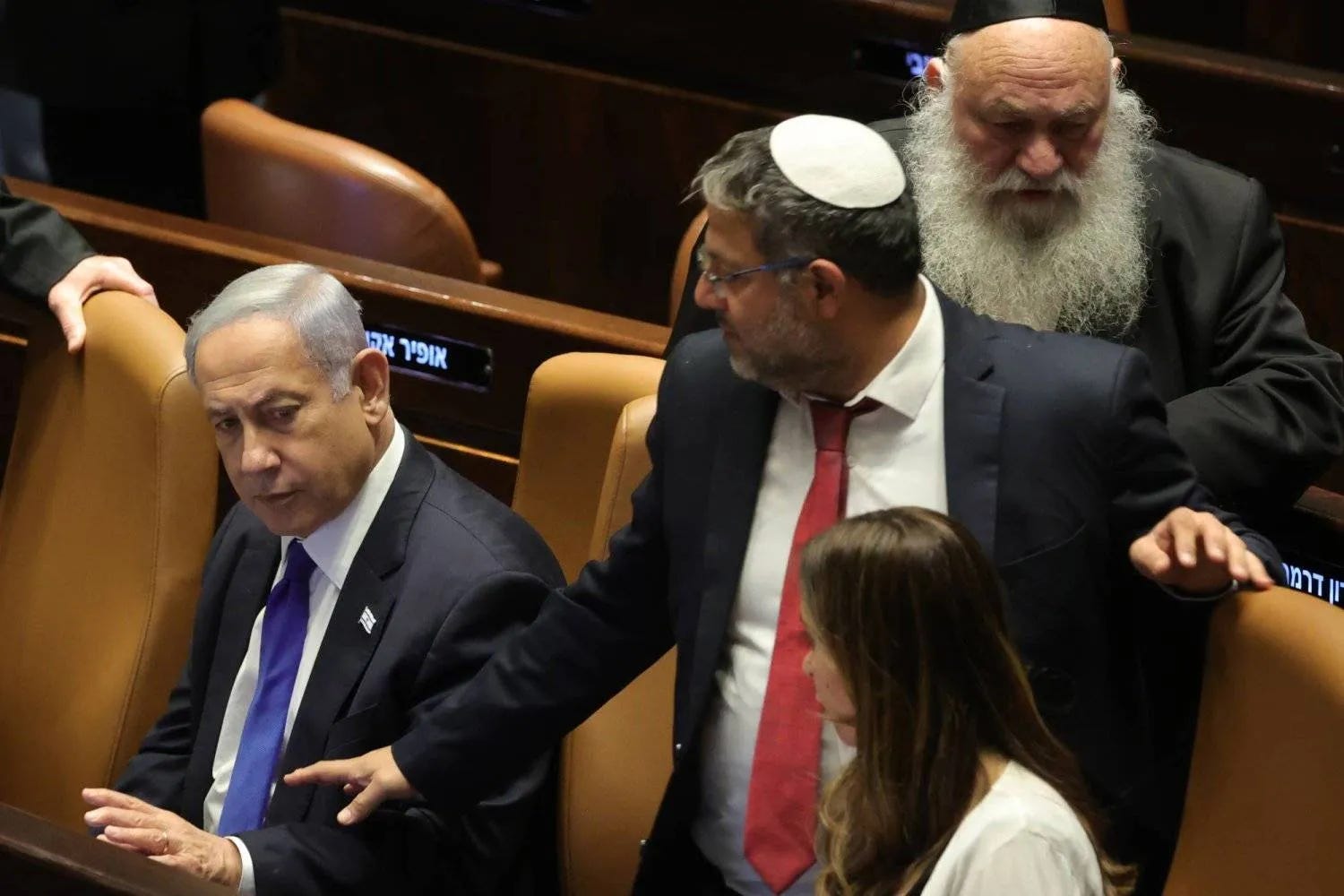
Experts at the Council on Foreign Relations argue that a joint operation with U.S. President Donald Trump would strengthen Netanyahu politically by showcasing his close relationship with the White House and reinforcing voter perceptions that he is best equipped to “deal with enemies” in an election year.
2. Undermining the Judiciary
At the height of speculation over war with Iran and negotiations over ultra-Orthodox military conscription, Netanyahu continued to push forward legislation aimed at weakening the judiciary and prolonging his coalition’s lifespan. One proposed law would bar the Supreme Court from intervening in ministerial appointments.
The bill is widely seen as designed to shield the far-right minister Itamar Ben-Gvir after Israel’s Supreme Court ordered Netanyahu in early February to explain why he had not dismissed him. Ben-Gvir has been accused of undermining police independence and turning the force from a law enforcement body into a political instrument.
Debate over exempting ultra-Orthodox (Haredi) yeshiva students from military service continues to threaten coalition stability. Religious parties demand guarantees of exemption in exchange for remaining in government, while Netanyahu faces mounting pressure on the issue.
3. Electoral Branding
The Hebrew daily Haaretz reported that Netanyahu quickly sought to harness the war for campaign purposes, unveiling an election slogan featuring a roaring lion draped in the flag a design echoing the Likud party emblem.
Yet such gains could prove fleeting. If the war drags on and casualties mount, the public may ultimately hold Netanyahu accountable.
An analysis by The Christian Science Monitor noted that Netanyahu faces domestic pressure, including calls for a commission of inquiry into the failures of October 7 and scrutiny over corruption allegations surrounding his circle. The operation’s success, therefore, hinges on battlefield outcomes.
Prolonged military action could also intensify internal blackmail within the far-right coalition over issues such as conscription, threatening the government’s cohesion.
What Do His Rivals Gain?
1. Security Credibility Without Bearing Responsibility
Supporting the war grants opponents a certificate of “patriotism” and shields them from accusations of weakness explaining Lapid’s insistence that there would be no “opposition” on this matter.
2. Electoral Calculations
Opposing war with Iran carries high electoral costs in Israel, where public discourse equates reluctance with complacency toward what is framed as an existential threat.
Lapid spoke of the need to “erase evil,” while Netanyahu claimed Iran was developing missiles capable of striking the American coast rhetoric suggesting that rejecting war amounts to denying a mortal danger.
3. Positioning for Future Accountability
The opposition appears aware that a prolonged war could politically exhaust Netanyahu. By backing the operation now, they can wait for attrition to set in and later hold him accountable.
According to The Christian Science Monitor, war talk may boost Netanyahu electorally while diverting attention from corruption and security failures. Should outcomes sour, the blame may fall squarely on him, while the opposition insists it supported the army, not the government.
The Stimson Center report adds that focus on Iran has become embedded in Israel’s political culture. Any leader aspiring to power must demonstrate toughness, and backing war becomes a prerequisite for credibility in the eyes of the security establishment.
4. Returning Later to Corruption and Economic Issues
By signaling commitment to “security,” the opposition can later pivot back to corruption charges and economic mismanagement particularly if wartime spending worsens economic conditions.
When Could the Consensus Fracture?
Despite the strength of the current alignment, several fault lines loom:
1. Prolonged War and Rising Human and Economic Costs
If exchanges continue for months, with rising casualties and civilians sheltering for extended periods, public opinion may begin questioning the war’s objectives and returns.
The Christian Science Monitor warned that the conflict could impose “significant” losses on both sides and leave Israel struggling to protect its settlers or replenish military stockpiles.
2. Disputes Over End Goals
If the operation shifts from limited strikes to an open-ended campaign for regime change in Iran or if Washington demands a halt short of that objective—divisions may surface between those satisfied with deterrence and those pressing for total war.
The Stimson Center cautioned that making the overthrow of Iran’s regime an existential principle risks draining resources and reopening questions about strategic feasibility.
3. The Return of Domestic Politics and Elections
As elections draw nearer, judicial reform, economic performance, and corruption allegations are likely to reemerge, potentially eroding Netanyahu’s camp.
Should he continue leveraging the war to protect his coalition and advance legislation shielding himself from prosecution, the opposition may repurpose its earlier support as a political weapon arguing that it backed the army while rejecting what it calls “rule by corruption.”