

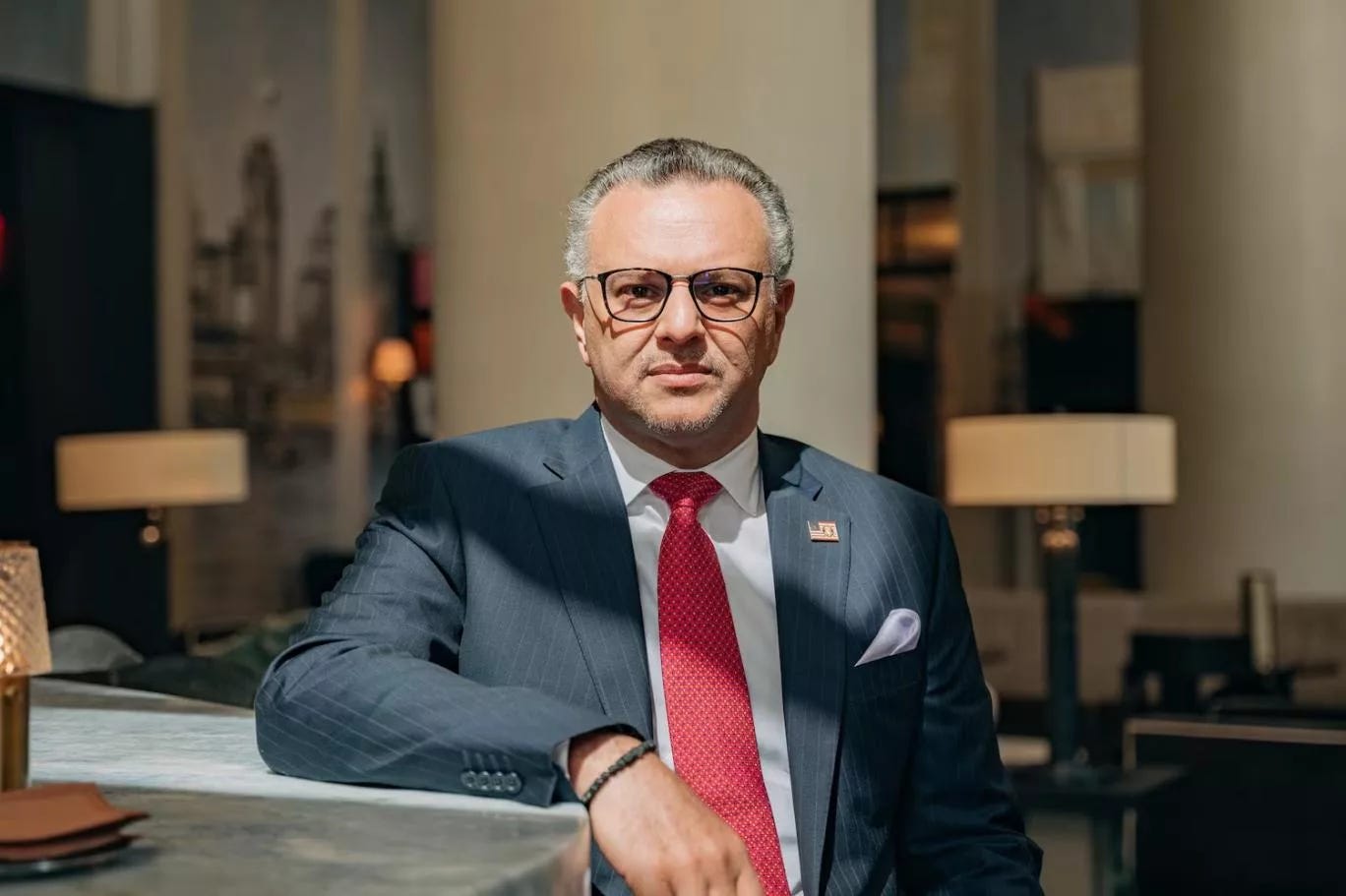
While the administration of U.S. President Donald Trump seeks to grasp the threads of the Sudanese crisis and contain the spiral of fighting that culminated in the tragedy at Al‑Fasher, the name Masaad Boulos has resurfaced at the forefront as one of the key officials reportedly involved with the matter.
The man who officially holds the position of U.S. Special Envoy for African Affairs known as a Lebanese businessman and the president’s son‑in‑law has once again found himself at the heart of a deeply complex political scene, where African maps intersect with the delicate balances of the Middle East.
It was expected that Boulos would advance to the forefront of decision‑making on Middle Eastern issues upon Trump’s return to the White House especially after being promoted in the early days as “the President’s senior advisor on the Middle East.”
Yet despite retaining this ceremonial designation, the reality within the administration showed that the actual role in Middle Eastern files went to Steve Witkoff a move that seemed to respond to Israeli anxieties that Boulos’s Arab background might influence his handling of the occupation‑related dossiers.
Despite the high hopes that accompanied his entry into the administration whether from Arab circles that saw in him a potential channel to influence Washington’s policy, or from American quarters that regarded him as a bridge to a more balanced regional understanding his practical presence has remained limited.
Even in Africa, and especially in the Sudan file, which has become a global hotspot, his level of engagement remains below what one would expect from a figure with such political and familial proximity to the center of power.
Nevertheless, Masaad Boulos remains a player under watch: an official of Arab roots, close to the inner circle at the White House, but still operating in a gray zone between the role he was expected to play and the role he actually occupies in waiting for what the next developments in Sudan and the Middle East will reveal.
From Lebanon to the World via the United States
Masaad Boulos traces his roots to the town of Kfar Hata in the Koura district of northern Lebanon, where he was born in 1971 into an Orthodox family whose members played modest roles in Lebanese politics.
Meanwhile, his own family became involved in the public sphere through his father‑in‑law, a prominent backer of the Free Patriotic Movement.
This intricate Lebanese background, coupled with traditions of public affairs, formed the early environment from which Boulos emerged before his life took a completely different trajectory.
As a teenager, Boulos moved to the state of Texas in the United States, where he completed his high school studies and then university, culminating in a law degree from the University of Houston Law Center.
That period he is told by close associates was a pivotal turning point that opened wide doors to business and the political networks he would later approach.
After graduating, Boulos opted to return to the family business. He later became the CEO of SCOA Nigeria, one of West Africa’s largest conglomerates, specializing in the distribution of automobiles and industrial equipment. Economic reports indicate that the value of this conglomerate exceeds one billion dollars — a fact that made Boulos a significant player in the regional economy, and one of those businessmen who bridged Western expertise with African reach.
But his professional career was not only his gateway to prominence; his personal life also expanded across borders. He married Sara Boulos, a well‑known businesswoman and founder of a theatrical arts association in Nigeria, who holds the license for “Cred International Lagos Island.” They have four children.
This blending of Lebanese, Western, and African milieus gave Boulos a vast social and economic network that later enabled him to navigate complex political spheres with confidence. Professor Habib Badawi, a professor of International Relations at the Lebanese University, describes Boulos’s story as an exceptional model of an “immigrant’s success,” noting that his law studies in Houston, followed by his leadership of a major international company, “contributed to refining his ability to negotiate between different cultures” a skill that allowed him to later become a political connector across multiple worlds.
Entangled Political Attempts in the Lebanese Arena
Boulos’s political presence in Lebanon remains one of the most ambiguous aspects of his career, as he has moved on the margins of Lebanese politics without ever settling into a clearly defined position or reflecting a firm alignment with any particular current.
Although his political beginnings were associated with alliances to the Free Patriotic Movement — leveraging family relations and their ties to Nigeria his trajectory later took different turns as the nature of alignments in Beirut evolved.
In an early phase, Boulos attempted to enter the Lebanese Parliament from the Koura constituency, before withdrawing in favor of a slate that included the Free Patriotic Movement a group that represented his interests in Nigeria when he was overseeing the family business there.
Later on, his political compass shifted toward the camp of Sleiman Frangieh, leading him to find himself close to the “Murrada” movement, a Christian ally of Hezbollah.
Despite this history of shifting alliances, Boulos has been careful to present himself as politically non‑partisan, while at the same time maintaining a network of relationships across most of the Christian sectarian spectrum in Lebanon from groups close to Hezbollah to those who oppose it.
His ability to communicate within a deeply divided political environment is viewed as a sign of a flexible character skilled at operating across traditional fault lines.
This duality reflects a capacity to manage complex balances rarely found in figures who do not hold official state positions a blend of family influence, economic reach, and cross‑sectarian relationships.
Thus, Boulos’s political role in Lebanon never crystallized into a clear political project. Instead, it constituted a reservoir of diverse relations that later enabled him to enter U.S. political circles as a figure capable of understanding Lebanese and regional complexities without being fully aligned with any fixed bloc.
An Arab Face within Trump’s Electoral Machine
The name Masaad Boulos first emerged in American politics with the rise of Trump’s campaign, before later becoming one of the most prominent Arab faces within the election team. During the campaign, Boulos assumed a central role in outreach to Arab and Muslim communities in the United States particularly in critical states such as Michigan, which hosts one of the country’s largest Arab‑American populations.
He leveraged his relationships, background, and Eastern culture to build bridges with voters who felt disillusioned by President Biden’s Middle East policies especially those related to Gaza and Lebanon. It became clear that he succeeded in opening a breach within a constituency that had traditionally leaned toward the Democrats, exploiting deep dissatisfaction that the war on Gaza had stirred among the Arab and Muslim communities.
Boulos offered a simplified address directed at the Arab public, and appeared on major Arab TV channels in the United States and beyond to explain Trump’s vision for the region in terms more palatable to Arab sensibilities.
He did not shy away from defending some of the former president’s controversial decisions; on the contrary, he sought to reframe them politically arguing they were “security measures” misunderstood as policies targeting Arabs or Muslims.
As the election approached, Boulos expanded his role to become one of the central faces of the field campaigns in Michigan, participating in direct meetings with community leaders. He traveled with prominent Republican campaign members to Detroit to open channels with groups of Arabs who had long been neglected in GOP campaigns.
In this way, Boulos transformed from a Lebanese businessman turned-successful African and American entrepreneur into one of the most prominent Arab figures in the 2024 elections a feature rarely seen before in Republican campaign teams.
A Family Gateway into the Heart of Trump’s Circle
Before Masaad Boulos emerged as one of the prominent Arab faces in Trump’s electoral machinery, the marital tie was the turning point that redrew his political trajectory within the Trump circle.
His son Michael Boulos met Tiffany Trump the youngest daughter of the President from his second marriage to Marla Maples during a vacation in Mykonos, Greece.
The relationship quickly developed into a betrothal announced during Trump’s first term, specifically from within the Rose Garden at the White House.
In November 2022, the wedding was held at Trump’s Mar-a-Lago resort in Florida, in a ceremony attended by close associates a symbolic moment that marked the transition of the Boulos family from the realm of journalists and businessmen in Africa and Lebanon to the very core of the most powerful political family in the Republican Party. From that moment, Masaad Boulos’s name began to feature prominently in American political backstage not just as a successful businessman but as part of the family itself.
With the approach of the 2024 elections and the consolidation of the familial bond, Boulos appeared at the forefront alongside Trump before the latter announced his appointment as senior advisor for Arab and Middle Eastern affairs.
The official statement did not reference the marriage directly, but it praised Boulos as “a distinguished lawyer and respected deal‑maker, a staunch proponent of peace in the Middle East” language that suggested Trump wanted to present him as an independent political figure, even while everyone recognized that the family tie had opened the door to this extraordinary influence.
Before this appointment, Trump had revealed in a speech at the Detroit Economic Club that his daughter Tiffany was pregnant making the President soon to become grandfather to a half‑Lebanese child.
Thus the interplay between family and politics became intertwined, and Masaad Boulos’s transformation from Lebanese businessman into a special envoy with broad powers upon Trump’s return to the White House in his second term marked a step that reflected a mixture of familial trust and political calculation within the Republican administration.
A political Role Yet to Be Completed
Since entering the Trump family through marriage, Masaad Boulos began playing informal roles in opening back‑channel communications between the U.S. President and various Middle Eastern leaders.
In the context of Trump’s campaign and decision‑making circles, he became a hidden bridge allowing direct communication with a wide spectrum of Arab actors.
In this context, Boulos met in September 2024 with Palestinian Authority President Mahmoud Abbas on the sidelines of the U.N. General Assembly meetings in New York. Prior to that, in July of the same year, he reportedly conveyed a message from Abbas to Trump, expressing wishes for his safety after an assassination attempt in Pennsylvania.
While these meetings appeared to signal an opening of political engagement, they have not yet translated into a clear or influential role in the Palestinian dossier.
Perhaps Boulos’s first genuine test came with attempts to calm the situation between Israel and Lebanon. Although the initial steps of Trump’s administration in the Middle East focused on consolidating a cease‑fire in southern Lebanon, nothing has emerged publicly to prove that Boulos played the central role in this track despite his Lebanese heritage and the hopes of Arab‑American voters that he would represent their voice in the White House.
In the Sudan file where his role as Special Envoy should have given him a more direct and official involvement his influence remains limited. Although he has taken part in discussions of the international quartet handling Sudan (comprising the United States, Saudi Arabia, Egypt, and the UAE), the proposals he has put forward have not yet reached the level of impact expected in a deeply complex crisis, especially amid rising Saudi pressure urging Washington to move more decisively.
So far, reliance remains on Masaad Boulos’s role in Trump’s second administration as an Arab‑American voice capable of softening certain harsh angles of U.S. policies in the region intersecting with Trump’s ambitions to re-engineer the Middle East based on new calculations rooted in American influence and interests.
But after many months in office without clear steps or tangible impact, the space for expectations has shrunk raising a fundamental question: Will Boulos succeed in transcending the boundaries of his symbolic role as a front-facing Arab envoy to become an effective player in the complex files of the Middle East?
