

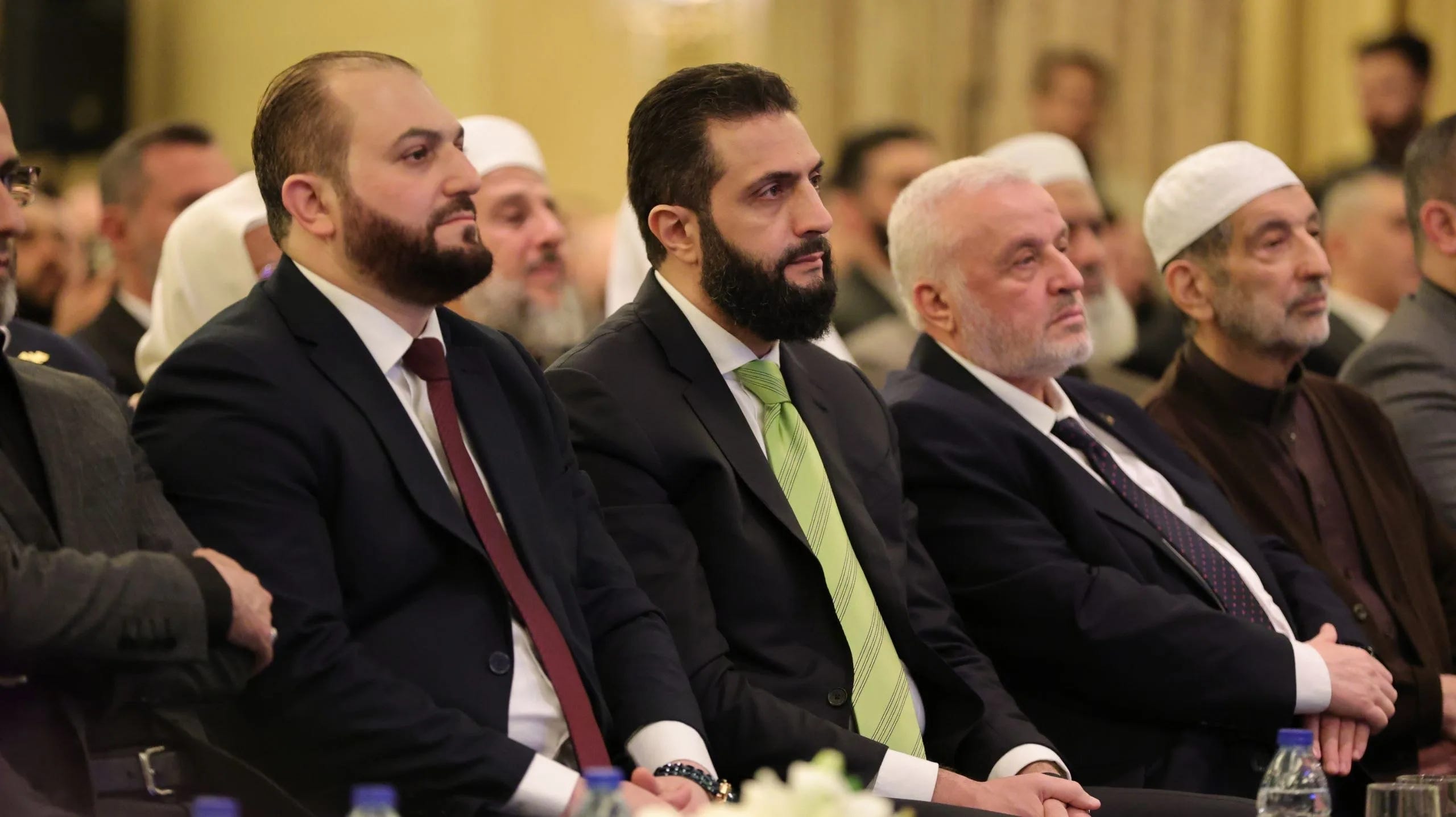
In the transitional period following the fall of Bashar al-Assad’s regime, Syria’s new administration has undertaken a series of government appointments many of which involve individuals linked by kinship, marriage, or complex social networks.
This pattern has emerged across various levels of governance, from the pinnacle of power embodied by President Ahmed Al-Sharaa, down to numerous state institutions.
These appointments come amid a new political and administrative reality, shaped in the wake of ending 53 years of Assad family rule, following the “Deterrence of Aggression” campaign led by military factions, most notably Hay’at Tahrir al-Sham.
The country is now navigating a delicate transition, steered by political figures who previously governed Idlib under the “Salvation Government” and Hay’at Tahrir al-Sham.
President Ahmed Al-Sharaa has been at the helm of this transition. Initially, a three-month caretaker government was formed, followed by the appointment of a 23-member cabinet a critical phase given the legacy of institutional dysfunction, economic collapse, and entrenched corruption from previous decades.
Despite calls for reform, this pattern of appointments persists without clear public criteria or transparent selection mechanisms. Information about these roles has surfaced through leaked images from official visits, congratulatory social media posts, or unofficial media sources.
This report examines several cases where relatives of top officials have been appointed to public office. While familial ties alone do not necessarily indicate corruption, their prevalence raises questions about favoritism, legality, and the risks of prioritizing bloodlines over qualifications.
From the Presidency to Municipal Councils
After serving as acting Minister of Health in the caretaker cabinet, Maher Al-Sharaa, 53, the president’s brother, quietly assumed the post of Secretary-General of the Presidency in April 2025 without any formal announcement.
Maher had previously worked as a senior advisor to the Minister of Health in the Salvation Government in Idlib, a position he took in 2022. His appointment was controversial at the time, as he had worked in regime-held areas until 2020, which conflicted with Salvation Government directives.
A gynecologic surgeon by training, Maher holds a PhD in medical sciences and a diploma in health systems management.
Another of the president’s brothers, Hazem Al-Sharaa, 51, accompanied him on his first official visits abroad to Saudi Arabia and Turkey in February 2025, despite holding no formally announced government post. His role became gradually clearer:
On July 24, 2025, a Reuters investigation revealed that Hazem was covertly overseeing the restructuring of Syria’s economy. His responsibilities included managing acquisitions of major firms, dismantling the Assad-era economic network, and seizing over $1.6 billion in assets from businesses previously linked to the regime.
On December 5, 2025, Hazem appeared in a photograph onboard a flight to Saudi Arabia alongside Safwat Raslan, Director General of the Syrian Development Fund, and Talal Al-Hilali, Director General of the Syrian Investment Authority.
On December 15, 2025, the Qatari Businessmen Association publicly named Hazem as Vice President of the Supreme Council for Economic Development the first formal acknowledgment of his role by a non-Syrian entity.
The council, established by Decree No. 115 of 2025 and chaired by President Ahmed Al-Sharaa, includes 16 members—eight of whom are ministers. Its mandate is to stabilize and stimulate the economy, develop an investment strategy, and chart a national economic map.
Hazem holds a doctorate in economic and legal sciences from the Egyptian-American International University, a master’s degree in law from the same institution, and a law degree from the University of Damascus.
Following the regime’s collapse, Maher Muhammad Marwan Idlabi a native of Damascus and the brother-in-law of the president’s wife was appointed governor of the capital. Idlabi had held several positions in the Salvation Government, including Vice Minister of Religious Endowments, member of the Supreme Judicial Council, and Chairman of the General Zakat Authority.
In September 2025, Ayman Abu Qasra, brother of Syrian Defense Minister Marhaf Abu Qasra, was named director of the Jarablus border crossing with Turkey. No official statement was issued by the border authority or the General Authority for Land and Sea Ports, nor was a biography made available. Activists noted that his prior experience in a rural hospital laboratory bore little relation to his new administrative role.
In January 2026, engineer Abdullah Al-Alabi brother of Syria’s ambassador to the UN, Ibrahim Al-Alabi was appointed chairman of the Syrian Industrial Bank. Abdullah also serves as an advisor to the Minister of Communications for robotics and smart systems. He holds an executive MBA and a software engineering degree from the American University of Sharjah and has founded several companies, including Tulip in Riyadh.
Meanwhile, Raafat Hassan, brother of Foreign Minister Asaad Hassan Al-Sheibani, heads the Arab Advertising Organization. Official documents list his name without the family surname “Al-Sheibani.” He appeared publicly only once, in a photo published by the Qatar Media Corporation during a July 7, 2025, visit.
“Nun Post” was unable to verify the familial link through additional sources, though the Syrian Heritage Protection Society noted in November 2025 that Raafat Al-Sheibani, described as the foreign minister’s brother, joined an official delegation to heritage conferences in Lausanne and Naples despite lacking relevant credentials or official employment at the Directorate of Antiquities.
After Assad’s fall, Muhammad Bara Shukri, son of Minister of Religious Endowments Muhammad Abu Al-Khair Shukri, quickly rose through the ranks at the Ministry of Foreign Affairs. He was appointed Director of Consular and Expatriate Affairs in January 2025, then Director of European Affairs in May, and Acting Ambassador to Germany in January 2026. Shukri holds a BA and an MA in political science and international relations from Istanbul Sabahattin Zaim University.
Abdul Basit Abdul Latif, cousin of Justice Minister Mazhar Al-Wais, was named chair of the newly created National Transitional Justice Commission under Decree No. 20 of 2025. A former Secretary-General of the Syrian National Coalition, Abdul Latif holds a law degree from the University of Aleppo.
Local Networks and Family Ties
A journalist from Deir Ezzor told “Nun Post” that several officials in the province are related but added that their appointments haven’t sparked backlash partly because many of them are viewed as competent or revolutionary veterans. He cited Khalil Abdul Munim Al-Ayyoub, director of the Al-Mayadin district, and his cousin, Yaqub Al-Ahmad Al-Ayyoub, head of the city council. General Intelligence Director Hussein Al-Salama is reportedly a cousin of Foreign Ministry official Yusuf Al-Hajjar, though this couldn’t be independently verified.
In Daraa, two sons of Governor Anwar Al-Zoubi—Jaafar and Suhaib—frequently accompany him to official meetings, including some held inside the governorate’s headquarters, despite having no declared roles. In April 2025, a viral video showed Jaafar blocking a citizen from filming a public meeting, identifying himself as the “Governorate’s media representative” a claim that stirred anger and condemnation.
Elsewhere in Daraa, lawyer Abdul Munim Faleh Al-Khalil was appointed to lead media affairs for the governorate’s media directorate, while his son worked in a separate office within the same department.
Al-Khalil was later appointed head of the legal affairs directorate, with his son remaining in the media directorate. No formal policy was released regarding these appointments or how to separate professional roles from familial affiliations.
Fragile Governance and Transition Constraints
The new Syrian administration has made some early efforts to combat corruption. The finance minister revealed during the caretaker period that of the 1.3 million public employees, only 900,000 were actively working, while the remaining 400,000 were so-called “ghost employees.” Tens of thousands were dismissed pending investigation.
In February 2025, President Al-Sharaa declared that appointments would not be based on political favoritism, and that merit would be the key criterion. This was followed in May by Decree No. 45, which established a formal system for executive-level appointments outlining nomination criteria and performance evaluation mechanisms aimed at institutional stability and transparency.
The president also urged officials to disclose financial interests and prohibited them from engaging in private business with entrepreneurs, signaling a desire to break with the Assad-era norms.
Some ministries and agencies such as the General Authority for Radio and Television and the Ministries of Information and Foreign Affairs now publish open job postings with clearly defined qualifications. The Ministry of Administrative Development also periodically posts vacancies with transparent competition guidelines.
In one case at the Bab al-Hawa border crossing with Turkey, a customs agent was required to choose between keeping his job or allowing his son to continue working at the same site, due to internal rules prohibiting relatives from being employed at the same location.
“Nun Post” contacted Mazen Alloush, Director of Public Relations at the General Authority for Land and Sea Ports, to inquire about hiring policies and whether family relations are considered. No response was received as of publication. The same applies to inquiries sent to the Ministry of Administrative Development regarding appointment mechanisms.
Despite these reformist signals, recent appointments continue to draw criticism, either for perceived incompetence or for their familial nature. Leaked lists of new diplomats include Mohammad Bara Shukri (Germany), Mohammad Qanatri (United States), Mohsen Mehbash (Saudi Arabia), Mohammad Al-Ahmad (Egypt), Iyad Hazaa (Lebanon), Zakaria Lababidi (China), and Ashhad Salibi (Afro-Asia Affairs).
Legal Ambiguity and Awaiting Parliamentary Oversight
More than eight journalists and government officials confirmed to “Nun Post” that several appointments were made through personal endorsements based on familiarity with an individual’s past performance or revolutionary record.
Such practices—especially when disclosed through unofficial leaks—raise legal and ethical questions, particularly in a period aimed at establishing rule of law and institutional integrity.
Legal scholar Dr. Ahmad Qarbi argues that the transitional government’s appointment mechanisms deviate from the old legal frameworks, which he believes were implicitly annulled by the revolution.
“The old laws are void if they conflict with revolutionary goals,” Qarbi said, adding that trust remains a valid criterion during political transitions, though it must gradually be paired with competence.
He emphasized that Syrians have the right to question and criticize appointments, a right enshrined in the interim constitutional declaration. The government, in turn, has the right to make decisions as long as they balance public interest with executive authority.
Qarbi maintained that leaked appointments are not problematic if the appointee meets minimum qualifications, but emphasized that accountability will only become meaningful after the formation of a national parliament empowered to conduct hearings and investigations.
