

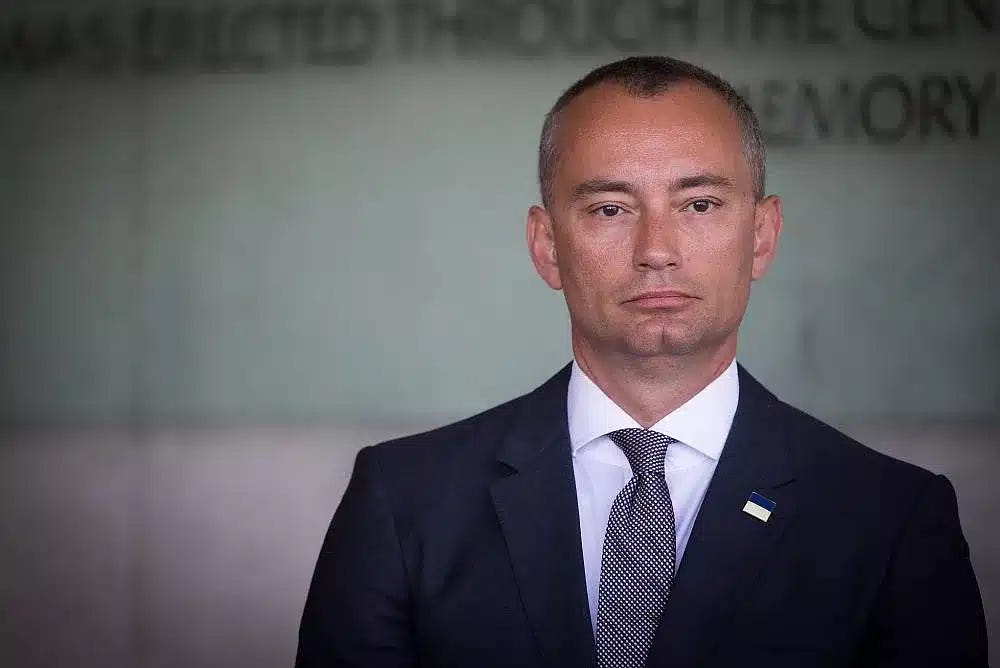
In an intensely complex political moment where arrangements for the “day after” in the Gaza Strip intersect with tangled regional and international calculations sources have revealed to Axios the emergence of Nikolay Mladenov as one of the strongest candidates to assume the position of representative of the “Peace Council” on the ground in Gaza.
He would work with a future Palestinian technocratic committee as part of what is being promoted as a pathway for reconstruction and stability.
This nomination is not merely an isolated administrative detail or a technical option; it reflects directly the crisis of choices facing the United States and its allies in managing the post‑war phase, and the failure of attempts to impose more controversial figures most prominently former British Prime Minister Tony Blair.
It also fundamentally reflects an international insistence on reproducing an approach that manages conflict rather than dismantling it, using new tools and familiar faces.
Returning Mladenov’s name to the forefront raises deeper questions than mere biography and career path: Why is a figure associated with managing ceasefires in Gaza being recycled now?
What makes him a candidate to play a central role in one of the most complex stages of the Palestinian issue? Are we witnessing an attempt to adapt wartime realities into new international frameworks, or the reproduction of an old model in a new guise?
Early Life and Education
Nikolay Mladenov was born on May 5, 1972, in Sofia, the capital of Bulgaria, and grew up in a central urban environment within a country that was then still part of the socialist bloc, before entering a period of political and economic transformation with the collapse of the Eastern bloc in the early 1990s.
Educationally, Mladenov received his foundational academic training in Bulgaria, graduating in 1995 from the University of National and World Economy with a degree in international relations.
In 1996, he continued his postgraduate studies in the United Kingdom, earning a master’s degree in war studies from King’s College London, one of the foremost academic institutions specializing in security and military studies.
This academic path reflects a clear blend between classical diplomatic‑political study on one hand, and a security‑military approach to conflicts on the other a combination that would later become evident in his professional career, especially in his dealings with conflict zones.
Politically, Mladenov belonged to the dominant current in post–Cold War Bulgaria, a conservative liberal stream that supports full integration into the Western system, particularly the European Union and NATO.
He was not known for intense ideological engagement or agitational political rhetoric; rather, his public presence focused on security, stability, and institution‑building priorities that would accompany him throughout his later political and diplomatic career.
Political Engagement in Bulgaria and European Trajectory
Mladenov’s actual political engagement in Bulgaria began amidst the transformations the country underwent after joining the European Union, specifically through the Citizens for European Development of Bulgaria (GERB) party, a center‑right conservative liberal party that led Bulgaria’s political and security integration into the European‑Atlantic system.
In 2007, Mladenov was elected a Member of the European Parliament, his first prominent political position at the supranational level. During his tenure (2007–2009), he served on committees concerned with foreign policy and security, focusing on EU security files, the Eastern Neighborhood, and common defense policy.
This experience provided him with direct exposure to European decision‑making mechanisms and entrenched his position within the political and diplomatic network in Brussels.
After returning to Bulgaria, he was elected in 2009 to the Bulgarian Parliament, where he chaired the Foreign Affairs Committee and played a role in shaping Bulgaria’s foreign policy directions particularly regarding relations with the EU, NATO, and regional security issues.
During this period, he was known for his clear commitment to reinforcing partnership with the West and active engagement in common European policies.
In 2013, Mladenov was appointed Bulgaria’s Minister of Defense during a period marked by internal and regional sensitivity in light of tensions in Eastern Europe and the repercussions of the Ukrainian crisis.
During his tenure, the government’s defense policy concentrated on strengthening defense cooperation with NATO, modernizing military capabilities, and aligning Bulgaria’s defense policies with Atlantic standards, consistent with Bulgaria’s commitments within the alliance.
In 2014, Mladenov became Minister of Foreign Affairs, a post that afforded him a broader presence on the international stage. Bulgaria’s foreign policy under his leadership featured key elements such as consolidating Bulgaria’s position within the EU, supporting European expansion in the Balkans, enhancing partnership with the United States, and adhering to the EU’s unified policies on international security files.
Overall, his political career in Bulgaria whether in parliament or the executive was marked by clarity in supporting Euro‑Atlantic integration, a focus on security and stability, and working from within institutions rather than outside them.
These attributes, together with his early European experience, later paved the way for his transition to international work within the United Nations system as a political figure experienced in complex security and diplomatic files.
International Roles and Engagement in the Middle East
After leaving the Bulgarian government in 2014, Mladenov moved into international work through the United Nations, reflecting his shift from national politics to managing complex international files. In the same year, he was appointed UN Special Coordinator in Iraq and Head of the United Nations Assistance Mission for Iraq (UNAMI), during a phase marked by wide security and political turmoil alongside the expansion of ISIS and the weakening of state authority in parts of the country.
In this role, Mladenov undertook coordination and political tasks under the UN’s mandate, including supporting the political process, liaising with the Iraqi government and international powers, and overseeing the mission’s work in an open conflict environment. This experience was a critical chapter in his international career, cementing his presence as a diplomat dealing with crises that combine security and political dimensions.
In 2015, the UN Secretary‑General appointed him as Special Coordinator for the Middle East Peace Process and Head of the United Nations Office for this file, a position he held through 2020.
Under this mandate, he became the UN’s official representative on the Israeli‑Palestinian conflict, responsible for reporting regularly to the Security Council and working within the UN’s mandate to manage the file.
His new position involved supervising a UN team operating between Jerusalem, Ramallah, and Gaza, coordinating with relevant international and regional parties under the traditional UN role in the peace process without executive powers or independent leverage.
His tenure came at a time marked by complete political stalemate and a real decline in the role of the political process amid escalating field and humanitarian challenges.
It is worth noting that Mladenov’s involvement in Middle East issues was neither incidental nor merely the product of UN appointments; it dated back to his membership in the European Parliament (2007–2009), where he participated in European parliamentary delegations that visited Iraq, Afghanistan, and the occupied Palestinian territories.
This exposure allowed him to engage directly with diverse conflict environments and understand the complexities of security and political files in the region, laying an early foundation for his engagement with Middle East issues from a European‑international perspective.
In addition, Mladenov held other international roles beyond governmental and parliamentary frameworks, including work with the World Bank in contexts related to development and institution‑building in post‑conflict countries.
His Role in the Palestinian File: “Edge Management” and the Limits of the UN Role
Mladenov’s tenure as the UN Special Coordinator for the Middle East Peace Process (2015–2020) became a clear example of what can be described as “edge management” in handling the Palestinian file meaning a continuous effort to prevent large explosions without approaching the political roots of the conflict.
From the moment he was appointed, Mladenov confronted a closed political scene: stalled negotiations, deep Palestinian division, an Israeli government uninterested in any political track, and an international community practically withdrawing from investing in the idea of a settlement.
However, this reality was not the only factor that constrained his role. His appointment occurred in a Palestinian environment that did not view international envoys with trust from the outset, due to accumulated previous experiences that reinforced the belief that these roles albeit to varying degrees favored the Israeli occupation.
In this context, Palestinian factions early expressed rejection of his appointment, considering his leadership of the settlement coordination to be antithetical to any genuine effort for a just peace, and they accused him of intersecting with the occupation and justifying its crimes, based on his past positions while serving as Bulgaria’s foreign minister.
This position was neither exceptional nor isolated, but reflected a structural Palestinian skepticism toward the very nature of the UN role which often seemed incapable of playing a balanced part or genuinely applying political pressure on the occupation.
Accordingly, Mladenov was not seen as different, but as a continuation of an international course focused on managing the consequences of occupation rather than confronting it.
Practically, Mladenov’s field presence in the Gaza Strip viewed as the most fragile and explosion‑prone arena was marked by his involvement in crafting unwritten ceasefire understandings under Egyptian–Qatari mediation and with UN backing.
These aimed to halt cycles of escalation and prevent a slide into full‑scale war. This approach relied on specific tools, most notably partial economic facilitation, financial inflows, and limited humanitarian improvements, presented as practical substitutes for the absence of a political horizon.
Although this approach succeeded temporarily in stabilizing the security rhythm, it entrenched the equation of “calm in exchange for facilitation” without any real addressing of the fundamental causes of explosion primarily the siege, occupation, and absence of political rights.
This transformed calm into an end in itself rather than a gateway to a political track, rendering Gaza a humanitarian‑security file managed independently from the broader Palestinian national context.
This model aligned closely with the approach adopted by successive Israeli governments, particularly that of Prime Minister Benjamin Netanyahu, which focused on managing rather than resolving the conflict and imposing realities on the ground while continuously maintaining Palestinian political division.
From the occupation’s perspective, calm was not a means to end the conflict, but a tool to securitize Gaza and neutralize it politically using economic facilitation as a functional replacement for rights.
Within this framework, Mladenov’s approach did not clash with this Israeli vision; it intersected with it in essence, even if the rhetoric differed.
The UN role as practiced under him was limited to containing outcomes rather than dismantling causes, managing the crisis rather than altering its rules reflecting the limits of the international mandate and the constraints of the UN system itself, which lacks real pressure tools and operates within a low political ceiling imposed by international power balances.
Nevertheless, it cannot be denied that Mladenov represented for the United Nations a key communication channel in moments of danger a figure capable of moving swiftly between capitals and actors, and coordinating urgent interventions to avert explosion.
Yet this field efficiency came at the cost of the political dimension and contributed to prolonging crisis management rather than approaching its resolution.
In this sense, Mladenov’s experience cannot be reduced to being a “failed” or “successful” envoy, but rather as an embodiment of a broader international approach to the Palestinian issue that prioritizes temporary security stability over serious political tracks and manages conflict instead of seeking to dismantle it.
Why Is Mladenov Being Recycled Now?
The name Nikolay Mladenov did not surface suddenly; rather, it emerged as the alternative option after the stumbling of a candidate strongly discussed in international backrooms former British Prime Minister Tony Blair.
Blair was put forward early as the most likely candidate to assume the pivotal role in the “Peace Council,” but this proposal quickly encountered widespread Palestinian rejection and clear Arab and regional reservations, given his political record and his role in the US wars in the Middle East and the enormous human cost associated with them.
The objections were not limited to Blair’s past support of and political involvement in the Iraq and Afghanistan wars; they extended to his subsequent role as envoy of the Quartet, where he was viewed as a partner in engineering a security‑economic approach that aimed to dismantle the structure of the Palestinian uprising, contain resistance, fully side with the Israeli narrative, and undermine the outcomes of Palestinian elections treating Palestinian democratic legitimation through a security rather than political lens.
This background rendered his name unmarketable, both popularly and politically, in any sensitive Palestinian or regional setting.
Faced with this rejection, the United States found itself compelled to seek an alternative that was relatively more acceptable in terms of the ability to operate within the complex Palestinian scene without direct provocation.
Here, Mladenov’s name returned to the forefront seen as a figure less symbolically confrontational and more practically engaged with the details of the Palestinian scene in recent years, with direct field experience in handling sensitive files, especially in the Gaza Strip.
During his previous tenure, Mladenov was distinguished by his ability to deal with Hamas through indirect channels and precise approaches aimed at neutralization rather than confrontation, in coordination with regional mediators especially Egypt and Qatar.
From the American perspective, this made him a suitable candidate to play an executive role in a complex phase that requires managing contradictions more than presenting solutions.
In this context, Mladenov is not seen as someone with an independent political vision, but as an operational tool capable of translating the provisions of US President Donald Trump’s 20‑point initiative and UN Security Council Resolution 2803 into actionable programs on the ground. This task is extremely complex given the wide interpretive gaps among different parties:
Palestinians, the three mediators (Egypt, Qatar, and Turkey), the group of eight Arab and Islamic states most involved in the file contrasted with the Israeli vision aimed at cementing war outcomes and reproducing them through political and security tools and the American vision strategically aligned with Israel but also seeking relative calm that can be marketed as a success for the Trump administration in addressing one of the region’s most volatile flashpoints.
Within this intricate landscape, Mladenov is presented as a maestro capable of managing these contradictions without openly aligning with any party, preventing the collapse of the cease‑fire arrangement, ensuring minimum Israeli security interests, and meeting the American need to move the “Peace Council” and “International Force” from conceptual designs to practical implementation.
He is also expected to manage the complex relationship between the proposed international body and any local Palestinian administration in Gaza, under a model based on control rather than sovereignty.
In this sense, recycling Mladenov does not reflect confidence in his ability to produce a political solution as much as it expresses a crisis of choices within the United States and its allies indeed a renewed search for a figure able to manage an extremely fragile stage and prevent the collapse of transitional arrangements, even if that comes at the expense of major questions related to justice, rights, the roots of conflict, and a serious political track toward a Palestinian state.
