

At a historical moment when the contours of a new Syria are beginning to take shape and as the country reexamines its cultural and intellectual roles after years of stagnation and political subjugation the question of the relevance and role of cultural institutions, particularly the Arab Writers Union, has once again come to the fore.
What role can the Arab Writers Union play today? Is it enough for it to remain a traditional syndicate, or has the current period thrust upon it broader responsibilities ones that involve fostering civic dialogue, connecting writers and intellectuals inside and outside the country, and contributing to a cultural vision aligned with the social and political transformations underway?
These questions are increasingly urgent as institutions shift and as writers renegotiate their relationship with the public sphere and with the very idea of freedom.
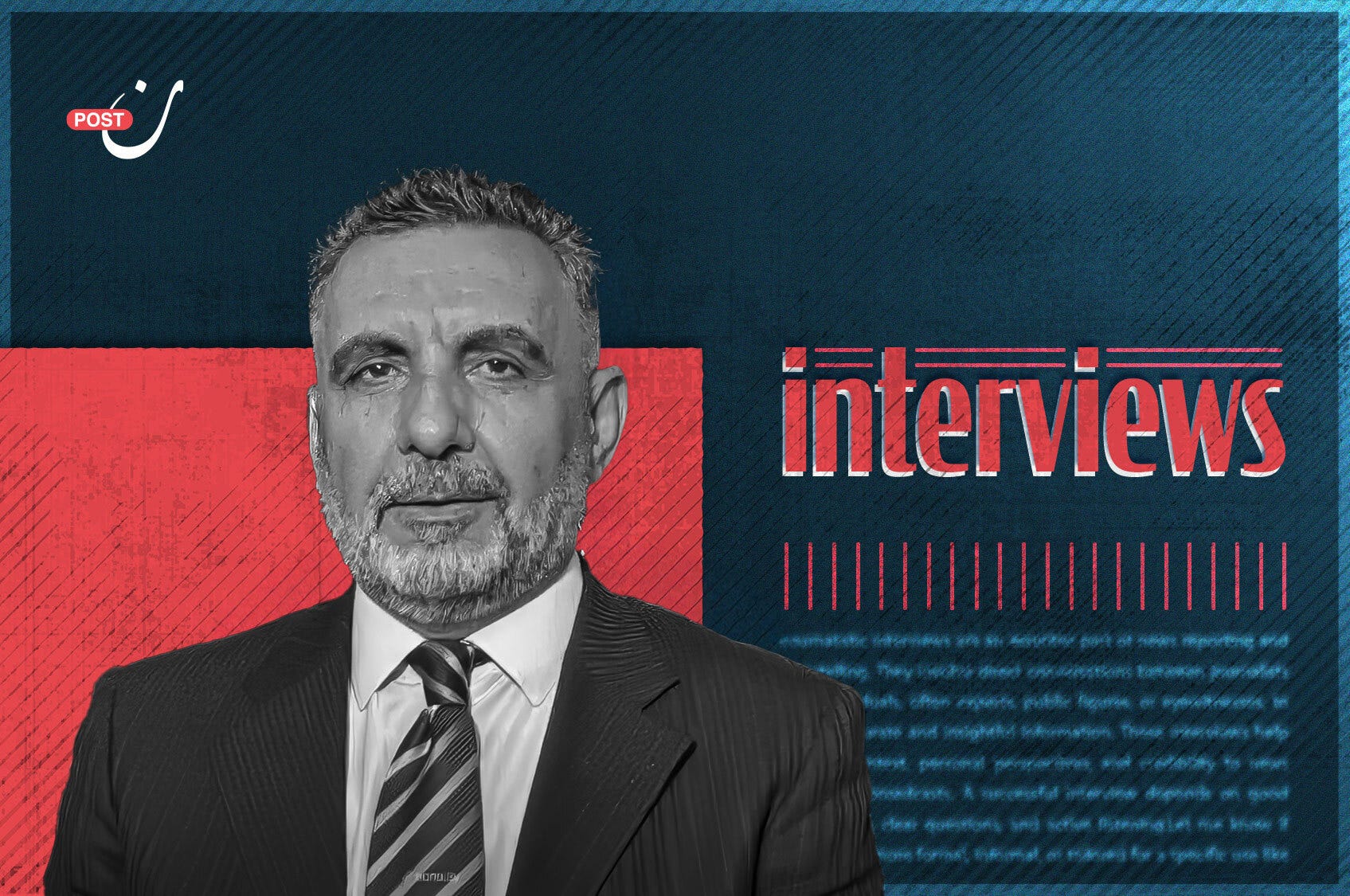
In this exclusive interview with Noon Post, Dr. Ahmad Jassem Al-Hussein, the president of the Arab Writers Union, shares his vision for the organization’s future. He speaks about redefining the Union’s role, its relationship with Syrian writers at home and abroad, the current boundaries of creative freedom, and the evolving role of intellectuals in a period of transition.
He also discusses the Union’s concrete steps toward internal restructuring, publishing and translation projects, and support for young writers an effort to move beyond a heavy legacy and build a new, meaningful cultural institution.
Ahmad Jassem Al-Hussein is a Syrian writer and literary critic. He holds a PhD in modern literature and criticism from the University of Damascus. Over the years, he has held several academic and cultural posts, including teaching in the Arabic Department at the University of Damascus and serving as Dean of the Faculty of Arts at Al-Furat University in Hasakah.
He currently heads the Arab Writers Union in the emerging Syria and has published several works in literature, criticism, and textual editing.
What definition do you think best suits the role of the Arab Writers Union today? Should it remain merely a cultural syndicate, or has the current moment placed wider responsibilities upon it?
Syria today truly, in every sense is redefining itself. It is rediscovering its strategies and formulating new policies and visions. It’s clear that organizations, unions, and syndicates cannot remain as they were. Those earlier structures existed primarily to serve a dictator, a single party, and outdated strategies that no longer apply.
Moreover, the world itself has changed. Organizations now play communicative and representative roles and reflect the dynamics of civil society in each country. From this perspective, the Arab Writers Union should not be limited to a professional or cultural body—it must become a space for dialogue and discussion, a platform for exploring new horizons for Syrian society and the new Syrian state.
This places a great responsibility on the Union one that first requires vision from those who work within it, and second, acceptance from society and the authorities of the role it can play. That role should not be confined to the Union’s headquarters in Damascus but must extend to all provinces, so that the Arab Writers Union becomes a hub for dialogue, ideas, and policy proposals aimed at decision-makers.
All of this requires a redefinition of the Union’s role not only by its members and staff but also by society and the state because we are now speaking about civil society, about promoting dialogue, discussion, and democracy. The Arab Writers Union can be one of the gateways to realizing these aspirations.
How would you describe the Union’s current relationship with Syrian writers and intellectuals, both inside the country and abroad? What steps are necessary to rebuild trust and reestablish an inclusive, effective presence?
The Arab Writers Union has accumulated symbolic weight over the years, a symbolism shaped by two opposing forces: on the one hand, it represented Syria’s intellectual and literary community; on the other, it was seen as an emblem of the previous regime’s authority.
Reclaiming this symbolic stature and building a meaningful presence requires action on both sides. The Union must modernize its legal framework, revise its membership processes, and improve communication channels. Meanwhile, writers outside the Union or outside Syria should approach it with fresh eyes and contribute to its evolution, offering ideas to shed the residue that has built up over the years.
Today, there are still many divisions pulling Syrians in different directions. That’s why we, writers and non-writers, members and non-members, intellectuals and citizens alike, need to extend our hands to one another in search of common ground.
Through this platform, I want to emphasize that the doors of the Arab Writers Union are open to communication, discussion, development, and any initiative that activates its role and transforms it into a true space for cultural convergence.
What can the Arab Writers Union do today to ensure freedom of expression and creativity in the new Syria? How can it become a safe space where writers can express themselves freely and create without fear?
To be transparent, there are currently no banned books in Syria. The country today offers a safe space for freedom of writing and media, but that freedom needs a legal framework. It can’t be left without boundaries it must operate within clear mechanisms.
The Ministry of Information is preparing a code of ethics expected to be released soon. At the Arab Writers Union, if any member faces a situation that affects their freedom to write be it a book ban, a summons, or anything else we stand by them once we are informed and communicate with the relevant authorities. So far, there have been no genuine cases of censorship.
The very concept of banning has become outdated. In today’s digital age, a writer can publish anything online. Censorship is now a relic of the past. A wise authority allows space for expression—but with that space comes responsibility.
Writers must not engage in hate speech or promote racism or sectarianism. These concerns can be addressed through a writers’ or publishers’ code of ethics, ensuring that cultural discourse does not become a burden on society or a tool for destruction.
Freedom does not mean the right to insult or undermine any social, intellectual, or ethnic group. From this standpoint, freedom of expression and creativity in today’s Syria is wide open. Everyone can express themselves—so long as they respect the dignity and identity of the Syrian “other.”
The old-style censorship is over. The Arab Writers Union no longer plays that role. Manuscripts are now handled by the Ministry of Information, which, to the best of my knowledge, is quite open. Very few books are rejected. If any passage raises questions, the ministry engages with the author in dialogue.
I’ve personally witnessed these exchanges they were cordial and constructive. Occasionally, a writer might revise a page or two to avoid sparking societal tensions.
What role do you believe Syrian writers and intellectuals should play today? How can they become active contributors to this new cultural phase?
We are finalizing a document at the Arab Writers Union that members will sign. It emphasizes that writers must not contribute to the destruction of Syrian society, nor promote military solutions that endanger the social fabric or the state’s structure. We want writers to be advocates of citizenship, democracy, and civil society.
Our core reference points are human rights, the vision for a new Syria, and the promotion of civic values and national belonging. Syria has always been a place of diverse peoples and cultures.
Today’s writers must rise above old wounds, call for accountability and cultural transitional justice, and seek common ground in Syrian society, human rights, and new visions for a democratic civil state. We need voices that promote peace, harmony, and connection.
What is your strategic vision for the Union in the coming phase? Are there plans for a structured cultural agenda that extends over the years?
Yes, we have both plans and projects. We restructured the Arab Writers Union through a committee of legal and professional experts and transformed it into an institution. For many years, the Union was a vehicle for ideological production and the buying of loyalty.
Today, it has become an institution governed by international standards with clear departments, functions, and mandates. Cultural work cannot thrive without a well-structured foundation. That process took nearly three months and now enables us to transition into actual cultural production.
In 2026, we have a series of Arab and international events planned regular forums where we will host Arab and global writers, alongside strong participation from Syrian authors.
We also have thematic gatherings in the works on writing in exile, state-building, and the narratives of displacement. We will announce them successively. Now that our internal structure is in place, we can carry out impactful and meaningful activities with real cultural and media weight.
Do you have specific projects to reinvigorate publishing and translation, and to create opportunities for young writers both inside and outside Syria?
In terms of publishing, we are finalizing the licensing of a new publishing house. Historically, much of the Union’s publishing activity was driven by favoritism or involved books of questionable quality. Today, the new publishing house will operate according to market standards. It will have a clear vision, support outstanding writers with serious intellectual contributions, and engage in translation projects from various global cultures.
As for young writers, we are launching two major initiatives: an academy for teaching writing, which will begin offering courses soon, and specialized writing programs. We also have awards planned to be announced by year’s end, once all arrangements are complete. In short, any young writer with a strong manuscript will find a home in the Arab Writers Union.
What message would you like to send to Syrian writers as they enter a new chapter in the country’s cultural history?
I believe no one today is stopping Syrian writers from playing their role. And if they remain absent from the scene, others will fill the void. Syrian writers must raise their voices, shed fear, and say clearly: “I am here.” Silence is not an option.
The space for expression is open to everyone. Every writer has their own platform now. No authority suppresses speech or imprisons writers for their views.
There is no publisher holding power over you, no media gatekeeper silencing you. There are no more excuses for Syrian writers to avoid the public sphere.
We are living through a rare historical transition moments like these often give rise to writers, thinkers, and visionaries. If you have something unique to offer, the door is open.
The ball is in the writer’s court. It is time to present bold, human-centered ideas to help build a better state and society. Digital publishing is open and free just share your voice and your vision. The stage is yours.
