

Amid sweeping political and military shifts reshaping the map of northeastern Syria, Hasakah province is undergoing a painful transition toward a new reality one governed by fresh understandings between the Syrian government and what remains of the Syrian Democratic Forces (SDF) militia.
In practical terms, the SDF has reverted to its pre-2015 core structure: the Kurdish People’s Protection Units (YPG), following major defeats it recently suffered in Deir ez-Zor and Raqqa.
These understandings, reached under intensive international and regional sponsorship to avert a military confrontation, aim to close the penultimate chapter of Syria’s prolonged administrative and military fragmentation an outcome of the January 18 agreement.
At the same time, they raise pressing questions about the agreement’s durability and the consequences of its potential failure, foremost among them the future of coexistence among local communities in northeastern Syria and the nature of sovereignty in the region.
Hasakah and Qamishli: The Epicenter of Events
On Monday and Tuesday, February 2 and 3, the cities of Hasakah and Qamishli experienced an atmosphere of extreme tension and anticipation. Qamishli’s streets were transformed into a ghost town after the SDF announced a total curfew via loudspeakers, warning residents that any movement would be met with “direct targeting,” particularly in Arab neighborhoods. Snipers were deployed on rooftops in the Tayy and Zunoud districts, as well as atop schools and hospitals.
Simultaneously, internet services both satellite and the local Rcell network were cut across Hasakah province, while electricity was severed from large swaths of Hasakah city. Bakeries were also shut down in the Ghuwayran neighborhood.
On the same day, SDF forces carried out mass arrest campaigns in Hasakah, detaining dozens of Arab residents, including children, after they went out to welcome convoys of Syrian internal security forces entering the city. According to local sources, the arrests were accompanied by racist insults and physical abuse.
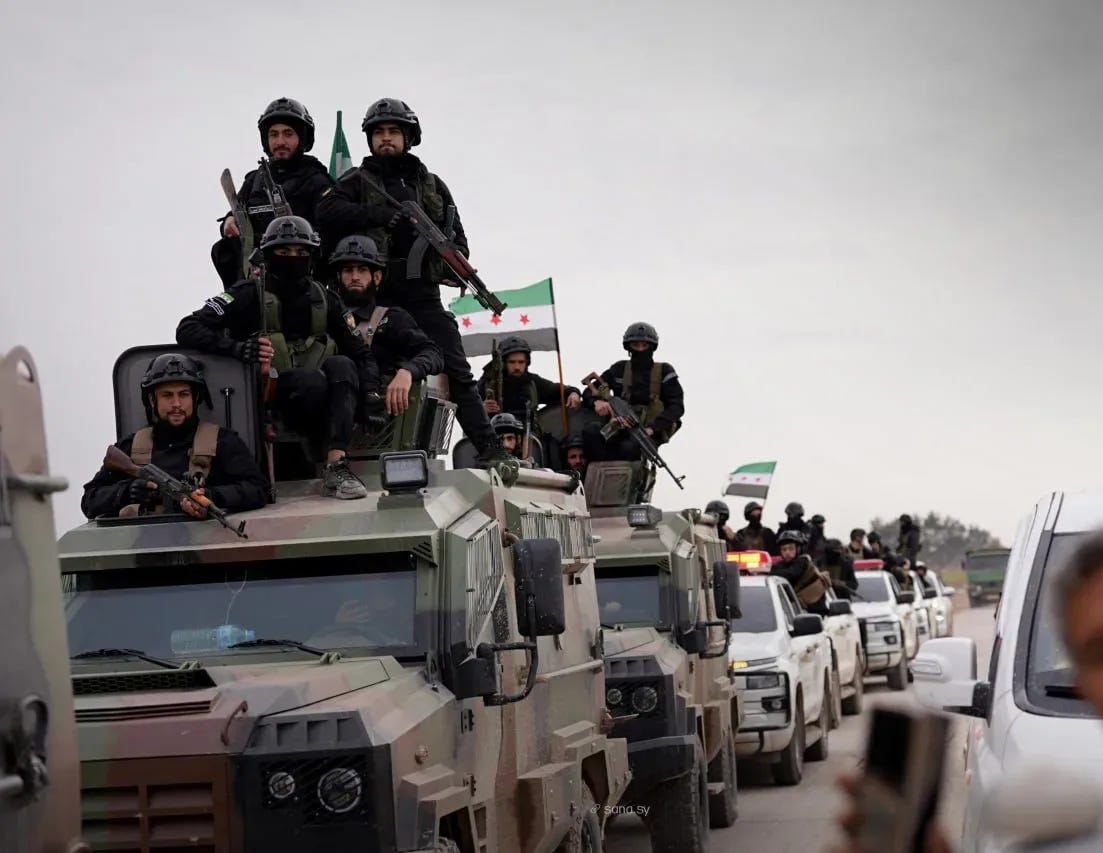
Convoys from Syria’s Ministry of Interior approximately 15 armored vehicles carrying around 100 personnel per city entered both Hasakah and Qamishli, deploying to security squares and government institutions as an initial step toward assuming security responsibilities in the province.
January Agreements: A Roadmap for Institutional Integration
The current developments are grounded in a series of understandings signed between the Syrian government, led by Ahmad al-Sharaa, and the SDF leadership. These understandings have since unraveled, leaving behind only the militia’s true backbone fighters of the Kurdish YPG/YPJ. The key provisions can be summarized as follows:
Military and security integration: SDF fighters are to be merged into a Syrian army division composed of three brigades, with a fourth brigade dedicated to the Ain al-Arab (Kobani) forces under a division administratively affiliated with Aleppo province.
Security forces integration: The Asayish forces are to be incorporated into Syria’s Ministry of Interior.
Institutional handover: The Syrian government is to assume control of all institutions in city centers, including traffic police.
Demilitarization: Armed manifestations are to be removed, with the army withdrawing to military barracks outside cities and dismantling checkpoints in residential neighborhoods.
Administrative integration: Institutions of the so-called Autonomous Administration are to be merged into state structures, with guarantees for civilian employees’ rights and job security.
Civil and cultural rights: Kurdish civil and educational rights are to be settled, ensuring recognition of cultural specificity within the framework of national sovereignty.
Appointments: A governor of Hasakah is to be appointed upon SDF nomination, along with a deputy minister of defense.
The agreement reflects the SDF’s success in presenting itself as the sole representative of the Kurds an outcome made possible by its forceful marginalization of other Kurdish parties, most notably the Kurdish National Council. On February 3, some KNC leaders met President al-Sharaa in Damascus. Consequently, all nominations for senior posts including Hasakah governor and deputy defense minister came from within the YPG/PKK orbit.
The SDF nominated Azad Simi, known as Jiya Kobani, for the post of deputy Syrian defense minister. A senior PKK figure wanted by Turkish authorities, Simi is accused of involvement in multiple attacks against the Turkish army that resulted in the deaths of numerous soldiers, including operations in Van, Hakkari, Şırnak, Çukurca, and Dağlıca.
He previously served as an operations commander in Iraq’s Zagros region and in Hakkari, Turkey, before becoming head of intelligence for the YPG in Ain al-Arab (Kobani) after the Syrian uprising.
For the post of Hasakah governor, the SDF nominated engineer Nour al-Din Ahmad al-Issa, known as Abu Omar Khanika, born in Qamishli in 1969. A former employee of the Hasakah Telecommunications Directorate, he later became a senior figure in the Autonomous Administration and head of public relations for the SDF.
He hails from a family known for its loyalty to the PKK; several of his relatives were killed fighting alongside the group against the Turkish army.
His only son, Omar, was killed while fighting with the SDF against ISIS. Despite preliminary consensus on his nomination, Khanika carries a heavy local legacy of accusations, with critics attributing to him exclusionary policies and repressive practices during his oversight of the Alaya prison and the tribal relations portfolio.
Will the Agreement Hold?
The agreement between Damascus and the SDF represents a “marriage of necessity,” imposed by international pressure, the looming U.S. withdrawal, the sensitive issue of ISIS detainees, and Damascus’s need to reunify the country and reclaim the economic resources of the northeast.
Yet its success hinges on dismantling accumulated security and political obstacles chief among them allegations of exclusion, the SDF’s separatist tendencies, and the Arab community’s security concerns in Hasakah.
Turkey’s fixed parameters also remain central to the equation: rejecting parallel military entities outside a unified Syrian army, preventing the agreement from providing cover for PKK elements, and supporting any step that dismantles “mini-state” projects while ensuring stability along its 911-kilometer land border.
The new agreement marks a pivotal attempt to transform a fragile truce into an executable path toward implementing the January 18, 2026 accord. While Damascus seeks a field breakthrough to counter international political pressure, unresolved logistical and political complexities threaten to reduce the rapprochement to little more than an “updated version” of past control models.
At the heart of the agreement lies the mechanism for integrating the SDF into Syria’s military and security institutions: a division composed of three brigades in Hasakah and a fourth in Ain al-Arab, Aleppo countryside. While significant, this step underscores the SDF’s waning influence.
The current proposal offers brigades rather than the three full divisions presented in March and rejected at the time a refusal that ultimately cost the group vast areas of control. In return, the agreement stipulates the withdrawal of military forces from contact lines and the deployment of Interior Ministry security forces in the centers of Hasakah and Qamishli.
Despite the fanfare, critical gaps remain. The fate of the Autonomous Administration’s internal security forces (Asayish) remains unresolved, amid SDF statements insisting they will remain in place—raising the specter of a return to the “joint checkpoint” model seen previously in Aleppo’s Sheikh Maqsoud district.
The agreement also omits any concrete mechanism for removing non-Syrian PKK leaders and fighters, long a cornerstone of earlier understandings and a chronic obstacle to implementation.
Meanwhile, the integration of Autonomous Administration institutions remains vague: border crossings and oil fields are to be handed over to Damascus, while autonomy is retained in education and services suggesting a postponement of confrontation over core sovereignty issues.
Between “Security Squares” and Full Sovereignty
Fears are mounting that the agreement could devolve into a revamped version of the “security squares” that existed under the former Syrian regime. While today’s situation differs particularly in the absence of independent government security control in cities like Ain al-Arab the ambiguity surrounding timelines and shared responsibilities risks producing overlapping and unstable security pockets.
Damascus appears to be betting on time: testing political solutions, averting war, closing the ISIS prisons file, and ultimately arranging a full U.S. military withdrawal.
The road ahead is far from smooth. PKK-linked cadres view the agreement as a tactical maneuver to preserve what remains of the Autonomous Administration project after losing Deir ez-Zor and Raqqa. Yet the gradual return of government security presence may fuel local rejection of YPG policies, potentially leading to their eventual expulsion from the region even if the agreement collapses politically.
Statements from Kurdish militia leaders further underscore the divergence from integration. Roxen Mohammed, spokesperson for the Women’s Protection Units (YPJ), declared that her forces would not relinquish their weapons or autonomy.
“We do not see Damascus merely as a political partner,” she said, “but as an existential threat to Kurdish women’s gains. Our struggle goes beyond territory; it is a battle for identity and women’s rights that we have won with blood.”
These remarks highlight a fundamental rift in interpreting the agreement: Damascus views it as a full restoration of state sovereignty, while some Kurdish factions see it as a tactical arrangement that must preserve broad self-rule and a counterweight to any future government moves.
Turkey’s position continues to oscillate between warnings and a commitment to “one Syria.” Most recently, Turkish President Recep Tayyip Erdoğan issued a direct warning to the SDF during a speech following a cabinet meeting on Monday, February 3, cautioning against attempts to “undermine the agreements” and stressing that any backtracking would return the region to square one.
