

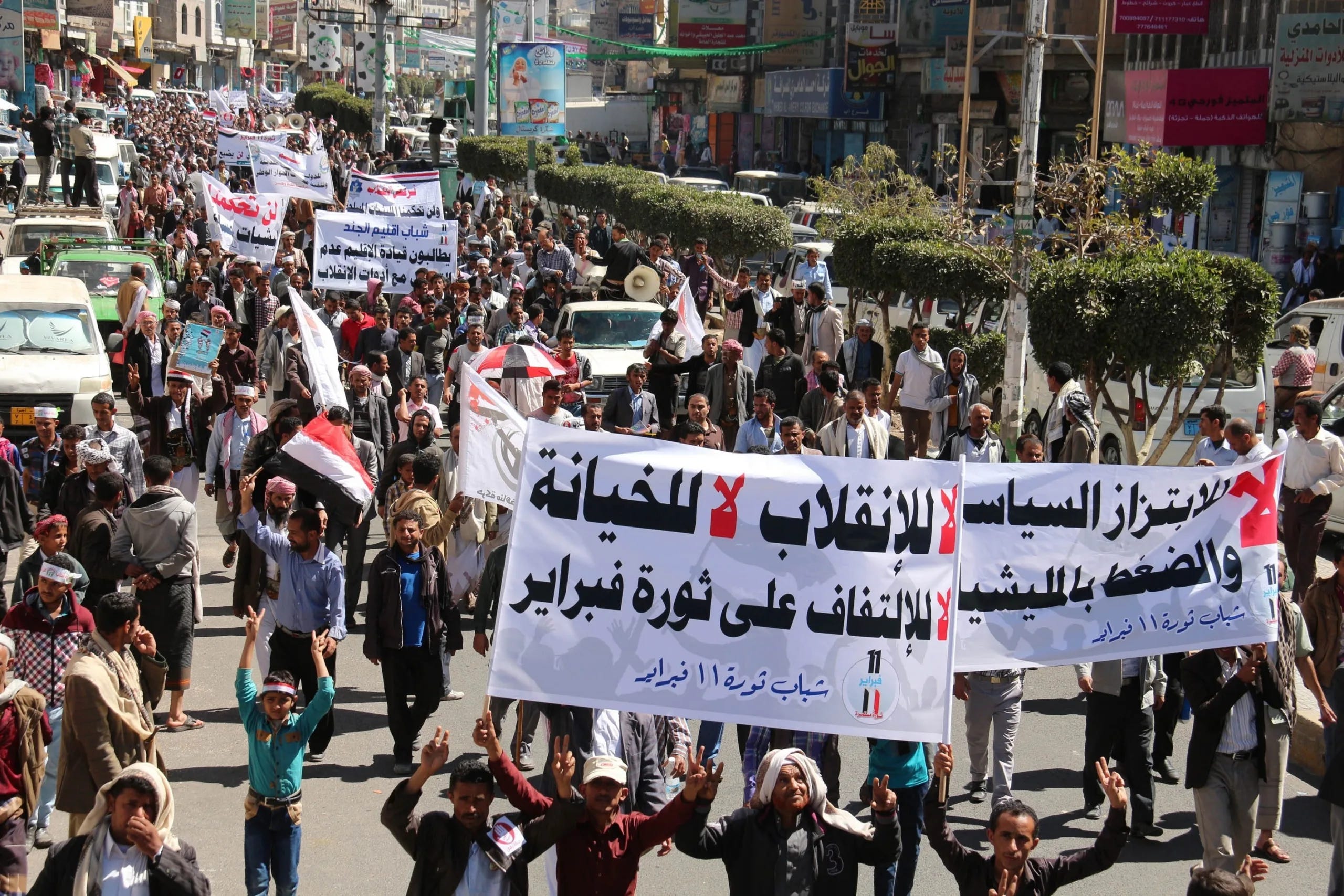
As the fifteenth anniversary of the February 11, 2011 revolution in Yemen approaches, the country remains mired in one of the longest and most complex wars in its modern history. Competing de facto authorities divide the land, regional agendas weigh heavily on its trajectory, and the very idea of the state continues to erode in favor of armed networks and narrower identities.
In this turbulent context, revisiting February has itself become a political act. Between those who hold it responsible for Yemen’s collapse and those who regard it as the most significant awakening in the country’s contemporary history, narratives clash over the revolution’s meaning and the limits of its impact.
Over the past 15 years, Yemen has moved from a single, calcified regime to a fractured landscape of competing projects: a broad-based youth uprising; a Gulf-brokered initiative and comprehensive National Dialogue; then a setback in the form of an armed coup against the transitional process, followed by sweeping regional intervention and an open war that reshaped the political and military map.
Although the balance of power on the ground has shifted repeatedly, the fundamental questions ignited by February remain unresolved: Who owns the state? How should power and wealth be distributed? And how can a new social contract be founded on equal citizenship rather than domination and force?
Despite attempts to erase or demonize it, the February Revolution has not disappeared from public debate. It resurfaces at every sharp turn as a moral and political reference point invoked as the moment when fear was broken and a new consciousness began to take shape among the generations who lived through it and those who followed.
A Revolution Interrupted, but Its Consciousness Endures
Muawiya Al-Hammadi, one of the young activists of February, told Noon Post that the uprising was not merely a fleeting protest against a specific political system, but a profound shift in Yemeni society’s awareness. Millions, he said, expressed their aspiration for a just state grounded in equal citizenship and a break from entrenched authoritarianism and hereditary rule.
Recalling the early days, Al-Hammadi speaks of a widespread sense of freedom and the recovery of a public voice after decades of marginalization. Yet that feeling later collided with the complexities of political reality, the derailment of the transitional process, and the coup that upended it making emotions surrounding February today more layered, combining pride in the experience with pain over its outcomes.
He argues that assessing February’s achievements amid ongoing war, regional interventions, and the rise of counterrevolutionary forces is inherently problematic. A revolution cut short, he suggests, cannot be measured by conventional standards of success or failure.
In his view, February remains present in the consciousness of a broad segment of youth as a moral and political touchstone. Some see it as a revolution aborted halfway; others regard it as the starting point of a national project not yet complete but not yet closed either.
Al-Hammadi concludes that February’s values have not vanished. They have been besieged and distorted, yet remain active in public discourse, because the conditions that gave rise to the uprising still exist and because the idea of a civil state continues to resonate powerfully with new generations.
A Moment of Reconciliation with the Nation
For journalist Ahlam Al-Sabri, another participant in February, everything began with television screens following the revolutions in Tunisia and Egypt and asking whether Yemen, too, could break the cycle of prolonged rule and hereditary succession. That question led her to join protests in Sana’a from their earliest days.
She describes February as a moment of reconciliation with the very idea of the nation. The presence in the squares, she says, generated a profound sense of belonging she had never experienced before.
Her feelings toward the revolution have not changed more than a decade later, despite her recognition of the transitional period’s missteps foremost among them the suspension of protests after the Gulf Initiative and the space left for political parties to redraw the scene in their own way.
Practically speaking, she believes one of the revolution’s most significant achievements was thwarting the succession project, alongside the outcomes of the National Dialogue Conference, which February youth helped shape.
Other goals related to democracy and state-building remain difficult to judge, she notes, due to the coup that derailed the national trajectory and plunged the country into prolonged war.
Al-Sabri points to divisions among youth today between those who recall February with gratitude and a willingness to reassess mistakes, and those who blame it, or those who raised its banner, for the coup, war, and displacement that followed. Yet both positions, she argues, reflect the depth of the revolution’s imprint on the collective consciousness.
She insists that February’s values and ideas remain alive among large segments of the new generation those engaged in the national struggle intellectually or on the ground, holding fast to the dream of a unified and just Yemen despite the heavy toll and complex realities.
A Generation That Did Not See the Squares
Sohaib Al-Mayyahi represents a generation too young to have experienced the protest squares firsthand, yet raised within February’s discourse and aspirations. For him, the February 11 Revolution is not merely a historical chapter but a dream inherited by subsequent generations and embedded in political and social consciousness shaped at home, in school, and in the public sphere.
Despite the long war and its tragedies, he believes the revolution remains an ongoing act and a living dream. “If February came again,” he says, “I would step into it with absolute loyalty.” His faith in its values, he insists, has not wavered.
Every positive change, however small, reflects part of February’s spirit. The revolution, in his view, is not confined to years or to direct experience in the squares; it is an idea rooted in consciousness, renewing itself amid shifting circumstances and challenges.
Osama Al-Sabiei, similarly too young to have joined the squares, says he was nonetheless immersed in their hopes and aspirations through family and community. Yemen, he argues, still lives the revolution’s debates and birth pangs.
He regards the National Dialogue outcomes sketching a more hopeful future as one of February’s most important achievements and a translation of youth aspirations. Any responsible end to the conflict, he suggests, will require a return, in some form, to that national path, even if the details and tools differ.
For him, national struggle does not end when the squares empty. Youth today can engage in revolutionary and civic action in peace and in war alike through diverse forms of political and social work while remaining faithful to the sacrifices of February and the years since.
Struggle, he concludes, is cumulative; generations are measured by their long-term imprint, not merely by their ability to overcome immediate challenges.
Breaking Fear, Opening the Door to a Civil State
Afif Al-Abab, deputy head of the Marib Youth Council of the Revolution, argues that February marked a turning point in Yemen’s political landscape. It broke the equation of fear before it altered the equation of power and opened space for the idea of a civil state and political pluralism.
The key lesson for youth who did not participate, he says, is that change is a long-term process. Awareness and organization matter more than numbers. A revolution without a clear and cohesive national project is always vulnerable to hijacking by forces better prepared and organized.
The revolution’s core values justice, partnership, and rejection of authoritarianism remain actionable at any moment. The problem lies in the absence of effective political tools to translate them into realistic programs and public policy.
Among the challenges facing the new generation, Al-Abab lists accumulated frustration, the dominance of traditional elites, a battered economy, politics reduced to a struggle for influence detached from public concerns, and the lack of genuine representative platforms enabling youth participation in decision-making.
Restoring trust between youth and politicians, he adds, requires honesty and transparency, opportunities for new faces, acknowledgment of mistakes rather than their justification, and linking political discourse to citizens’ daily concerns not merely to grand slogans.
Between the Memory of Revolution and the Memory of War
In the past two decades, Yemen has undergone defining experiences that shaped generations in uneven ways. Between the February 11 Revolution sparking collective hope and the ongoing war that has reshaped daily life in tragic ways, society’s memory oscillates between two central moments: political and social transformation, and conflict, displacement, and collapse.
Writer and researcher Nabil Al-Bakiri describes February as a watershed in Yemen’s contemporary history not only for what it toppled politically, but for the profound impact it had on youth consciousness, whether among supporters or opponents.
The revolution, he argues, re-politicized the Yemeni scene in unprecedented fashion, producing a high-ceiling discourse and embedding politics into the daily lives of young people.
Its presence or absence in public space, he notes, fluctuates with the broader political mood sometimes receding under the weight of war and polarization, at other times reemerging during crises as a moral and symbolic reference.
February’s symbolism, in this sense, moves between ascent and decline without losing its essence as a rupture in traditional power structures and a serious attempt to redefine the relationship between society and the state.
While the generation of the revolution sees February as part of its lived history and struggle, the generation of war has formed its memory around battlefronts, displacement, and economic collapse. Yet Al-Bakiri does not see this divergence as structural; rather, the two generations remain extensions of one another, united by shared political awareness regarding Yemen’s future.
February, he concludes, will remain an unavoidable moment in any serious reading of Yemen’s state and society.
February and the National Dialogue: A Chance for a New Social Contract
After the February 11 Revolution toppled former President Ali Abdullah Saleh, the National Dialogue Conference convened in Sana’a between March 2013 and January 2014. It brought together nearly 500 representatives from political and social forces, including women, youth, and civil society, aiming to chart a constitutional and political roadmap for a modern state based on decentralization and equal citizenship.
Nadia Abdullah Al-Akhram, undersecretary at the Ministry of Youth and Sports for the Women’s Sector, says the revolution was pivotal in bringing diverse forces to an unprecedented dialogue table. The conference produced a draft constitution and a vision for transitioning from a centralized to a decentralized state as a foundation for stability and development.
The grave mistake, she argues, lay in allowing the Houthi group to enter the dialogue while retaining its arms, paving the way for a coup against the state and the subsequent derailment of February’s and the Dialogue’s outcomes. The responsibility, she insists, lies not with the revolution but with armed actors and alliances that led the counterrevolution.
Yet she believes an opportunity remains to rebuild an inclusive national project, especially after the failure of sectarian, regional, and separatist initiatives. Yemen’s only path forward, she says, lies in equality, redistribution of power and wealth, and preserving national unity and republican identity.
February as the Dream of “Reclaiming the Nation”
Magdi Naqeeb, a former National Dialogue member, sees February not as a mere historical recollection but as a defining moment embodying Yemen’s true spirit a generation daring to imagine a different homeland, not reduced to a leader, party, or sect, but founded on equal citizenship and human dignity.
The squares, he says, were not crowds of numbers but individual stories and living consciences united under the banner of “reclaiming the nation.” The revolution was not only a reaction to corruption and authoritarianism, but a creative act an attempt to sketch a future once confined to dreams.
He describes an unprecedented dissolution of regional, sectarian, and partisan divides, replaced by a single identity: the Yemeni dreaming of a better tomorrow. That moment, he suggests, embodied what could be called the “Third Republic,” born first in collective consciousness before appearing in texts and constitutions.
Though adversarial forces later plunged the country into conflict, he maintains they failed—and will fail—to extinguish the idea or the flame ignited in a generation’s awareness.
February 11, he concludes, is not a finished event to celebrate or mourn, but a moral compass and inexhaustible reservoir of hope present in every serious search for justice, freedom, and dignity.
From the Brink of State Failure to a Chance for Peaceful Transition
On the eve of 2011, Yemen faced a profound governance crisis: eroding legitimacy, weakened institutions, and decision-making monopolized outside formal frameworks. As social tensions mounted, peaceful political transition emerged as a path to avoid collapse, backed regionally and internationally. Yet institutional fragility and entrenched interests thwarted the process.
Dr. Mutab Bazyad, deputy director of the Prime Minister’s Office, says Yemen stood on the brink of state failure due to political deadlock and concentrated authority. February, he argues, arrived as a corrective movement, opening the way for a national project embodied in the National Dialogue outcomes and supported by the Gulf Initiative as a roadmap for building a modern state.
That consensus project, however, was derailed by a sectarian-tinged military coup, triggering broad regional intervention and a war threatening not only Yemen’s future but regional stability. Still, Bazyad contends that February successfully placed Yemen on a peaceful transitional path; the failure of the process reveals the old system’s resistance to change rather than the flaw of the idea itself.
He urges Yemenis especially the younger generation to read their revolutions, from September and October to February, as chapters in a single, cumulative struggle shaping the present moment.
The Revolution Changed Minds More Than the State
Independent politician Najeeb Al-Kamali argues that youth apathy or frustration today does not mean February was a mistake. Rather, it reflects natural disappointment after immense sacrifices, political gains seized by traditional and armed forces, and the descent into war instead of democratic transition.
Youth demanded dignity, statehood, justice, and opportunity; what followed were power struggles, war, poverty, and migration. The frustration, he says, is with the stolen trajectory, not the revolution itself.
While immediate political and economic outcomes were limited, February was transformative at a deeper level: it broke the barrier of fear, fostered unprecedented political awareness, and toppled the notion of a sacred ruler.
The revolution changed minds but not the state. Change that begins with consciousness, he argues, takes time to reshape structures and institutions.
February planted enduring values citizenship over regionalism, peacefulness over violence, the right to dissent, the dream of a civil state, and youth and women’s participation in public life. These, he concludes, are its true capital, sustaining its spirit even as the political path faltered.
