

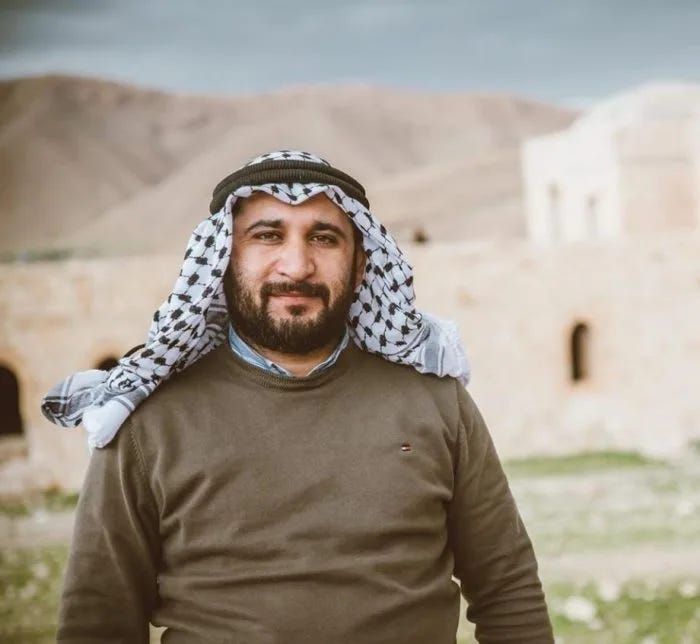
On the Palestinian Digital Museum’s website lies a special collection curated by researcher Hamza al-Aqrabawi: over 900 documents and archival photographs of his hometown, Aqraba, and its surroundings, spanning the 19th and 20th centuries.
But in the hearts and memories of people, the echoes of his stories stretch even further tales longer than the years he lived before his life was abruptly swept away by the Nile’s depths.
This is not the biography of a conventional historian, but the story of a man who loved his homeland deeply and found his own way to protect it. Hamza’s devotion was to Palestine’s social history, to its oral traditions, to the proverbs, rituals, and legends passed down through generations.
A true son of the land, he could tell you when each wild plant in Palestine blooms, its local names, and the traditional dishes it flavors. He could transform what sounded like folklore into documented truth. His speech overflowed with proverbs and parables. He was, as they said of him, the storyteller who “makes the world go quiet when he speaks.”
That was Hamza until December 30, when his tale was extinguished in the waters of the Nile he so loved. His sudden passing broke the hearts of those who yearned to hear the rest of his stories, those who relied on his tireless work to preserve what remains of a homeland teetering on the edge of oblivion. Hamza — Abu Osama — disappeared before the country did.
Son of the Land, Keeper of Its Soul
Hamza Osama Khader Dirieh was born just after mid-July in 1984 in the town of Aqraba, southeast of Nablus. The son of a farmer and a mother who spoke the language of the earth, his childhood unfolded among olive groves and harvest fields the earliest playgrounds of his memory. It was no surprise he proudly identified as a fellah a peasant, in the most honorable sense of the word.
As a child, Hamza would sit beside his grandfather, absorbing stories of families and neighboring villages. It was there he developed his storytelling instincts, learning to weave words into memory a skill that would become his legacy.
Just before his high school exams, during the height of the Second Intifada, while the West Bank was ablaze, Hamza immersed himself in collecting stories of the martyrs. He pieced together their lives from newspaper clippings, making that paper trail his world. He later enrolled at An-Najah National University to study business administration.
But business was not his calling. After a single academic year and a brief stint at a company in Ramallah, he chose instead to return to the land and to his true vocation: documenting and preserving memory. In 2006, he launched a personal research project to uncover the hidden stories of Palestinian farmers their sayings, songs, beliefs, myths, seasonal customs, hunger, thirst, cold and heat breathing life into Palestinian folklore, and transforming it into a living, collective memory.
He left no valley unexplored, no protest unattended, no cave untouched. He never separated memory from the present. Instead, he focused his efforts on reinforcing Palestinian villages besieged by settlement expansion and forced displacement.
His activism earned him a seat on the Committee for the Defense of Khirbet al-Tawil a hamlet east of Aqraba threatened with seizure.
Through that work, he captured the attention of solidarity activists and hikers alike. In 2012, he led a walking group called Tijwal Safar (“Travel Trek”), guiding participants through Palestinian villages with stories that turned every stone into a chapter of history. Recognizing the power of these stories, he published them in his 2014 book, Minbar’s Overlook.
It was then that Hamza, known increasingly as al-Aqrabawi, took his first steps toward community archiving. He traveled from one elder to another, gathering their memories, until he earned another nickname: Abu al-Ajāyez Father of the Elderly.
From Memory Keeper to Storyteller
The collecting, documenting, and retelling of heritage and memory filled every corner of Hamza al-Aqrabawi’s being. In a previous interview, he described how he began speaking simply to fill time then, to his surprise, someone introduced him as a hakawati (traditional storyteller).
At first he resisted the label but once he started, the words flowed like an unstoppable spring. He had found his voice.
With documents dating as far back as 1842, spanning the British Mandate, the Nakba, the Naksa, and the Palestinian revolution including handwritten manuscripts attributed to Imam Ali and Sultan Abdul Hamid II he amassed a priceless archive. And yet, he never kept it under lock and key.
Like his memory and his stories, it was always available to anyone with a thirst for knowledge. He would begin with his trademark line: “Don’t you want to know the details?” and keep going until his audience was too full to absorb any more.
Al-Aqrabawi was more than an archivist or storyteller. He became a tour guide, launching initiatives such as the Social Media Bus taking young Palestinians from schools and universities on tours through historical landmarks, ancient domes, and scenic hills, narrating stories nearly erased by time stories that would have vanished if not for his persistence.
In his eulogy, journalist Imad al-Asfar wrote:
“From a young age, Hamza shouldered a burden too heavy for institutions and universities. He worked alone, with unmatched passion and love. He couldn’t limit himself to one task because he stood before mountains of abandoned heritage, stories and proverbs no one had documented, and sites no one had studied.”
“Tell Palestine’s Story… So That It May Live”
In 2015, Hamza was joined on his walks by the late activist Basil al-Araj. Together, they launched a unique form of resistance they called “Oral Archiving of Resistance and Reviving Popular Memory.” Al-Araj would recount the events of the Great Palestinian Revolt and retrace the steps of its battles, while al-Aqrabawi urged young people to walk the land:
“If you don’t know your country, how can you love it? And if you don’t love your country, how can you defend it?”
Al-Araj would go on to live — and die — by those words. “I did what I believed in,” he said. “I researched, spoke, wrote, walked, planned, organized, bought a weapon, got arrested, went on hunger strike, got released, went underground, and initiated confrontation.” He died a martyr.
Hamza’s path led him instead to proclaim: “Walk the land, and it becomes yours.”
He echoed Palestinian artist Salman Natour: “The hyenas will devour us if we lose our memory.”
And so Hamza chased memory fearing that we might forget, or worse, that the land might forget us.
He believed that “the death of an elder is like burning down a library,” and that documenting history was as vital as any weapon.
In recent years, Hamza’s archival work grew more expansive. His stories reached beyond borders, and his sign-off “Stay with the stories” became a signature. His voice resonated across youth initiatives, from Karavan al-Shabab to the Prophet Moses Festival, unconsciously becoming a bridge between land and memory, between history and now.
But he didn’t stop at storytelling. He wove his research into historical, economic, social, and cultural contexts to safeguard Palestinian identity. He contributed to the founding of the Khazaa’in (Treasures) archival project, generously offering his materials, always racing death to preserve memory.
He also collaborated with Roya Center for Political Development on a documentation project about displaced Bedouin communities in the Jordan Valley over 212 communities, where more than 9,000 Palestinians were displaced in the past decade. With the Institute for Palestine Studies, he produced several policy papers and studies, proving that Palestinian resilience endures.
For two years, Hamza was barred from traveling. When the ban was lifted in September, he returned to schoolchildren, speaking in their classrooms and libraries telling stories untold. And when he could finally leave the country, he carried Palestine’s stories with him stories that defy erasure and annexation.
Thus ended, on the banks of the Nile, the rich yet brief journey of a man who loved his homeland a devoted father of four, a husband with endless stories, a son who lived in the memory of his parents. They say he died too young. But Palestine mourns not only his youth, but his loyalty, his memory-fueled resistance, his curiosity, his generosity.
Had the country the means to bid him farewell as he deserved, it would carry Abu Osama’s body through its plains and valleys across walls, checkpoints, and exhaustion until the people reached the place where their memory keeper now rests.
So his story could end where it should not in silence, but in continuity.
So his tales may become schoolbooks, bedtime stories, maps of return for a homeland burdened by loss.
Hamza once said, “A person is born a storyteller.”
What he didn’t know was that some stories cling to their tellers even after death.
