

For decades, the question of how to organize the political presence of Palestinians abroad has remained one of the most pressing issues in national discourse. There is near-unanimous agreement that the Palestinian diaspora represents a vast untapped force demographically, politically, intellectually, and economically spanning five continents.
Yet despite this immense potential, it remains largely dormant, lacking the unifying structure and shared programs needed to transform this global presence into real political influence in service of the national cause.
This gap between necessity and reality becomes particularly glaring at critical junctures in the conflict. One such moment followed the widespread mobilization of Palestinian and Arab communities in Western cities during the 2021 “Sword of Jerusalem” uprising, and more profoundly, in the wake of the “Al-Aqsa Flood” operation in 2023.
The ensuing wave of global solidarity succeeded in putting a halt to genocide on the agendas of several Western governments, prompting many to reassess their unwavering support for Israel ultimately contributing to an unprecedented level of isolation for the occupation in recent memory.
In this context, numerous initiatives emerged to bridge the organizational gap, most notably the Popular Conference for Palestinians Abroad, which adopted this mission as a strategic path toward building a broader network of engagement and participation.
Despite the political pressures and controversies it has faced particularly given the Palestinian leadership’s sensitivity toward any initiative that could be perceived as a challenge to the Palestine Liberation Organization’s (PLO) dominance this movement has persisted in asserting an independent presence, aiming to expand the sphere of Palestinian activism beyond the borders of the occupied territories.
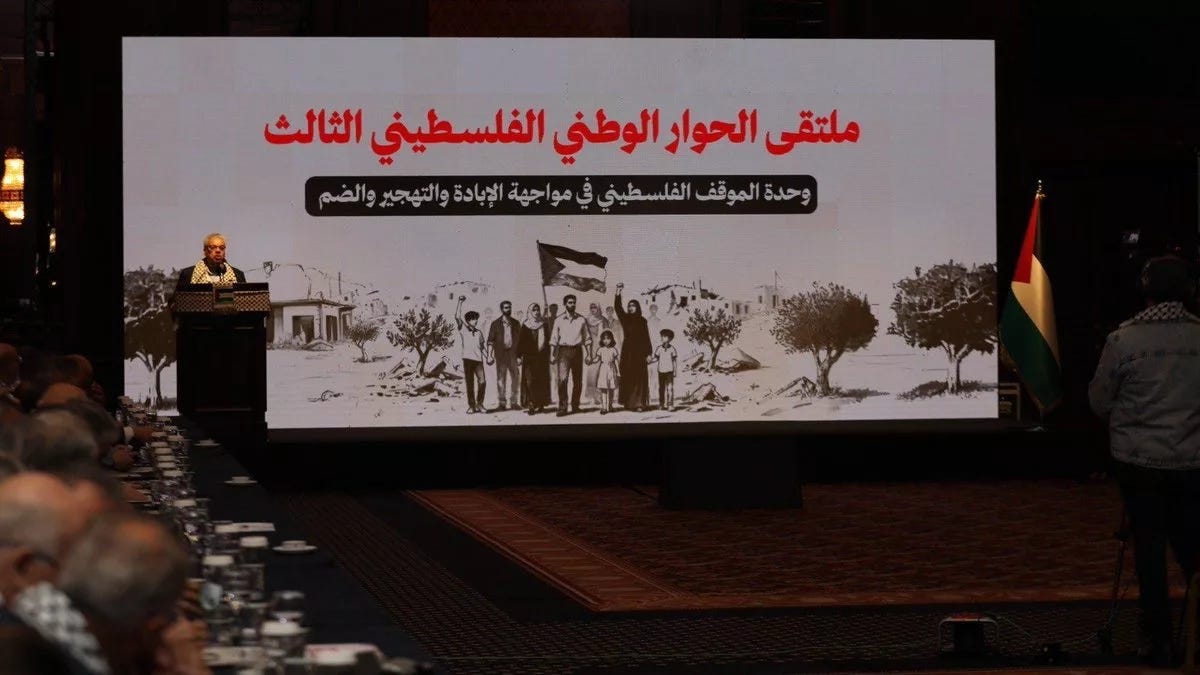
It was from this vantage point that the third Palestinian National Dialogue Forum convened in Istanbul, forming a new link in the chain of efforts to address the difficult questions facing Palestinians abroad in the post-deluge era.
The forum reignited debates around the major challenges confronting the Palestinian cause today, the opportunities presented by international momentum, and the urgent need to unify the energies of the diaspora and channel them into a strategic force that can support the national project and promote its sustained global presence.
A Growing Gap in a Time of Great Transformation
The “Al-Aqsa Flood” did not merely expose deep field and political shifts in the structure of the conflict it also cast a stark light on a long-standing void in the Palestinian body politic: the absence of a unifying organization for Palestinians abroad.
At a time when the Palestinian cause had returned to global prominence and diaspora communities were more visible than they had been in decades, a central question emerged: why does this presence remain improvised, fragmented, and transient?
The sweeping global response to the events of 2023 marked a rare breakthrough in international awareness, offering Palestinians abroad extraordinary opportunities to build grassroots and political influence, particularly in Western nations that witnessed the largest pro-Palestine protests in their histories. Yet this massive mobilization remained largely unorganized, relying on scattered individual efforts and grassroots energies with no unified entity or reference point.
This concern resonated throughout the forums and workshops that followed the deluge. Scholars and experts pointed out that Palestinians abroad are today paying the price for a “representation vacuum” left by the PLO’s diminished mobilizing capacity, which has effectively excluded millions from influencing central national decisions.
While a broad popular movement has emerged in the West—through mass demonstrations, university protests, and media campaigns—this movement remains seasonal and uninstitutionalized, sustained by a well-known set of underlying issues:
The fragmentation of diaspora communities and the varying legal and political environments across continents.
The official Palestinian leadership’s resistance to independent organizational initiatives outside the framework of the PLO or Palestinian Authority, often labeling such efforts as seeking to establish a “rival.”
The absence of a unified reference body capable of managing and directing this momentum toward clear political goals.
The erosion of Palestinian unions and grassroots institutions in exile since the mid-1990s.
As a result, the gap between activism and representation has widened. The Al-Aqsa Flood revealed that Palestinians abroad have become central to international mobilization, and that the Palestinian cause now figures as a domestic issue in several Western countries—not merely a Middle Eastern concern. This marks a historic shift that places a new responsibility on the diaspora: to transition from advocacy to initiative and leadership.
Voices within the diaspora and research centers view this as a “once-in-a-generation opportunity”—provided the fragmentation can be overcome through the building of civil institutions, organized advocacy networks, and the empowerment of Palestinian youth, who are now leading most digital and protest movements.
While the deluge revealed the diaspora’s capacity to influence international public opinion, it also laid bare the fragility of its organizational infrastructure, which prevents this influence from being converted into enduring political power.
The Question of Viability and the “Specter of an Alternative”
From the outset of any effort to revitalize Palestinian activism abroad, a persistent question looms: are we on a viable path toward institutional transformation, or are we repeating a familiar cycle of short-lived initiatives?
This question weighted with a long history of incomplete efforts has instilled a deep sense of caution and pragmatism among Palestinians when it comes to new frameworks.
This skepticism deepened with the launch of the Popular Conference for Palestinians Abroad in 2017, which, according to its own literature, emerged from a serious diagnosis of the organizational vacuum and the failures of previous attempts.
Over time, the conference established a General Secretariat, an Executive Committee, and a General Assembly composed of hundreds of members worldwide, gradually developing a model for collective action, particularly through the creation of the “National Dialogue Forum” as a mechanism for drafting a unified strategic vision.
Yet despite its growth, the viability question remains: Can these efforts create a meaningful breakthrough in the Palestinian representation structure? Can they overcome the cloud of suspicion surrounding any independent initiative outside the official umbrella?
Complicating matters further was the political demonization campaign the conference faced from the outset. Fatah led a broad wave of criticism, portraying it as an attempt to bypass the PLO, accusing it of perpetuating division, and even claiming it served “Israeli agendas” and endangered national principles, including the right of return.
In response, conference organizers stressed that their role is not to compete with the PLO, but rather to fill the grassroots and organizational vacuum within the diaspora.
They maintain that the conference has become an active platform for Palestinians abroad, with extensive ties to Arab and Western states and to most Palestinian factions operating outside the territories.
It has also played a key role in organizing protests and managing solidarity campaigns during escalations in Gaza, Jerusalem, and the West Bank.
Still, a fundamental truth remains: no initiative abroad can succeed without addressing the structural and political challenges that reappear with every new effort. The absence of a unified framework, constant tension with the official leadership, and the diaspora’s fatigue with repeated and often fruitless experiments all these factors place significant constraints on any organizing attempt and hinder its ability to evolve into a sustainable institutional force.
That said, the trajectory of the Popular Conference though it may not yet have answered all questions of viability represents a serious attempt to create a new model. It seeks to leverage the unprecedented global attention generated by the Al-Aqsa Flood and chart a course that reasserts the role of the diaspora in shaping the national future.
Unity as an Existential Imperative in the Era of Displacement
The question of unified representation and the need to restore a minimum level of national consensus dominated the discussions at the Istanbul forum. This theme reflects the urgency of the current Palestinian moment, as the cause faces concerted efforts to reproduce the Nakba in new forms.
This debate did not arise in a vacuum. Participants argued that the continued political void and the paralysis of national institutions are weakening Palestinian capacity to resist displacement and uprooting, giving Israel more room to impose realities on the ground aimed at redefining the conflict outside the framework of historical rights.
Over two days in Istanbul, under the banner “The Palestinian People Reject Displacement Projects and There Is No Alternative to the Right of Return,” the forum addressed the challenge of restructuring the Palestinian house, drawing more than 250 participants representing a broad spectrum of political and intellectual perspectives.
In the session dedicated to internal Palestinian reorganization, speakers agreed that the current moment cannot tolerate the continuation of a 17-year-long division. They argued that this rift has become the main entry point for Israeli policies of settlement expansion and forced displacement, coupled with a scorched-earth campaign in Gaza that has triggered one of the largest waves of displacement since the Nakba of 1948.
Mu’in Taher, Secretary of the General Assembly of the Palestinian National Conference, stated that the resistance has in the past year “brought the Palestinian cause back from the brink of liquidation to the forefront of international attention,” but warned that this momentum cannot be harnessed without rebuilding Palestinian national structures on democratic and pluralistic foundations that ensure inclusive participation.
He emphasized the need to anchor Palestinians wherever they are, support all forms of resistance permitted under international law, and isolate Israel by prosecuting its leaders as war criminals.
Scholar and writer Khaled Hroub described internal fragmentation as “the crack preventing the emergence of unified leadership,” noting that the presence of more than 25 factions without a common framework has created a politically disoriented environment, enabling Israel to enforce new realities without facing a responsive political structure.
He stressed that ending division is not optional but a prerequisite for countering an Israeli strategy that seeks to erase Palestinian existence altogether.
Organizers highlighted the forum’s timing as symbolically significant, coinciding with the height of Israel’s assault on Gaza and a historic wave of mass displacement. In this context, restructuring the Palestinian political house becomes more than a bureaucratic demand it is a political and existential necessity to thwart projects of “alternative homelands” and forced displacement, and to reshape Palestinian political action around consensus and broad popular participation.
Outcomes and the Challenge Ahead
The third forum concluded with an unexpected outcome: the announcement of the formation of the National Body for Popular Palestinian Action. This step went beyond the scope of the Popular Conference itself, bringing together individuals, organizations, and initiatives from across various arenas including Palestinians from within the 1948 territories thereby establishing a broad-based framework for popular activism across Palestinian geographies.
While the final statement adopted a tone of consensus reflecting a near-unified stance on key issues, at its core it represented a serious effort to build a working agenda amid a historical moment shaped by both danger and opportunity.
The Palestinian national project today faces one of the most aggressive attempts at liquidation in its history, but also a unique window of opportunity opened by the Al-Aqsa Flood—through massive global support and shifting political and popular currents.
According to the statement, the National Body seeks to rally efforts and unify energies to support Palestinian resistance in all its forms, strengthen the steadfastness of Palestinians in Gaza and the West Bank, and counter annexation and displacement plans.
It also aims to coordinate media and political campaigns among conferences, institutions, and influential individuals, allowing for the development of unified national positions on major issues.
One of the body’s most sensitive goals is to organize and represent Palestinians where possible and to seek democratic representation where feasible an attempt to close the gap left by the decline of the PLO and other representative institutions over the past decades.
Beyond structural foundation, the political ambition of the National Body lies in developing a unified national vision for managing the next phase: setting priorities, leading coordinated political and diplomatic actions, rallying Arab, Islamic, and international support, and confronting externally imposed guardianship plans that seek to reshape the Palestinian landscape. The body also proposed dispatching delegations to friendly states as part of a broader people’s diplomacy initiative.
Although its formation is a significant step, the body faces a crucial test: Can it turn its founding documents into a practical agenda that transcends declarations and avoids confrontation with official concerns or the creation of new divisions within the Palestinian landscape?
The presence of prominent figures such as Dr. Mustafa Barghouti, Dr. Hassan Khreisha, Mu’in Taher, Oraib Rantawi, Majed al-Zeer, and Wadah Khanfar lends it political and symbolic weight but does not diminish the formidable challenges ahead.
The real wager lies in the body’s ability to establish an independent and credible political presence, build sustainable tools for engagement, create effective representation networks across the diaspora, and safeguard national decision-making from external manipulation and internal fragmentation.
In this sense, the National Body for Popular Palestinian Action begins its journey at an incredibly complex moment but if it succeeds in institutionalizing the forum’s outcomes, it may open the door to a new framework for mobilizing Palestinians abroad and reintegrating them into a broader national project capable of confronting the gravest challenges facing the Palestinian cause since the Nakba.