

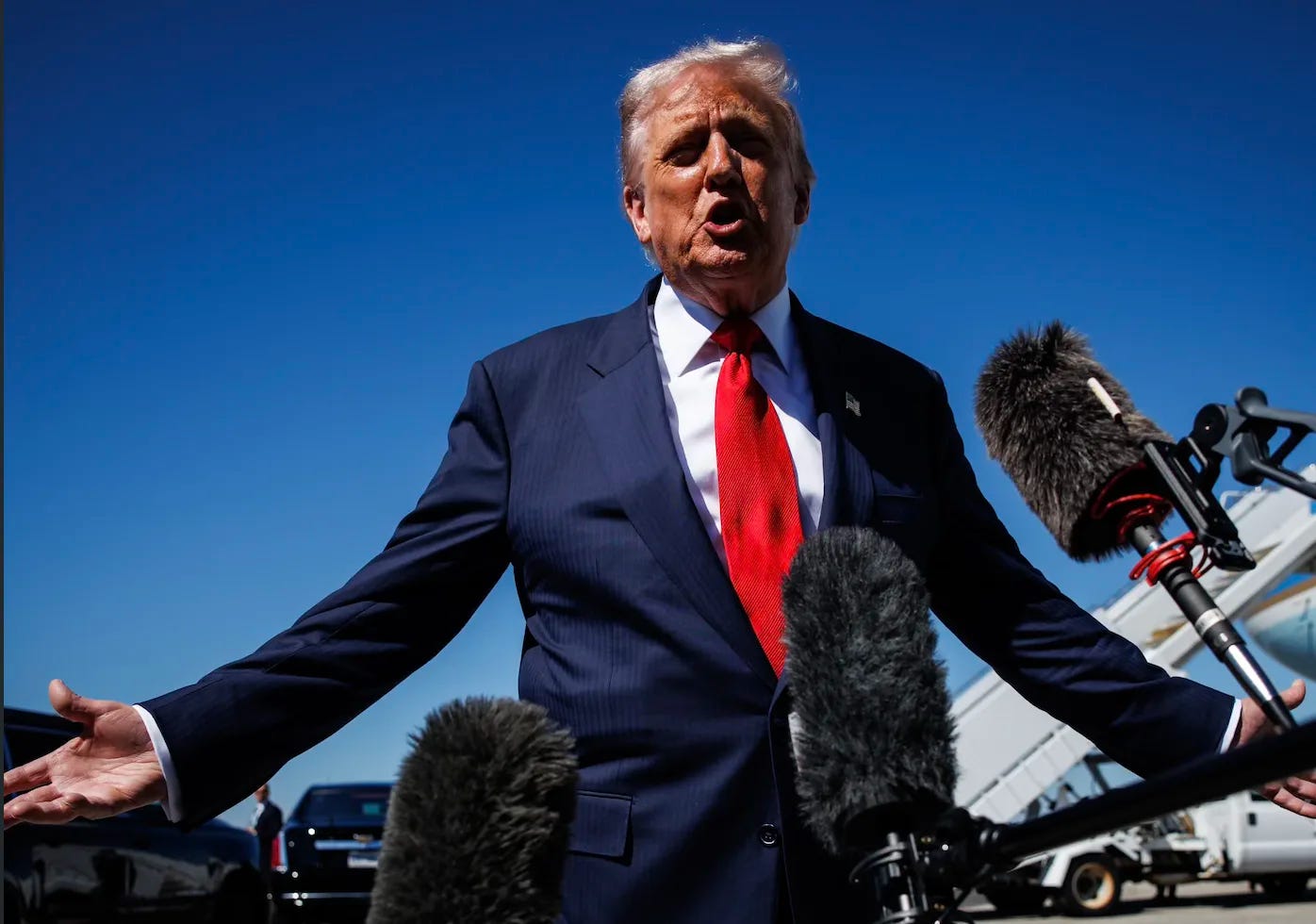
In May 2025, when President Donald Trump accused South Africa of committing “genocide” against white farmers and launched a diplomatic campaign to isolate Pretoria, it wasn’t merely a passing event it marked the beginning of a broader escalation. The question wasn’t whether another strategically significant African nation would be targeted next, but simply when.
Just months later, Nigeria became the next focus, this time under the banner of “Christian persecution.” A country thousands of miles from Washington long regarded as a key security and economic partner in West Africa was abruptly transformed into a target of militarized rhetoric cloaked in religious language, closer in spirit to coercion and domination than to genuine concern for religious freedom.
From Diplomatic Criticism to War Drums
During Trump’s first term, U.S. relations with Nigeria were marked by diplomatic coldness and soft pressure around security and religious freedom. But upon his return to the White House, the tone shifted drastically. Legalistic critiques gave way to menacing rhetoric fueled by a right-wing administration steeped in ideology and driven by a populist, confrontational style.
Initially, Nigeria was merely re-added to the list of “Countries of Particular Concern” under the 1998 International Religious Freedom Act, enabling the U.S. to sanction nations accused of violating religious rights. The same designation was used during Trump’s first term but later revoked by Joe Biden.
What changed in Trump’s second term was the bypassing of traditional bureaucratic channels, such as recommendations from the U.S. Commission on International Religious Freedom. The decision was political and unilateral.
The pivotal moment came in late October 2025, when Fox News aired a report—seen by Trump aboard Air Force One depicting violence in Nigeria as purely religious in nature. The segment showcased decontextualized footage and framed it as evidence of a systematic campaign targeting Christians.
Trump didn’t wait for verification. He took to Truth Social with an unprecedented, incendiary post, using overtly religious language and pushing diplomatic norms aside for something resembling a declaration of war.
Within days, the rhetoric intensified. Trump announced a fact-finding mission led by Republican Congressman Riley Moore, threatened to cut all U.S. aid to Nigeria, and hinted at sanctions.
Secretary of State Marco Rubio a devout Christian whose faith shapes his political agenda revealed plans to impose visa restrictions on individuals suspected of involvement in the “killing of Christians.”
Until then, Nigeria had not featured in American public consciousness as a potential arena for military engagement. But within days, Trump raised the stakes, instructing the Department of War (the renamed Department of Defense) to prepare for possible airstrikes and ground operations.
He vowed a response that would be “swift and brutal,” effectively turning a supposed humanitarian concern into a pretext for military action against a sovereign nation.
This rapid escalation reflects a broader Trumpian pattern: jumping from human rights talk to military threats without a clear intermediary phase. We’ve seen it with Iran, Venezuela, and North Korea. In Nigeria’s case, the situation is more perilous due to the overt religious framing a binary of “Christians vs. Muslims” in a region already beset by fragility.
Even more dangerously, this narrative didn’t emerge in a vacuum. It was echoed by right-wing Christian Zionist activists and lawmakers, fueling legislative pushes in Congress. Evangelical-aligned Republicans like Senator Ted Cruz known for blending religious causes with foreign policy played a key role.
Cruz, along with Riley Moore and others, pushed hard for heightened action against Nigeria, introducing bills and urging the State Department to reclassify Nigeria as a religious freedom violator.
Cruz’s legislative proposals steeped in Islamophobia and arrogance weren’t isolated. They were part of a broader network of actors in Washington promoting the “Christian persecution” narrative. At the heart of this network lies an evangelical base that views global affairs through the lens of spiritual warfare and sees itself as the protector of persecuted Christians worldwide. This base pressured Trump directly to intervene.
Also instrumental in shaping this narrative were religious freedom advocacy groups many of which selectively apply their principles to suit political agendas. Within the Trump administration itself, evangelical advisers like Pastor Paula White, head of Trump’s 2016 Evangelical Advisory Board, portrayed the Nigerian crisis as a moral battle of global proportions.
Against this backdrop, Trump’s war talk was not an anomaly but the logical next step in a steadily escalating religious discourse fueled by right-wing media, amplified by lobbying groups, and culminating in a direct military threat. It represents one of the most aggressive American threats to an African nation in modern history, built on a religious framing that dangerously resurrects the us-versus-them logic of holy wars.
Nigeria: A Landscape of Complex Violence
To understand the risks of this religious oversimplification, one must look beyond simplistic narratives. Nigeria is not just Africa’s most populous nation it is also one of its most complex, demographically, ethnically, religiously, and politically.
Violence in Nigeria takes many forms, carried out by various armed groups across a fragmented geography. In the northeast, jihadist organizations like Boko Haram, Ansaru, and ISWAP operate. Muslims are the majority of victims there due to population density and the nature of the conflict.
In the northwest and central regions, a different pattern emerges. Armed gangs commonly referred to as “bandits” engage in kidnapping and extortion without religious motives. Their victims include both Muslims and Christians, revealing the criminal, economic roots of the violence.
In the Middle Belt, where religious and ethnic identities overlap, deadly clashes occur between herders and farmers. These are often cast as religious conflicts but are largely driven by competition over land, water, climate change, and population growth.
In the Christian-majority southeast home to various religious minorities—a separatist insurgency led by the Igbo ethnic group has taken shape. The Indigenous People of Biafra (IPOB), seeking to revive the defunct Biafran state, targets government institutions and civilians. Ironically, many of their victims are fellow Christians, undercutting the narrative of one-sided religious persecution.
This mosaic of violence illustrates that Nigeria’s crisis cannot be reduced to a simple Christian-versus-Muslim dichotomy. The American narrative, which ignores these nuances, is not only misleading but dangerous. It invites foreign interventions based on misdiagnosed problems and risks exacerbating rather than resolving the crisis.
The Myth of Christian Persecution
Since Trump invoked the plight of Christians, “persecution” has morphed from a legal term into a vague political weapon. Yet statistical data quickly undermines these claims. According to the Armed Conflict Location & Event Data Project (ACLED), as of September 2025, there were 317 identified Christian victims of religiously motivated attacks in Nigeria compared to 417 Muslims.
This indicates that Muslims, especially in the north, have borne the brunt of targeted violence. Armed groups have never exclusively targeted Christians. Since 2009, their attacks have primarily struck mosques, Muslim clerics, and communities that oppose extremist ideologies or cooperate with the state.
Some Nigerian Christian officials, particularly in the north, have denied the existence of systemic religious persecution. They argue that the violence is a security issue, not a religious one. The Nigerian government itself maintains that no specific ethnic or religious group is being targeted. Yet these voices are often drowned out in U.S. media, which gravitates toward sensational narratives that align with specific political agendas.
Reports used to support the persecution narrative are often marred by methodological flaws such as unverified numbers, blurred motives behind violence, and premature labeling of victims as martyrs without sufficient field evidence. This risks misleading the public and misrepresenting Nigeria’s reality.
More importantly, the Nigerian state despite its security failings does not pursue an official policy of religious oppression. The constitution guarantees freedom of belief, Christian institutions operate freely, including in the north, and Christians hold prominent positions across the political, judicial, and military spectrum. Civil society oversight is robust, countering the notion of an anti-Christian state.
The Hidden American Agenda
Trump’s rhetoric about “protecting Christians” is less about humanitarian concern and more about electoral strategy. White evangelicals form a core part of his political base, especially in swing states. Appealing to their worldview through foreign policy serves his campaign interests.
This strategy also sends a global signal: under Trump, the U.S. is not retreating but asserting itself as a defender of Christian faith worldwide. This took institutional form in his announcement of a government task force to combat “anti-Christian bias” globally.
Religion, however, is often a loud cover for tangible American interests. Nigeria is Africa’s largest oil producer, a key OPEC member, and a source of sweet crude favored by U.S. refineries enough to keep it firmly on Washington’s radar.
Beyond oil, Nigeria sits atop vast reserves of strategic minerals like lithium, cobalt, and nickel essential for global supply chains. This makes it a prize in the growing resource competition with China, which has deepened its presence through infrastructure, mining, and energy investments under the banner of “non-conditional partnership.”
Nigeria’s foreign policy pivot has also raised alarms in Washington. Its increasing alignment with BRICS and diversification of financial partnerships threaten U.S. dominance. Russia’s rising military and diplomatic clout in West Africa compounds these fears, offering regional actors an alternative to Western security arrangements.
One final irritant: Nigeria’s stance on the Middle East. During the most recent Gaza war, Abuja called for a ceasefire, criticized Israeli operations, and reaffirmed support for a two-state solution. This made Nigeria given its demographic and political heft—a thorn in the side of Washington and its allies, especially as global opinion turns against Israel.
Adding to the tension, Nigeria has repeatedly rejected U.S. requests to accept deported migrants and detainees, citing economic and population challenges. This refusal coincided with rising cultural and diplomatic friction, exemplified by the revocation of author Wole Soyinka’s U.S. visa following his public criticisms of the Trump administration.
In this light, religion becomes a tool of political blackmail. The U.S. leverages moralistic rhetoric to reshape Nigeria’s foreign policy, particularly on Palestine, and to extract economic or diplomatic concessions. Investment and energy cooperation become bargaining chips in a game of compliance or face reputational and political warfare dressed in humanitarian guise.
Ironically, this strategy could backfire. Rather than returning to the U.S. orbit, Nigeria may seek greater independence from Western hegemony. By reducing its complex reality to a simplistic religious narrative, Washington risks inflaming sectarian tensions and accelerating the erosion of its credibility in Africa and beyond.
Ultimately, the American escalation against Nigeria cannot be separated from a larger power play. Religion becomes a weapon, morality an instrument of coercion, and African nations test cases for how much sovereignty they can retain in a world increasingly shaped by geopolitical maneuvering disguised as moral crusades.
