

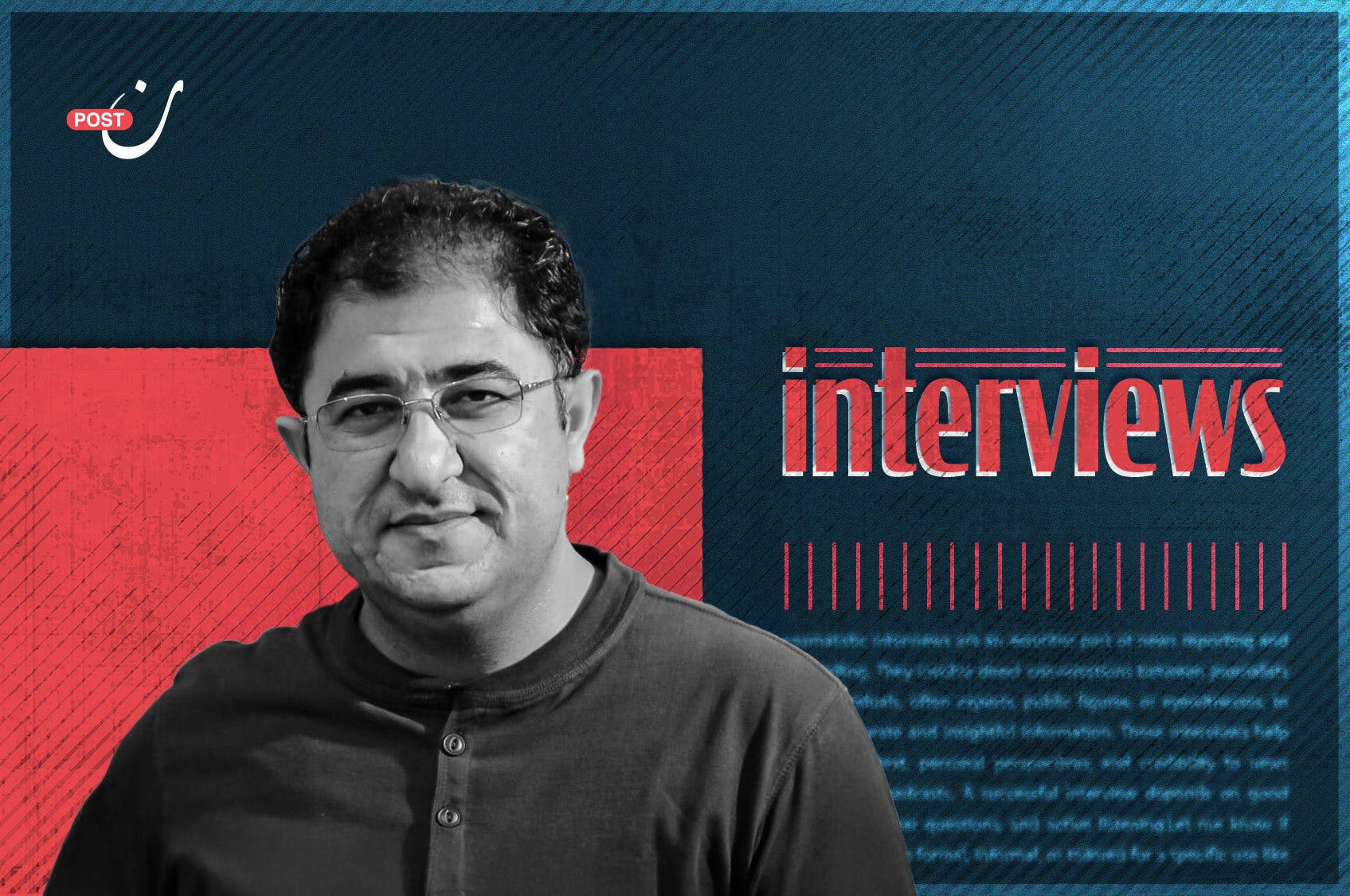
In a country exhausted by decades of denial, exclusionary identity politics, and a deep-seated mutual fear that has become part of daily consciousness, words themselves become a moral act. Speaking out breaks the silence, creates space for difference, and affirms that listening to others does not require adopting their views it simply acknowledges their right to be heard.
In this interview with writer and critic Haitham Hussein, we open a space for joint reflection on the Kurdish issue as a question of state and citizenship. The discussion navigates history, language, memory, and literature as vital elements shaping Syrian consciousness.
We explore the possibilities of national partnership, the role of law, culture, and narrative in reopening the public sphere on the basis of mutual recognition, and the capacity of literature to express what politics has failed to articulate, restoring the individual to the center of the story after decades of marginalization.
Haitham Hussein is a Syrian Kurdish writer, novelist, and critic, born in Amuda al-Hasakah in 1978. He resides in London, is a member of the Society of Authors in the UK and Scottish PEN, and works as an editor at the international newspaper Al-Arab based in London. He is also the founder and director of the website Rawayeh. His novels and critical works have been translated into several languages.
What do you mean by “Kurdish rights” in the Syrian context?
Kurdish rights in Syria, above all, should not be placed in quotation marks. They are the rights of an indigenous national community to be treated within the state and public sphere on the basis of equal citizenship without denying its name, devaluing its language, or stripping its legal and political dignity. These rights are multilayered, beginning with legal recognition but not ending there.
Kurdish rights mean the right to identity the right for a Kurd to say, “I am a Syrian Kurd,” without that being read as a threat, political error, or cultural defect. It includes linguistic rights: Kurdish should be treated as a living language in education, culture, and media, free from the decades-long repression and criminalization under Baathist rule and the Assad regime.
Kurdish rights also mean full citizenship: the right to nationality, registration, documentation, property ownership, employment, and movement. When citizenship is revoked or restricted on ethnic grounds, the state becomes a tool of collective punishment.
The exceptional 1962 census in al-Hasakah is a stark example of politics turning into a widespread legal dispossession, stripping hundreds of thousands of Kurds of citizenship an injustice passed down through generations.
There is also the right to fair representation in political and administrative life, access to state institutions based on merit not on a presumption of guilt tied to identity. Kurdish rights include the right to memory: acknowledgment of Arabization policies, demographic engineering, and systematic marginalization, including the so-called “Arab Belt” project, which entailed forced displacement and settlement.
It is essential to emphasize that advocating for Kurdish rights does not mean inventing new frameworks outside established norms. These demands are firmly rooted in international human rights law, including identity, language, culture, political participation, non-discrimination, and self-determination in its internationally recognized forms.
Such rights are not matters of local interpretation or political mood; they are historical safeguards against exclusion and denial.
International law is clear from the Universal Declaration of Human Rights to the International Covenants on Civil and Political Rights, and on Economic, Social and Cultural Rights, all the way to the principles governing peoples’ right to self-determination.
There is no need to search for evasive or ambiguous solutions when legal standards are well-established. Syria’s problem was never a lack of texts or vague concepts, but the absence of political will to respect these principles. The state became a tool of denial rather than a guarantor of rights.
From this perspective, any serious discussion about a new national partnership or social contract in Syria cannot bypass these references or reduce rights to temporary settlements or political concessions.
Rights are not gifts from the authorities, nor bargaining chips for loyalty. They are upheld by law. Any attempt to circumvent this principle simply reproduces the crisis, even if the language or faces change. Kurdish rights must serve as a foundation for rebuilding a shared state based on genuine equality, embracing and protecting pluralism.
As a Syrian Kurdish intellectual and writer, how do you assess Decree No. 13? To what extent does it meet or align with the concept of Kurdish rights you just described?
What strikes me about Decree No. 13 is its timing it comes in a moment of political turbulence and reflects an official attempt to recalibrate the discourse toward Kurds after decades of denial. From this angle, it holds symbolic value. It breaks a long silence, reaffirms Kurds as an integral national group, recognizes cultural and linguistic identity, and reopens the citizenship file tied to the 1962 census.
These elements intersect with the essence of Kurdish rights as I’ve outlined: rights to name, language, and legal presence in the state.
However, its alignment with the broader concept of Kurdish rights remains limited. The rights I refer to are grounded in equal citizenship enshrined in law and the constitution, and in institutionalizing recognition. I’m not a legal expert, but as it stands, the decree offers general political acknowledgment without translating that recognition into constitutional guarantees or enforceable legal protections.
This reveals the difference between symbolic recognition and a solid legal foundation for the relationship between Kurds and the state.
Designating Kurdish as a national language is a step forward, given the long history of prohibition. However, confining it to optional or cultural domains leaves it outside the core educational system. This contradicts the notion of language rights as part of the public sphere, including education, media, and local administration.
In terms of nationality, the decree moves closer to the essence of Kurdish rights by addressing one of the deepest forms of exclusion: the legacy of the 1962 census. Resolving statelessness aligns with international legal principles that prohibit arbitrary deprivation of nationality.
Equally important is the question of implementation. Syria’s track record with decrees necessitates ethical and political caution. Bashar al-Assad issued dozens of decrees bearing reformist or rights-based titles that ultimately became hollow gestures. The executive authority treated law as rhetorical not a commitment to society.
The real test lies in practical questions: Which bodies will oversee implementation? What are the timelines? Will independent committees be formed to resolve nationality cases? How will curricula be restructured to include Kurdish? How will diversity rhetoric translate into concrete media and administrative policies? Without these tools, recognition remains suspended in the symbolic realm.
The decree also lacks a political and institutional dimension of rights no mention of fair participation in state institutions, administrative decentralization, or Kurdish representation in decision-making centers. These are essential components of the rights framework I’ve described, and are echoed in international minority rights standards that link cultural recognition with guarantees of participation in public life.
Real alignment requires moving from partial recognition to a comprehensive constitutional project that redefines the state as one of pluralistic citizenship, legally safeguarding rights and tying principles to institutions and practice.
How and when did ethnic tensions in Syria begin to form, and to what extent did Assad’s policies deepen this divide?
Ethnic tensions in Syria didn’t begin with Assad, but they hardened and became institutionalized under Baathist rule and later under Hafez and Bashar al-Assad. Before that, there were social frictions, local rivalries, and economic changes that led to conflict. But when a modern state is built around a singular identity and governed with a security mindset, those tensions evolve into mechanisms of exclusion.
The Baath party promoted an Arab nationalist narrative with chauvinistic tendencies that rejected diversity. The Assad regime took this further, embedding it into education, bureaucracy, security, and even the definition of “the nation” itself.
Consider the official language of the Syrian state: all constitutions enshrined Arabic as the sole official language, with no protections for other components. This doesn’t explain everything, but it reveals a state mentality that viewed pluralism as a burden.
One of the regime’s gravest offenses was transforming ethnic identity into grounds for suspicion. Kurds were routinely required to prove their loyalty more than others, and any cultural or artistic activity was interpreted as a political threat.
At the same time, a dominant “public culture” marginalized Kurds, erasing them from educational curricula, reducing them to stereotypes in the media, and treating Kurdish culture with condescension.
The 1962 census in al-Hasakah preceded Hafez al-Assad, but his regime inherited and expanded its impact using statelessness as a tool of control. In 2011, a partial solution was introduced to appease some of those affected, but not as part of a transitional justice effort.
Meanwhile, the Arab Belt project and other Arabization policies were not marginal historical details but expressions of a state-driven effort to reshape geography, demographics, memory, and language.
The divide deepened because the regime didn’t stop at excluding Kurds it embedded that exclusion into society, shaping an educational system that produced generations who saw Kurds as outsiders or as people with “excessive demands.”
Even after the fall of the Assad regime in many areas, the remnants of this mindset linger, surfacing every time the topic of rights arises. We see this clearly today in official and pro-regime Arab media discourse.
When does nationalism shift from protecting identity to becoming an exclusionary discourse?
Nationalism becomes exclusionary when it moves from “belonging” to “ownership” when the nation is defined in exclusive terms, and the “other” becomes a guest, an outsider, or even a threat.
It turns into a tool of exclusion when it justifies monopolizing the state, public discourse, history, and even the right to name the country and its people. Nationalism becomes dangerous when it demands symbolic obedience, sees questioning as suspicion, and converts culture into propaganda. At that point, human experiences are judged through an illusion of ideological purity.
In Syria’s case, Arab nationalism, when fused with the state, security services, and curricula, ceased to be a cultural identity and became an apparatus of repression. That’s the difference between a natural cultural belonging and an ideology that grades citizenship.
How can Kurds defend their language, culture, and memory without slipping into ethnic nationalism?
The first step is distinguishing between defending rights and turning identity into a closed fortress.
Defending language and culture is a right, but it requires a political and ethical mindset to avoid replicating the very violence that Kurds themselves endured.
A healthy defense frames language, culture, and memory as part of Syria’s broader public sphere—not as a private possession. This means building a narrative where protecting Kurdish identity strengthens Syria, not fragments it.
Kurdish language education, media platforms, and publishing initiatives should be seen as part of constructing a self-respecting state. Internally, the Kurdish community also needs self-critique and should avoid trends that turn identity into a tool for exclusion or treat Arab Syrians as a monolithic block.
Syria’s history is complex and filled with both victims and actors. Generalizations lead to political and moral paralysis. A healthy defense of Kurdish rights requires civil tools educational institutions, translation programs, literary criticism, cultural documentation, legal advocacy. When language becomes a long-term civic project, the risk of ethnic chauvinism diminishes.
How has the exclusion of Kurds from Syrian state institutions under the Assads shaped their later political participation?
When a community is excluded from state institutions for decades, exclusion becomes a social experience. It fosters fear of the state, distrust in central authority, a sense of futility, and reliance on alternative local networks.
Under the Assads, excluding Kurds was not a bureaucratic detail—it was part of loyalty engineering. The state accepted individual participation under conditions but rejected genuine collective representation.
This led to two simultaneous outcomes: weak participation within state institutions, as access was blocked, and growth of parallel participation outside the state—in political parties, cultural movements, and grassroots organizing. Some were mature, others troubled, some became entangled in regional dynamics and conflict.
After 2011, this legacy became evident. Many Kurds viewed the Syrian center with deep suspicion, given their experience with a state that was never neutral. At the same time, the collapse of the state created a pressing need for self-preservation.
One cannot ignore the autonomous administration in northeast Syria, which created space for Kurdish language, education, and initiatives. It broke a long stagnation and restored confidence in Kurdish identity in public life. But the experience remains isolated surrounded by hostility, attempts at containment and exclusion which has hindered its evolution into a culturally balanced model that connects with the rest of the country. This siege is political, military, economic, and symbolic, and it has affected cultural sustainability.
What kind of national partnership could secure Kurdish rights while strengthening unity among all Syrians?
A viable national partnership must be based on a simple principle: a state of pluralistic citizenship, not of a singular identity or inflated sectarian ego intoxicated by temporary power.
This means clear constitutional recognition of ethnic, cultural, and linguistic diversity with practical guarantees, not vague statements. It requires full legal equality, including final and just resolution of statelessness and its consequences, and genuine administrative decentralization that allows for elected local governance, equitable services, and fair resource distribution within a unified state not isolated “islands.”
It also requires political and security participation, so that identity no longer becomes grounds for exclusion or suspicion.
The unity of Syrians must not be built by denying difference, but by transforming it into a political and moral contract that protects all. Any unity imposed from above through coercive language or exclusionary narratives will eventually morph into resentment.
In your critical review of the Syrian experience, what has been the gravest error of the Arab Syrian discourse in addressing the Kurdish issue? And conversely, what was the most costly mistake of Kurdish political discourse in engaging with Syria as a collective homeland?
The gravest error in Arab Syrian discourse has been the normalization of Kurdish denial, embedding it into the national psyche. The Kurdish question was not addressed as one of state and citizenship, but as a nuisance, a file to delay, or a burden to manage through security tools.
This discourse accepted the presence of Kurds as individuals, but faltered at acknowledging them as a people with language, memory, and collective rights. Even at moments when it raised slogans of freedom and opposition, it retained the same mindset that the regime had produced. It asked Kurds to join a national project that didn’t even recognize them, and treated any assertion of ethnic rights as a threat to unity. Nationalism thus became a tool of exclusion rather than a unifying contract.
In contrast, Kurdish political discourse emerged as a defensive response to a repressive state. It was born of fear, shaped by a long experience of suspicion and marginalization. But the cost became apparent when legitimate self-defense turned into a limited political horizon one that prioritized consolidation over partnership.
In key moments, the focus remained on managing current realities, rather than building a broader national narrative, delaying investment in a shared Syrian future in favor of temporary security calculations. This deepened mistrust and left a vacuum filled by old fears and hostile propaganda.
This imbalance is ethically asymmetrical. Arab discourse erred from a position of privilege controlling state symbolism and tools. Kurdish discourse erred from a defensive position under duress. But persisting in this dynamic keeps the crisis alive.
The way out lies in a dual reckoning: dismantling symbolic privileges at the center, and overcoming isolationist tendencies at the margins. It boils down to a single, non-negotiable question: How do we build a Syria that includes everyone without asking permission, without favors, without forced assimilation, and without turning fear into permanent policy?
How can this mutual critique be transformed into legal and political solutions that redefine national relations?
Transformation begins when critique moves from moral rhetoric to a concrete political and social contract. That means a clear constitutional text that recognizes and guarantees ethnic and linguistic pluralism not just slogans. It requires education and cultural laws that restore respect to all community languages and open media and publishing space to them, according to the standards of a modern state.
It also calls for transitional justice mechanisms to address the consequences of exclusionary policies: statelessness, discrimination, demographic engineering, land confiscation, and harm caused by security agencies. Elected administrative decentralization must ensure participation and resource equity, with transparent oversight to prevent local tyranny.
Laws are also needed to counter chauvinism—Arab, Kurdish, or otherwise—through a clear party law, media law, and anti-hate speech measures. Cultural courage is essential. We must rewrite a national narrative that includes Kurds, Arabs, Syriacs, Assyrians, Turkmens, Druze, and others on the principle that Syria belongs to all its people, not to a single identity.
What does literature offer in understanding the Arab–Kurdish relationship that political language does not?
When literature is faithful to its intellectual, ethical, and human mission, it can reveal what politics deliberately hides and name what has been normalized as trivial. The problem in Syria isn’t just the poverty of political language, but the literary field’s reluctance to engage the Kurdish question.
It’s hard to justify the silence of many Syrian novelists who have written about oppression, prison, city, countryside, and marginalization yet ignored the Kurdish issue, as if it didn’t exist. This silence is not an aesthetic choice or an innocent omission. It reflects a broader cultural system of denial.
When Kurds are absent from Syrian fiction absent as characters, places, language, or wounds it means the writer never considered them part of their world. In that case, literature becomes complicit in exclusion, even unintentionally.
Literature can illuminate the Arab–Kurdish relationship by capturing everyday life: schools, neighborhoods, jokes, unspoken fears, complicity. But it fails when it chooses safety and complacency creating a fictional world devoid of diversity. In that case, literature becomes a tool of erasure.
Political language is coarse and blunt that’s expected. But literature should not share its blindness. A novelist who writes about Syria without Kurds isn’t writing about Syria, but a diminished version of it no matter how skilled or eloquent they may be.
Literature reveals human intersections that politics ignores: friendships, intermarriages, shared work, common fear of prison, collective longing for safety. Its power lies in dissolving “us” and “them” by returning each person to their human fragility, personal history, and unique wound not their slogans or isolation.
To what extent can literary storytelling contribute to building a shared Syrian memory that transcends ethnic divides and recent political history?
Literary storytelling cannot build a shared Syrian memory as long as it treats Kurdish memory as peripheral, local, or unworthy of the main narrative. Shared memory isn’t built by erasure or by collapsing Syria into a single narrative of victimhood no matter how powerful or human that narrative may seem.
When you read countless Syrian novels and find no Kurdish presence no characters, no places, no language, no wounds you must ask: What shared memory are we really talking about?
Any memory—shared or otherwise—cannot be built by silencing other memories, or by treating them as folklore or “non-literary” political issues. Narrative can contribute to shared memory when it brings diversity to the center of the story, not to its margins. We need fiction that places the Kurdish tragedy within the broader Syrian context without dissolving it and that addresses the Syrian tragedy as a whole without erasing its specificities.
Storytelling can revive oral traditions that shaped Kurdish music, songs, and memory, and document the institutional marginalization that kept hundreds of Kurdish intellectuals on the margins of Arab literary circles summoned only occasionally for symbolic decoration, without changing the structure of the field.
Literature doesn’t offer ready-made political solutions. But it provides what politics needs to cleanse itself of its blindness: the ability to see people, pain, and history not as the regime defines them, but as they were lived by real people.
Many Syrian literary works have produced selective memories: condemning the regime in one realm while reproducing its exclusionary logic in another. This contradiction has weakened literature’s historic role and created an ethical and intellectual vacuum.
That said, some exceptions exist Syrian writers who have addressed the Kurdish issue with moral and human sincerity, treating it as part of Syria’s fabric, not as an alien topic. These few attempts prove that such engagement was always possible and that the broader silence was neither inevitable nor innocent.
But the rarity of these exceptions highlights the general failure. It raises a collective moral question for Syrian literature: Why has Kurdish presence in storytelling remained dependent on the courage of individuals, rather than emerging from a shared cultural choice?
