

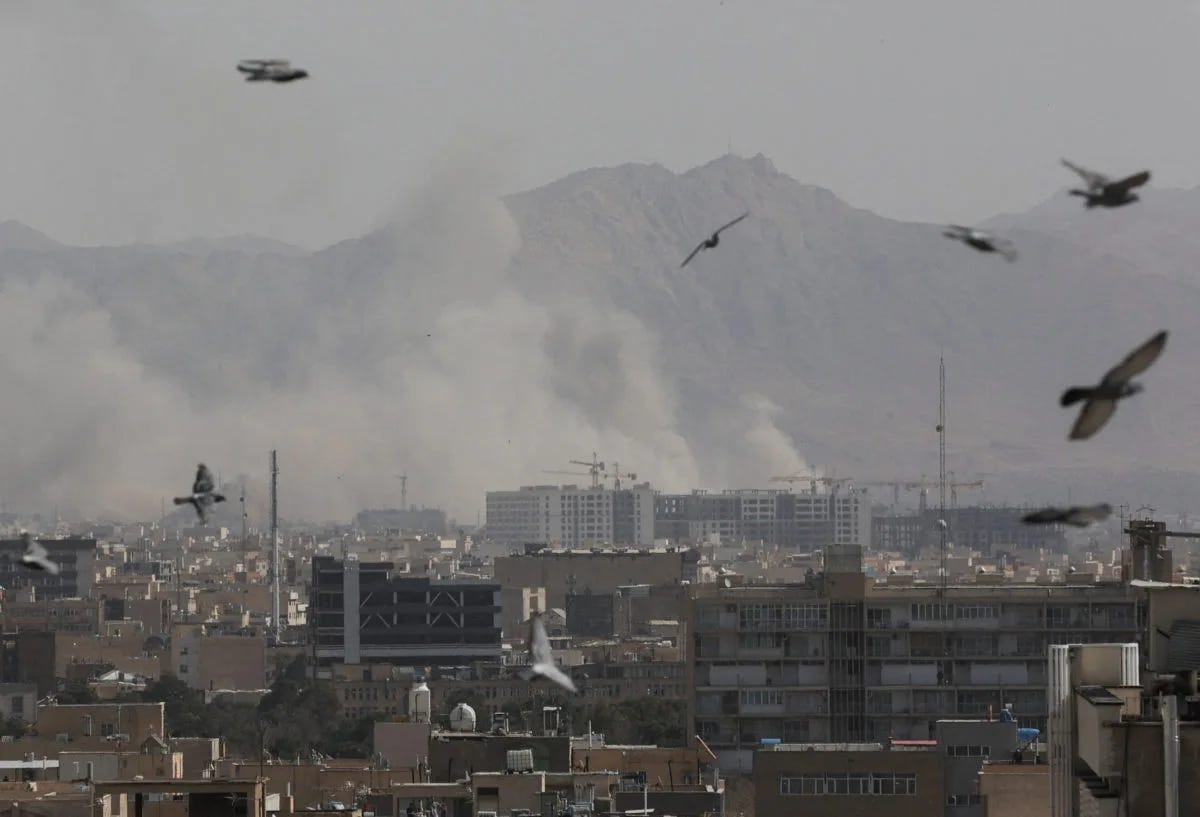
On the morning of February 28, 2026, “Israel” launched a surprise strike deep inside Iranian territory, describing the attack as “preemptive,” aimed at eliminating threats surrounding the state. The U.S. administration responded by saying the strike came in reaction to intelligence indicating Iran’s intention to carry out an offensive action against the United States and “Israel.”
Within hours, global media outlets were reporting on the attack, echoing the Israeli defense minister’s characterization and oscillating between describing it as “preemptive” or “preventive,” while pointing to Iran’s nuclear and missile programs as supporting evidence for that narrative.
In reality, this was far from the first time “Israel” has framed its assaults on states and individuals as either “preemptive” or “preventive.” The roots of this terminology stretch back decades, when its wars were largely confined to confrontations with Arab states and when international law and global norms of justice still carried considerable moral weight.
Over the past two years, however, such rhetoric has intensified, fueled by mounting Israeli attacks across the Middle East and by its manipulation of international law through elastic military language language that other powers have likewise adopted.
Vladimir Putin invoked similar logic in Russia’s war on Ukraine, and the United States did so in both its threats toward Canada, Cuba, and Greenland and during the 2003 invasion of Iraq, when George W. Bush described the war as America’s “right to act preemptively against threats before they are fully formed.”
The following lines seek to unpack Israel’s wartime lexicon its historical and contemporary manifestations and to situate it within the framework of international law, particularly in light of its latest assault and the questions of accountability it raises.
A History of Justified Aggression
Amid escalating hostility between “Israel” and Arab states, and nearly two decades after the Nakba, Israel’s military establishment found itself in a position to initiate war armed with extensive intelligence regarding Arab capabilities and the nature of inter-Arab political and military ties.
In 1967, “Israel” launched what it would later describe as its first preemptive war. Then–Prime Minister Levi Eshkol publicly warned Arab states that his government would respond forcefully to sources of “terrorism” and that the Israeli army would march toward Damascus. Shortly thereafter, some 13 brigades were mobilized along the Syrian border.
This culminated in a surprise Israeli air assault, meticulously planned and rehearsed, which quickly altered the course of the fighting. Notably, throughout the six days of war, “Israel” insisted that Egypt had initiated hostilities. Only after consolidating control did it acknowledge that the war had been a “preventive strike” against a potential Arab invasion while simultaneously refusing to bear the consequences of the war or withdraw from the territories it occupied.
Nearly two decades later, on June 7, 1981, “Israel” carried out “Operation Opera,” a surprise air raid conducted by eight F-16 fighter jets that destroyed Iraq’s Osirak nuclear reactor near Baghdad. The operation was justified as a preemptive move to prevent Saddam Hussein from acquiring nuclear weapons.
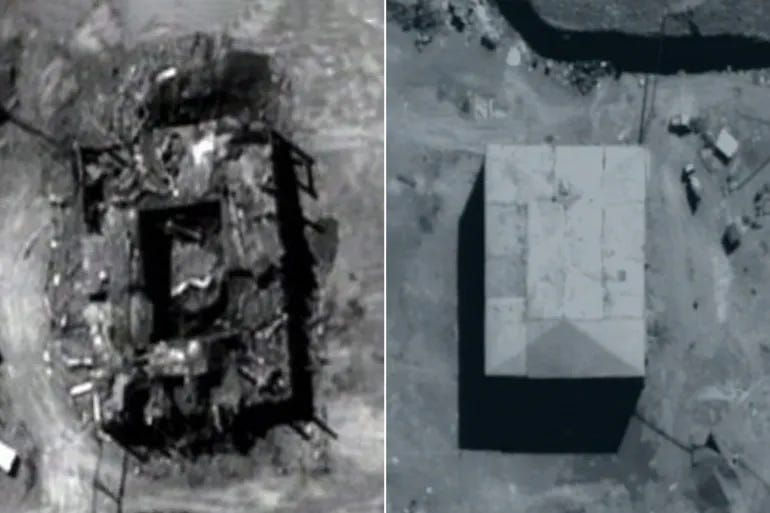
The same argument preempting the acquisition of nuclear arms was invoked again in Syria. On the night of September 6, 2007, Israeli warplanes bombed the al-Kibar facility in Deir ez-Zor, reportedly intended as a joint Syrian–North Korean–Iranian nuclear energy project.
According to later disclosures, the Mossad had tracked a North Korean scientist and infiltrated his personal computer, obtaining engineering blueprints for the site. The airstrike leveled the building with more than 17 tons of explosives, reportedly killing ten Korean and Syrian scientists.
Although “Israel” did not initially claim responsibility, it acknowledged the operation in 2018, asserting that the strike reflected the so-called Begin Doctrine, under which Israel reserves the right to prevent hostile states from acquiring nuclear capabilities.
The pairing of preemptive rhetoric with overt military aggression has recurred in Israel’s wars on Gaza, in attacks against Iran’s nuclear program between 2010 and 2021 ranging from cyber operations that caused explosions and casualties to coordinated assassinations of nuclear scientists reportedly aided by artificial intelligence.
The pattern extended to the August 2024 strikes on Lebanon and culminated in the June 2025 assault on Iran, when the term once again dominated headlines. Israel justified the war as an effort to forestall Iran’s attainment of a nuclear bomb by crippling its entire nuclear infrastructure through assassinations and targeted explosions.
Attack First, Justify Later
According to Stacie Goddard, professor of political science at Wellesley College, Israeli leaders routinely describe their strikes as preemptive, though they often resemble preventive wars more closely. In political science, the former refers to offensive action designed to thwart or mitigate the damage of an imminent enemy attack.
By this definition, preemptive strikes must be wholly defensive in nature, predicated on a threat that is immediate and substantiated by concrete evidence. The danger cannot be speculative or based on conjecture. Preventive war, by contrast, rests on the principle that fighting now is preferable to fighting later.
This distinction grants military leaders greater latitude in choosing the time, place, and method of attack latitude not afforded under genuine preemption, which is intended to blunt an impending assault.
The concept of imminence in self-defense law remains contested. Classical interpretations, rooted in the 1837 Caroline incident, require that necessity be “instant, overwhelming, leaving no choice of means, and no moment for deliberation.”
Tamir Moustafa similarly underscores the importance of distinguishing between preemptive and preventive war. International law largely accommodates preemptive self-defense under Article 51 of the UN Charter, provided that claims are immediate and fact-based.
Article 51 recognizes the inherent right of states to use force in self-defense if an armed attack occurs, pending Security Council intervention. Yet this right is not absolute; it must be exercised with necessity and proportionality. While a state need not wait to absorb the first blow, there must be credible confirmation that an attack is imminent.
Under customary international law, anticipatory self-defense may fall within Article 51’s scope, provided that imminent threats are clearly established.
With regard to the Israeli military, Moustafa argues that armies may resort to either preemptive or preventive wars depending on circumstances. Preventive wars, however, allow them to balance costs and benefits, secure offensive advantage, and accrue greater autonomy, material resources, and prestige than in defensive postures.
This dynamic may apply to the Israeli army, whose organizational culture arguably inclines it toward offensive action as part of its institutional identity and historical practice.
Despite this culture, Devang Kala, a legal scholar at the Jindal Forum for International and Economic Laws, considers the Israeli operations dubbed “Roar of the Lion” and “Rising Lion” unlawful under the UN Charter. In her assessment, they constitute unilateral and unjustified uses of force.
There is no evidence, she argues, that Iran used force or launched an armed attack against “Israel.” Moreover, the current strikes fail the necessity test, particularly as negotiations between Iran and the United States—mediated by Oman—were underway to revive a nuclear agreement. It is therefore implausible to frame the strikes as Israel’s last available option to avert a potential nuclear threat.
Conversely, Michael Schmitt, professor of international law at the University of Reading, contends that the persistent hostilities between “Israel” and Iran since June 2025 alter the legal calculus. Once war has broken out, he argues, self-defense may entail dismantling the adversary’s military capacity entirely to eliminate the threat. Waiting to suffer the first blow would be neither reasonable nor effective.
Schmitt cites the legal reasoning of Yoram Dinstein, former president of Tel Aviv University, who maintains that a justifiable attack requires demonstrated hostile intent, capability, and a closing “last window of opportunity” a phrase frequently invoked by Netanyahu. In such circumstances, military action may be preventive rather than preemptive, even absent a UN Security Council resolution under Chapter VII.
Israel’s Security Lexicon
Schmitt’s reasoning—and that of Dinstein—resonates with Israel’s longstanding reliance on assessments of intent and projection. Its justifications for operations in Gaza, the West Bank, southern Lebanon, southern Syria, Iraq’s interior, deep inside Iran, and even Yemen frequently invoke terms such as “mowing the grass,” “pruning terror,” and “preempting threats.”
Alongside its security vocabulary, Israel has developed a suite of concepts designed to manage what it perceives as future risks, calibrating the use of force below the threshold of genocide, aggression, or full-scale war. Before October 7, it was “mowing the grass” in Gaza; today, critics argue, it is uprooting both the grass and the soil beneath it.
Before the Syrian uprising, strikes were justified as efforts to halt qualitative military transformations supply lines, reinforcements, advanced weaponry. Today, attacks in southern Syria are framed as preventing the emergence of military or social infrastructures that could evolve into future adversaries, under the rubric of “preventing entrenchment” a form of long-term strategic prevention.
Across the Arab world, the doctrine of “cumulative deterrence” applies: calibrated economic, political, and social blows that gradually instill fear and enable military latitude without triggering comprehensive war.
There is also “escalation management” in Jerusalem during Ramadan; “below-threshold response” for precise cyberattacks short of war; “dismantling infrastructure” when targeting specific organizations; and “reengineering the security environment” when military action is coupled with land clearance, checkpoints, buffer zones, and shifting red and green lines.
Each phrase is accompanied by mobilized reserves, forward-deployed forces, a threatening discourse, and an eroding international legal order all in pursuit of a perceived security that “Israel” seeks to manufacture in a region that continues to reject and confront it.
