

In a time when narratives clash and truth erodes between noise and oblivion, the literary voice that can grasp the essence of tragedy becomes more necessity than luxury.
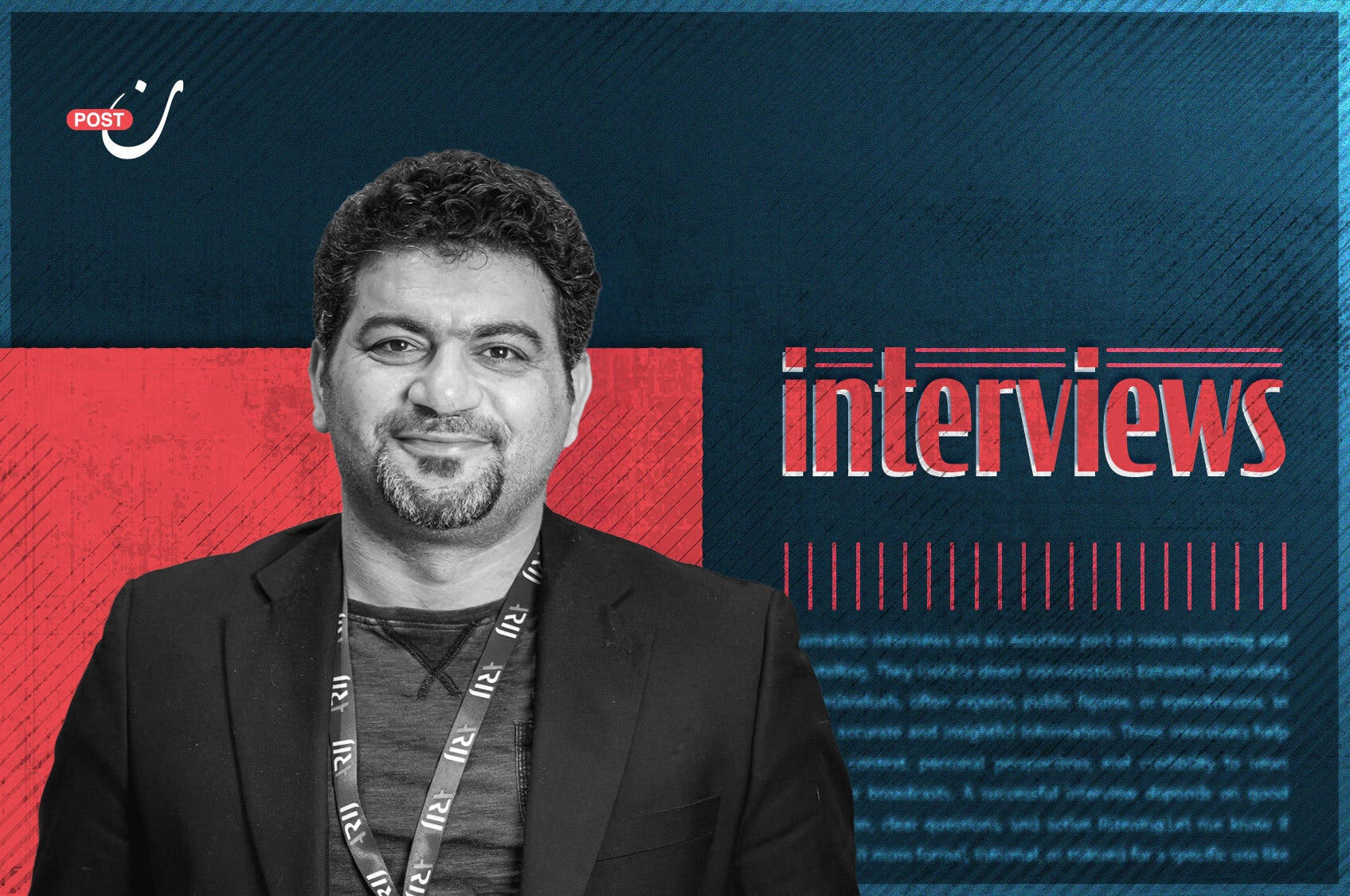
Among these voices is Syrian novelist and journalist Abdullah Maksour, the author of one of the most poignant literary portrayals of the Syrian pain, and the writer of the first novel about the Syrian revolution, Days in Baba Amr a book that captured the moment before it was swallowed by the darkness of the years that followed.
In this exclusive interview with Noon Post, we journey with Maksour back to his early days in Hama, exploring the foundations of his human and professional development, and delve into his trilogy that has come to represent one of the most important literary treatments of Syrian suffering.
From Baba Amr, to Aleppo, and finally to the sea in The Way of Sorrows, where the story ends and his characters are left suspended between life and exile.
We also reflect on his vision of the intellectual’s role in confronting forgetfulness and the fog of discourse. What emerges is a conversation that touches both conscience and intellect, offering the reader something beyond fiction and journalism a space where the human meets the truth.
What he shares here complements what he wrote in his novels, offering a broader image of what Syrians lived through and the transformations they endured. It is a conversation that reveals new layers of his experience and reshuffles the essential questions surrounding memory, justice, and the power of the word.
You were born in Hama. You worked as a journalist and novelist, then as a trainer in journalist safety and conflict-zone reporting. You’re also a creative writing coach. Over the years, you’ve navigated many professional and personal spaces. How did your journey with storytelling begin?
I was born in a land where people had long learned to forget, near the Orontes River, which carries with it streams of ancient tales. As a child, I tried to understand why everything seemed laden with unspoken weight.
Storytelling wasn’t a luxury; it was a survival tool a form of discreet disclosure, whispered as if afraid to be overheard. After the Hama Massacre of 1982, there at the wound’s threshold, I learned the alphabet, the language of silence and speech. I began to collect stories as if gathering scattered tablets before they vanish.
Reading smuggled into my life a second existence, and that led me to journalism. I wasn’t looking for a profession, but for a way to understand a world that always seemed too vast to bear. Journalism became a daily practice of witnessing human beings: their small wounds, their fears, their survival, the nightmares they carried like suitcases through the streets.
The airport became the nearest road to the future, but journalism alone wasn’t enough. It was too sharp, too immediate. I needed something slower, deeper a space that would allow me to recover what I lost between cities, exiles, and fractured dreams.
That’s when narration began: an attempt to reconstruct the world slowly, to gather the shards people drop in moments of chaos. The novel, for me, isn’t just a literary project it’s a way to rebuild myself and my perception of the world.
It’s the space where all my experiences, with all their characters and contradictions, can sit together and continue the story that remains unfinished.
You wrote Days in Baba Amr, the first novel to address the events of the Syrian revolution. You did so at a time when words were perilous. How did you manage the tension between fear and writing? And how do you view the classification of your novel as the first revolutionary work of fiction?
When I began writing Days in Baba Amr, I knew I was stepping into a space like walking a tightrope above a vast void. Fear wasn’t foreign to Syrians it was part of our daily breath: fear of words, censorship, mistakes. As a writer, I was terrified of betraying the narrative in the face of a tragedy too immense to contain. Yet I also sensed, with something like instinct, that silence would be a greater betrayal.
I didn’t write as a neutral observer, nor as a partisan voice, but as a human being who knew lives were being erased. The small details buried beneath breaking news deserved preservation in a way that statements could not offer. Writing was my attempt to stop time, to touch a moment the regime and its machinery sought to erase.
The tension between fear and writing became something I had to train myself in, to learn how to use. Fear reminded me this was real, and writing gave me enough distance to see without collapsing.
As for the classification of the novel as the first fictional account of the revolution, I never saw it as a badge or an achievement, but as a responsibility. I didn’t write to be “the first,” but because I couldn’t remain silent, despite the risks.
If the work was positioned as such, it was due to a specific historical moment when fiction was perhaps still able to capture the pulse of the street before the country shattered into maps of blood.
I didn’t care for the label; I cared not to betray the human experience of those who lived through Baba Amr, Homs, Hama with their voices, their shadows, their fear, their resilience.
I knew fiction wouldn’t change the course of events, but perhaps one day it would give readers a window into what they couldn’t see as it happened, a space for memory to breathe beyond the noise. That was the spirit in which I wrote.
In Return to Aleppo, you wrote about one of the most painful Syrian cities, depicting its experience under regime violence and siege. How did you shape such a brutal narrative without losing the literary voice of the novel?
Return to Aleppo wasn’t merely a return to a city; it was a descent into a dense layer of Syrian anguish, one that wounds the narrator simply by passing through. Aleppo is not easily told. It’s not just a geographical space but a living history of silenced voices and narratives resting uneasily on fear. At that time, people left their homes each morning unsure if they would return by night.
I chose to write through surrealism, anchored by a single conviction: the narrative must yield to the human experience, not the other way around. I wasn’t interested in framing the northern Syrian scene from a political lens.
Instead, I focused deliberately on small details often overlooked but carrying the essence of what happened. The harsh tone wasn’t a stylistic choice but a necessity. Violence wasn’t the backdrop; it was the main event, shaping everything around it.
To preserve the novel’s literary voice, I had to write with balance: to let pain be spoken without turning the text into a report or a manifesto. I searched for rhythm, for a language capable of carrying ruin without becoming ruined itself. I wrote like someone walking a bombed-out street who still looks up to notice a tree that survived the shelling.
This tension between brutality and humanity shaped the tone of the narrative and, I believe, found its way into the psychological structure of the characters as well.
How naturally did the sea journey in The Way of Sorrows emerge from the trilogy’s narrative arc? And why did you choose that particular moment to end the story?
When I reached The Way of Sorrows, the sea wasn’t a last-minute plot twist. It was the inevitable conclusion of a trajectory that began in Days in Baba Amr and Return to Aleppo. The entire trilogy moves along one line: life in Syria being pushed, bit by bit, from home to square, from square to trench, from city to exile, from language to silence. In that context, the sea became the point where all ruin converged.
I saw the characters even when unspoken move toward the sea as if it were their final hope for survival. After the neighborhood had become rubble, the city a siege, life a brutal exercise in endurance, and the homeland an open grave, nothing remained but that uncertain wave, which promised only a chance.
The sea is not a “setting” here, but a consequence the outcome of years of expulsion, fear, pursuit, and the collapse of meaning. Reaching the sea was a natural step, a culmination of long loss, not a narrative device for suspense.
As for ending the story there, it was because the sea was the last boundary I could reach without inventing what lay beyond. Beyond it was no longer narrative, but the unknown a space that belongs to fate and the reader, not the writer.
I wanted the project to end at the moment of decision, the moment of crossing: when a person places their entire life into a small boat and turns their back on the continent that was once their homeland.
Ending the story at sea was less of an ending and more of a mirror: a mirror of a generation’s journey emerging from fire, now standing at the world’s edge, unsure whether it will drown or arrive. At that moment, the trilogy had said all it could. What remained had to be left to silence and the tide.
That’s why The Way of Sorrows begins with the line: “All characters in this work are of flesh and blood. Today, they live their fates in different parts of the world.”
What has writing about Syrian pain taken from you? Has storytelling been a path to salvation, or did it return you to the very anguish you sought to escape?
I lived the Syrian pain like millions of others this is not metaphor. I experienced its details in flesh and bone. Writing about it took more from me than I realized at the time. These weren’t just pages to be written and filed away; they were pieces of soul, memory, and a layer of fear I naively believed could be left behind.
Each time I returned to the text, I was truly returning to the same alleys, the same streets, the voices, the scent memory never forgets, and the faces that now exist only in story.
Yet the paradox is that writing, despite its harshness, was not a punishment nor was it therapy. It was a necessity. Because unspoken pain turns into something formless and blind, haunting you without shape or name. Writing gave me a way to internally organize the destruction, to give it a language that softened its brutality. Still, it wasn’t a clear path to salvation.
It was a path to acknowledgment: that, like many others, I carry within me entire nations in the shape of a mass grave bleeding but unburied. Storytelling is the only way I can continue living with that without being consumed by its silence.
Each novel took me back to the same place, yes but each time from a different angle. It’s like holding hot coals with a slightly thicker glove each time. The pain doesn’t lessen, but it becomes speakable. And that, for me, was enough to survive one more day in a massacre unfolding in every direction.
Perhaps writing took a lot from me, but it also gave something invaluable in return: the ability to see Syrians not merely as victims, but as people who continued to hold onto life against all odds. That meaning alone makes the pain worthwhile, giving narrative a value beyond literature: the value of saying what must not be forgotten, and granting memory the chance to breathe rather than choke.
After writing this trilogy in the heart of Syria’s wound, the landscape has changed. Many have returned home, roles have reversed, and those who once destroyed are now fleeing. Do these shifts open a path for a new book that completes the trilogy, a book about triumph as you wrote about pain?
The question today is not about writing “triumph,” but whether we are capable of naming what is truly happening. Syria’s recent transformations bring back the central question: Has the story ended, or have we merely entered a new chapter?
Many expect a writer to offer a continuation, a transition from wound to healing, from collapse to joy. But literature does not function that way.
Literature doesn’t just record events, it interprets their meaning. I don’t deny that what’s happening today opens a different door a door distinct from the one the trilogy walked through. We are witnessing a stunning phenomenon in collective memory: the fleeing executioner, the returning victim to a home that no longer resembles home.
These shifts produce new layers of questions we haven’t faced before: How does one return to a city whose features have changed? How do you inhabit a house you once fled under threat? How does the oppressor see himself when he becomes the pursued?
This is not an ending. It is the beginning of another story. And yes, there is always space for a text that stands at the boundary between memory and justice, between return and impossibility, between the dead past and the unborn future.
From your position as a novelist and journalist who lived and wrote this experience, what do you see as the first moral and intellectual duty of the Syrian intellectual today?
I believe the first duty of the Syrian intellectual today can be summed up in one sentence: to preserve the truth from disappearing. But this simple sentence conceals complex layers of responsibility and testing.
The Syrian scene today isn’t just one narrative contending with another. It’s a dense web of fragmented stories, competing memories, and interests vying to impose a single interpretation of history. Here, the intellectual’s role whether novelist, journalist, researcher, or historian becomes critical in three key directions:
First: resisting the erasure of memory. The intellectual’s role is not to flatter the moment or rewrite the past to suit any authority, no matter its shape. Their role is to safeguard facts and collective narratives, to preserve victims’ voices without embellishment, and to resist turning tragedy into material for political deals or quick settlements.
Syrian memory today faces distortion and oblivion, and the intellectual stands on its front line of defense.
Second: producing knowledge that rescues meaning. Moral outrage and indignation are not enough. We need precise, coherent, critically free knowledge that reinterprets the past years beyond both political propaganda and abstract victimhood. The intellectual must offer a deeper understanding of violence, social fragmentation, and the reshaping of identity.
Third: restoring the human being to the center of the story. Politics dehumanizes, and war reduces people to numbers. The intellectual must bring the individual back to the foreground their fear, vulnerability, resistance, resilience, and right to dignity. Without this restoration, all cultural effort becomes hollow rhetoric.
What are the foundations of a unified cultural discourse that can speak to Syrians both inside and outside the country, without denying the differences in experience and context?
If we want a cultural discourse that speaks to Syrians inside and in exile, we must first abandon the illusion that there is a single shared experience or emotion. Syrians today live in different geographies, bear different sorrows, and follow varied paths to survival. Yet there is a thread that, if handled with care, can weave a shared language without erasing differences.
That thread is acknowledgment: acknowledgment that the experiences vary, that pain is not one-size-fits-all, and that no one currently holds a mandate to represent everyone.
From that acknowledgment, the foundations of a unified cultural discourse can be built on three pillars:
A discourse that embraces multiplicity rather than imposes a single narrative. The Syrian inside faces distinct living, security, and psychological conditions from one raised in exile. One is trapped in daily life struggles; the other by questions of memory and belonging. A discourse that respects both does not reduce one to the other but opens space for every voice to be heard without guardianship or accusation.
A discourse that redefines “belonging.” The homeland is no longer a fixed place, but a network of connections: language, memory, shared wounds, and a demand for justice. The unified discourse must liberate belonging from geography and reorient it toward shared values: dignity, freedom, the right to life, and rejection of reducing Syrians to pawns in others’ stories. These values can unite both those who lived near the fireline and those across continents.
A discourse that places the human being not authority or ideology at its center. When the human becomes the compass, we move from clashing camps to differing experiences of pain. The question becomes: How do we restore the Syrian’s voice and dreams? How do we rebuild a culture that listens, rather than dictates?
Thus, the unified cultural discourse is not one that dissolves differences, but one that makes them part of identity a discourse that tells every Syrian, wherever they may be: your place is different, but your dignity is the same; your right to tell your story is the same; and our future can only be built with your voice.
