

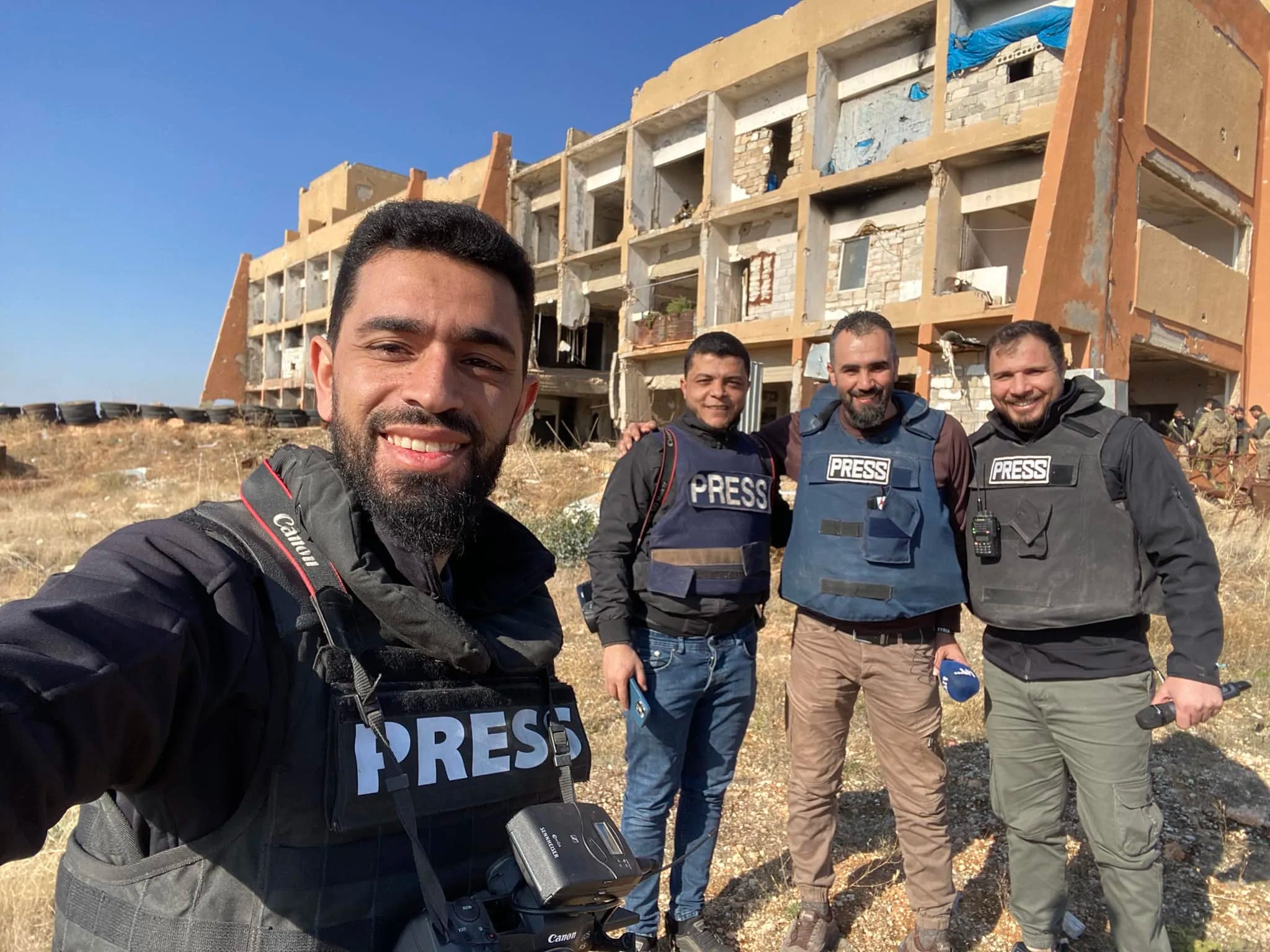
“I believe the name Majed has now become a substitute for Abdul Razzaq, and I prefer to be called by it. It has lived with me all these years. Through it, I experienced the revolution in all its events and details from peaceful protest to war, to displacement, to forced exile until we reached where we are today. The name stayed with me all the way to victory.”
With these words, media professional and political activist Abdul Razzaq Mustafa known as Majed Abdul Noor describes the pseudonym that became inseparable from his media and political struggle against the now-defunct regime during the years of the Syrian revolution, and which continues to accompany him to this day.
The use of pseudonyms was not an isolated phenomenon. Some evolved into powerful symbols etched into the collective memory of Syrians. Perhaps most notable are the names “Caesar” and “The Gravedigger,” both associated with exposing shocking truths that shaped public opinion domestically and internationally and contributed to documenting pivotal moments in the country’s history.
The name “Caesar” was given to defector Farid al-Madhhan, a former military photographer who documented thousands of images of detainees who died under torture. Meanwhile, the nickname “The Gravedigger” referred to Damascus municipal employee Mohammed Afif Naifa, who was forced to work with security services burying detainees’ bodies in mass graves. Both pseudonyms were used to protect them from security persecution after they came into possession of evidence and testimony of grave crimes.
Following the fall of the regime in December 2024, many Syrians awaited the revelation of the true identities behind “Caesar” and “The Gravedigger,” reflecting the profound symbolic weight these names had acquired over the years. Their significance extended beyond Syrian society, particularly in the case of “Caesar,” whose name became associated with U.S. legislation imposing economic sanctions on the former regime and its officials for violations against Syrians.
The phenomenon of using aliases and nom de guerre emerged among journalists, activists, field commanders, and defected officers in the early days of the Syrian revolution. While some names did not gain widespread recognition beyond Syria, many remained deeply embedded in Syrian memory. For their bearers, these names became symbols tied to their personal struggles, continuing in use even after the regime’s collapse.
On the fifteenth anniversary of the Syrian revolution, journalists and activists revisit, in this report, the stories behind the names they chose for their struggle, shedding light on the broader phenomenon of symbolic names in revolutions and their role in shaping collective memory.
Public Exposure… A Death Sentence
In an interview with Noon Post, Abdul Noor explains that appearing in the media at the beginning of the revolution was akin to signing one’s own death warrant. The former regime pursued those who filmed demonstrations, participated in media interviews, or relayed information to international outlets. He notes that adopting a pseudonym was not only for his own protection but also for his family’s, as everyone around him was at risk.
He adds that the name “Majed” was chosen randomly, recalling his first media appearance from Aleppo on France 24, when a colleague hastily gave him the surname “Abdul Noor” moments before going live. Although the name was not carefully planned, it acquired deep symbolic meaning over more than 14 years, becoming so familiar that even his family and children address him by it.
The greatest challenge, Abdul Noor explains, was maintaining the secrecy of his new identity. Over time, the pseudonym became part of who he is not merely a media identity especially as his audience came to associate the name with the person covering the revolution and the battles.
He concludes by saying that Majed is a name he is proud of and will not abandon. His social media accounts still carry it despite the regime’s fall, as do his old press credentials, which he continues to use.
A Long History of Work
For similar reasons, media professional Abdul Karim Ayoub known as Urwa al-Mundhir chose his pseudonym, particularly as he operated in areas under regime control while working for opposition media outlets.
Speaking to Noon Post, al-Mundhir describes such work as “true suicide.” Journalism in regime-controlled areas required extensive security approvals, which were nearly impossible to obtain.
“The work for revolutionary media was a cause that could not be compromised,” he says. “I am from Homs, and I wanted to preserve the narrative that Homs is the capital of the revolution. Reports opposing the regime had to be issued regularly from the province.”
On how he chose his name, al-Mundhir explains that many of the names he considered were already taken, and selecting one was not easy. “A person is shaped by their environment and cannot always think outside it,” he says. He ultimately combined “Urwa,” the name of a character from the TV series Al-Nadam, with “al-Mundhir,” taken from a character in Al-Arrab, forming the name “Urwa al-Mundhir.”
Maintaining secrecy proved difficult, as exposure could have cost him his life, especially while working in regime-controlled areas. To mitigate this risk, he minimized his social circle, scrutinized his relationships, and remained cautious of anyone approaching him.
He notes that the name initially carried no meaning beyond misleading the regime, but it has since become integral to his identity. Those who know him by this name are members of the revolution community and its audience, and to this day, he finds it difficult to introduce himself to them without it.
What About Women Journalists?
Female journalists faced similar circumstances. Journalist Yaqeen Bidou known as Mirna al-Hassan says she was compelled to use a pseudonym early in her career to protect her family, especially as she relied on them to obtain official documents from areas under regime control. It also helped her avoid potential repercussions amid the unstable security situation in Idlib, where she lived and worked.
In her interview with Noon Post, al-Hassan explains that the name initially held no particular symbolism, but it gradually became part of her professional identity and a means by which colleagues and audiences recognized her. It accompanied her from the outset of her career and was tied to the mission she sought to accomplish, providing a sense of safety and continuity.
Even after her real name became known, she chose to continue using “Mirna al-Hassan” among colleagues and the public as a distinctive marker and personal brand.
A Means of Protection
Syrian journalist and writer Ghassan Yassin explains that many Syrians especially journalists, activists, and revolutionaries were compelled to adopt pseudonyms during the revolution to protect their lives and those of their families in the face of the regime’s security grip. These names served as a shield, enabling them to continue their media and revolutionary work in a repressive environment.
Over time, however, pseudonyms transcended their protective function, evolving into symbols embedded in Syria’s collective memory. They came to embody values such as courage, heroism, and resistance, reflecting the revolution’s trajectory from peaceful protests to various forms of struggle.
Yassin notes that the symbolic power of these names has extended beyond local society, becoming part of the broader narrative of the revolution passed down to future generations through schools, culture, street names, songs, and drama thus cementing their place in national memory.
In this way, pseudonyms illustrate how personal tools of protection can transform into symbols of collective and historical significance, explaining the continued interest in documenting and analyzing their social and political impact.
From Personal Symbolism to Public Impact
The symbolic weight of these names among media professionals reveals a broader phenomenon concerning how symbolic naming functions in revolutions and wars and how it shapes collective memory and sensitivity to misuse or distortion.
Social researcher Talal Mustafa explains that such symbolism takes shape in collective consciousness when an individual’s name becomes tied to a broader revolutionary narrative, a tragic event, or a heroic act.
Symbolism is further reinforced through the circulation of images, videos, and reports, as well as repeated references across media platforms and oral testimonies, amplifying the name’s resonance. Names associated with resistance, courage, or exposing injustice gain symbolic power more rapidly, as they encapsulate the revolutionary experience in a single term.
Mustafa adds that the use of pseudonyms in revolutions and clandestine political work is historically widespread across the world, particularly in contexts involving risks of imprisonment or death, as was the case during the Assad era.
In global experiences such as the French Revolution, European revolutionary movements, and in Latin America, activists adopted aliases to conceal their identities. Similarly, in resistance movements against Israeli occupation such as the Palestinian resistance fighters used symbolic names to avoid arrest or assassination. In many historical cases, these aliases overshadowed real names even after victory and the end of danger.
In the digital age, the internet and social media have become key platforms for pseudonymous activity, allowing activists to share information or document violations without revealing their identities. While the primary goal remains personal protection, in some cases these names evolve into collective symbols as seen in Syria.
Mustafa outlines several factors that enable certain names to acquire greater symbolic weight during revolutions, including courage and personal sacrifice, memorability and ease of circulation, and moral and cultural resonance.
Media coverage also plays a critical role: names that receive widespread exposure become more deeply ingrained in collective consciousness. Longevity is equally important, as names that continue to circulate after the revolution through testimonies, books, or artistic works secure a lasting place in long-term memory.
He concludes by highlighting ways to protect the symbolic integrity of such names from distortion, including public awareness campaigns about their origins and meanings, media solidarity, legal protections, and cultural preservation through books, documentaries, museums, and art exhibitions ensuring their status as ethical and cultural symbols.