

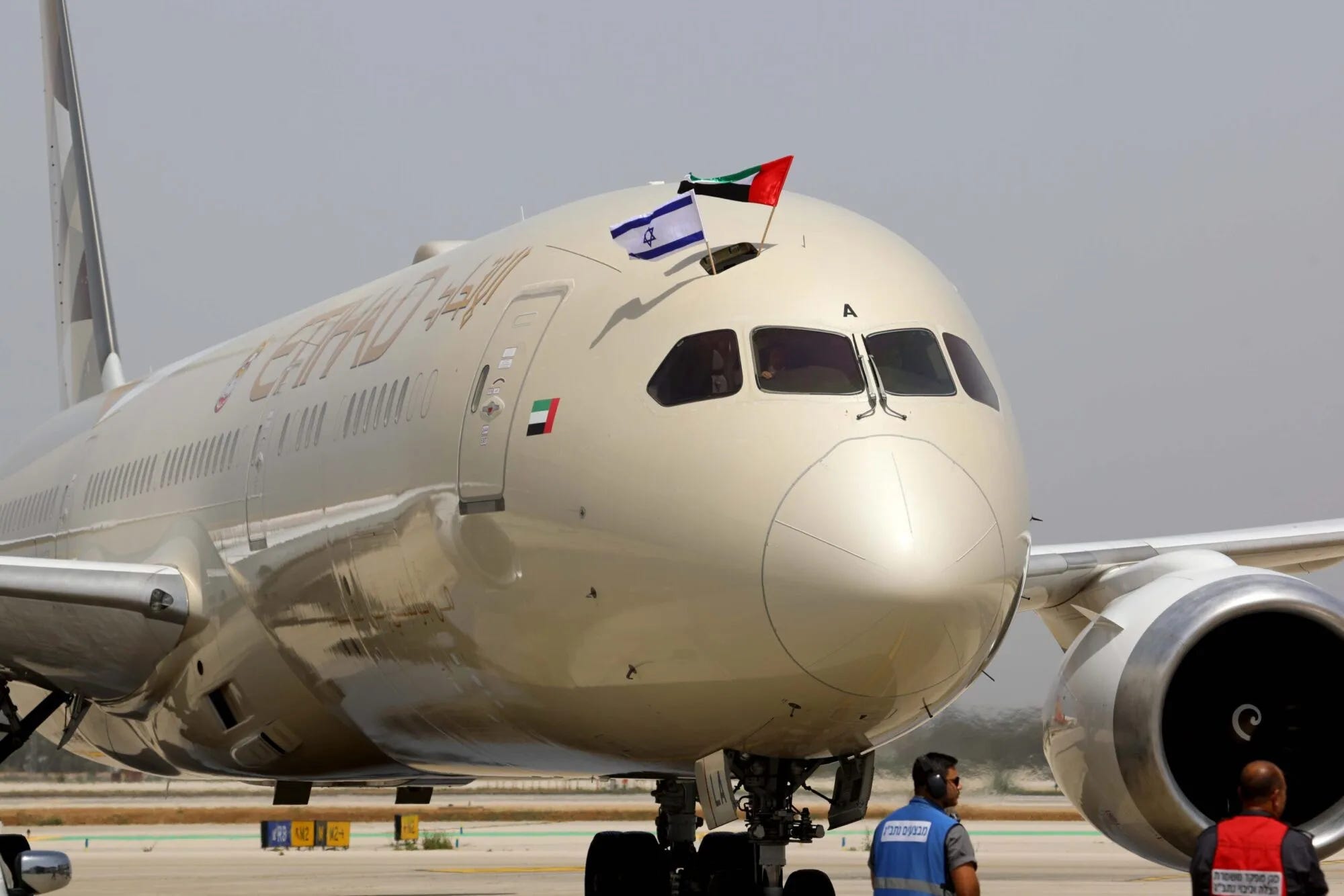
In a first since its founding in 2003, Etihad Airways the Abu Dhabi government-owned carrier has announced the launch of a new, regular flight route offering six daily flights to “Israel”.
This marks the first time in the airline’s history that a route exceeds five flights per day, underscoring the deepening ties between the UAE and Israel since the signing of the Abraham Accords in 2020 ties that now appear to outweigh political or ethical considerations.
The route officially launched on June 15, and currently includes connections to destinations such as Bangkok, Riyadh, and Mumbai. It operates on a schedule of 42 flights per week.
The expanded service reflects a growing demand for travel between the two sides, positioning “Tel Aviv” as a regular destination among the busiest in Etihad’s network effectively helping Israel mitigate the costs of the international isolation it might otherwise face.
Etihad’s “Israel” station, led by Ran Volk, is now ranked fifth among the airline’s destinations outside Europe, following Germany, France, Spain, and Italy.
According to Volk, “The decision to operate six daily flights to Tel Aviv is an important milestone. It reflects the airline’s commitment to deepening air connectivity between Israel and the UAE, and to linking Israel with the wider world through Etihad’s global network.”
Breaking Israel’s Isolation
Air travel between the UAE and Israel has grown rapidly since direct flights began in 2020. The number of flights gradually increased, reaching a peak of 10 daily flights in 2021, and at times even 14 per day.
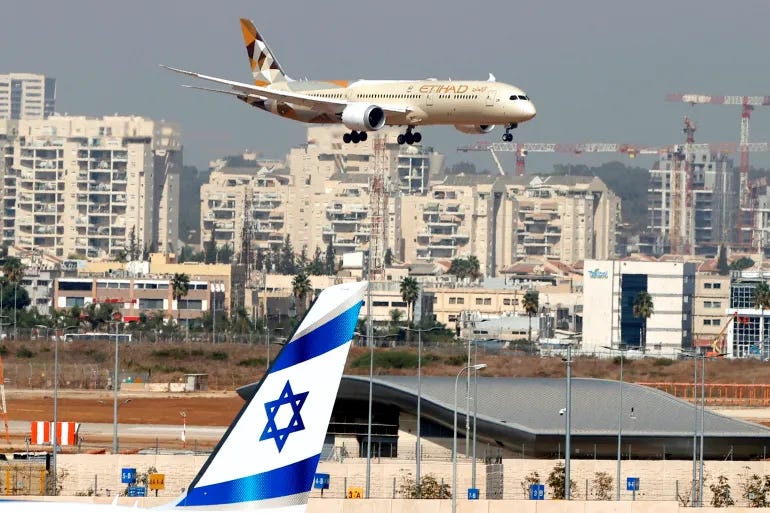
Today, with Etihad’s addition of six daily flights, the total number of direct daily flights has reached a new record a milestone boosted by a noticeable rebound in 2025:
Over 300,000 passengers traveled from Israel to Abu Dhabi on Etihad flights in 2025, with an average occupancy rate nearing 90%.
Around 30% of these travelers visited Abu Dhabi for leisure, while 70% continued on to farther destinations across Asia via Etihad’s global network.
This surge in air connectivity has stimulated travel and tourism between the two sides, albeit in a markedly unbalanced manner. The UAE has rapidly become one of the most popular tourist destinations for Israelis. For instance, early 2025 data and reports revealed that:
Dubai topped the list of winter destinations for Israeli travelers, accounting for over 10% of all departures from Ben Gurion Airport.
In just the first ten months of 2022, more than 150,000 Israelis visited the UAE, compared to only about 1,600 Emiratis visiting Israel during the same period.
This stark disparity indicates that the economic benefits of tourism normalization are largely flowing toward the Emirati tourism sector and broader economy though Israel’s economy also reaps indirect rewards.
As travel volumes increase, so do revenues for Israeli airports and airlines (such as El Al and Israir), and tourism agencies on both sides have seen a boost in activity.
According to the “Israel” Airports Authority, passenger traffic through Ben Gurion Airport surged by 33% in 2025, reaching 18.5 million passengers up from just 13.9 million in 2024, a year that saw travel heavily impacted by the war. Flights from the UAE remained among the airport’s most active routes.
Sustaining Flights Amid the War
The boom in air travel faced a critical test during Israel’s war on Gaza (2023–2025). As global carriers like Delta and Lufthansa suspended or repeatedly interrupted service to Israel, international travel declined sharply.
Passenger traffic through Ben Gurion Airport fell by nearly half compared to the previous year. Yet in stark contrast, Emirati flights continued helping break Israel’s isolation and maintaining its air links with the world during the height of the crisis.
Flydubai and Etihad Airways both maintained regular service between Dubai/Abu Dhabi and Tel Aviv, illustrating the UAE’s determination to separate its normalization strategy from the human toll of the war in Gaza. Statistics show that Flydubai:
Operated over 1,800 flights to and from Israel since the outbreak of the Gaza war in 2023.
Canceled only 77 flights during that period.
Carried out more than 200 flights in September 2024 alone.
Etihad Airways likewise maintained daily service to Tel Aviv throughout the war, alongside Israeli carrier El Al, relying on security monitoring and precautionary protocols as needed.
The Times of Israel reported that flights from the UAE were virtually the only international routes to remain operational during the war preserving a minimal level of air connectivity with Tel Aviv at the height of its crisis.
Following the October 2025 ceasefire, global airlines began to cautiously resume flights to Israel, resulting in a significant uptick in passenger volume in December (+59% year-over-year).
Over the full year of 2025, Ben Gurion Airport regained much of its pre-war activity, serving 18.5 million passengers a 33% increase from 2024, though still below 2023’s pre-war levels.
These figures underscore the blow the war dealt to Israel’s aviation sector while also highlighting the crucial role Emirati airlines played in bridging Israel’s aerial isolation. Thanks to them, thousands of Israelis were able to travel for business or leisure even in the midst of conflict.
Air Routes as a Pillar of Normalization
The past few years have shown that direct flight routes have become one of the most enduring pillars of normalization between the UAE and “Israel”.
Despite regional instability and widespread public anger across the Arab world over the war in Gaza, Abu Dhabi has doubled down on its partnership with Israel.
Rather than sever ties under pressure, official visits have continued, air links have remained uninterrupted and economic cooperation has even intensified.
Trade between the two countries grew at the height of the war, with bilateral commerce reaching $3.2 billion in 2024 an 11% increase from the previous year, reflecting a broadening of mutual interests even during the most sensitive periods.
The UAE also maintained its diplomatic presence in “Tel Aviv” throughout the conflict, even as public calls mounted for a freeze in normalization.
Commenting on this, Dina Esfandiary, an advisor at the International Crisis Group, said: “The continuation of flights between the two sides during the war symbolizes the UAE’s commitment to its relationship with Israel, no matter what.”
Bahraini analyst Ahmed Al-Khuzai told The Times of Israel that “The Abraham Accords have proven more resilient than older peace treaties with Egypt and Jordan. They withstood the October 2023 storm and the economic and popular ties between the UAE and Israel held firm.”
Etihad’s decision to increase its “Tel Aviv” service to six daily flights is more than just an operational detail. It signals a new phase in which the UAE-”Israel” relationship is managed as a routine service one that is expanded and marketed in the language of “demand” and “global connectivity,” while the costs of occupation and war are pushed to the margins.