

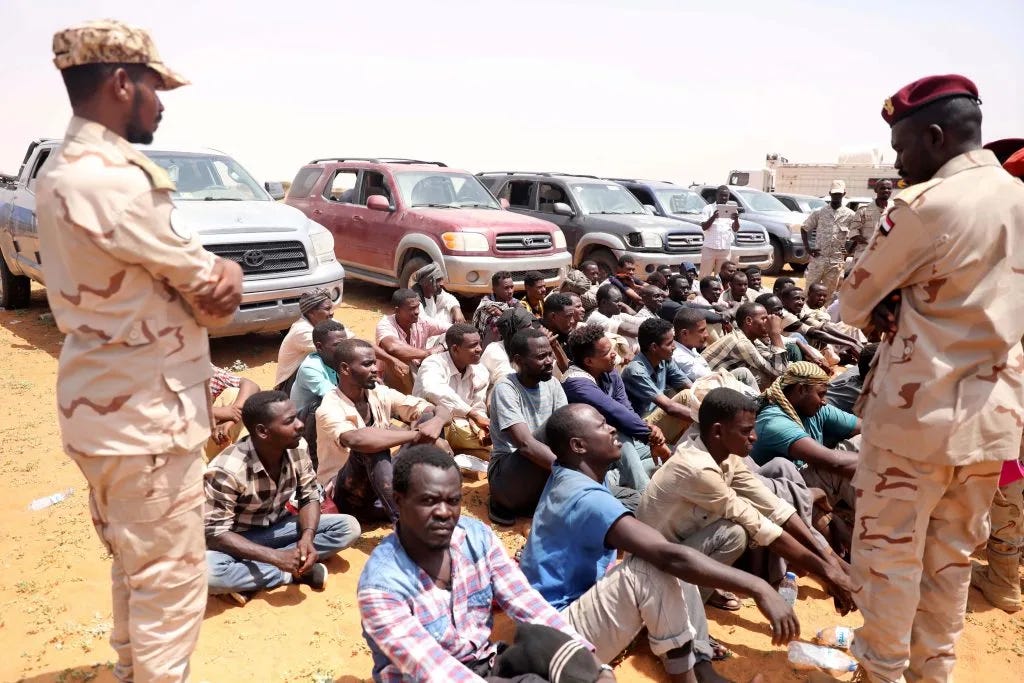
The Rapid Support Forces (RSF) militia has established a pattern of committing atrocities—including killings, rape, and genocide in the areas it attacks. In Darfur, western Sudan, it has swiftly erected a system designed to instill fear in the population, centered on a network of prisons and detention facilities.
Evidence suggests that the militia’s repeated attempts to detain university and school professors, journalists, volunteers, feminist activists, doctors, pharmacists, and community leaders are not merely aimed at silencing dissent. Rather, they form part of what could be described as the “engineering of society through fear.”
RSF detention centers across Darfur range from former state-run facilities seized by the militia—including police detention sites—to newly established civilian and clandestine locations created to accommodate the vast number of detainees.
Individuals are held without judicial warrants, even nominal ones. Mere suspicion of sympathy with the army or its allies is sufficient to land someone in prisons where various forms of torture are routinely practiced. Refusing the militia’s attempts to seize personal property can also result in imprisonment, under accusations of collaboration with the armed forces.
The Epicenter of Punitive Control
Dagreis Prison, originally constructed by the government prior to the war as a rehabilitation complex with training workshops and facilities capable of housing around 5,000 inmates, has become a site of terror, according to Sudan Tribune. The militia now detains thousands there.
Located 25 kilometers west of Nyala in South Darfur, Dagreis has become a powerful symbol among RSF fighters. Civilians are frequently threatened with being sent there due to the torture reportedly carried out within its walls.
A report published by Darfur24 in September 2025 estimated that around 3,000 detainees were being held in Dagreis, including army prisoners and civilians. It noted that five individuals are often crammed into cells measuring just one by two meters. Visits are prohibited unless mediated by local community leaders.
In December, the Sudan Doctors Network reported that the militia was holding more than 19,000 people across Dagreis, Kober Prison, and other detention centers, including 5,434 civilians—among them 73 medical professionals—while the rest include politicians, journalists, and individuals from other civilian professions.
The Emergency Lawyers Group documented deaths inside Dagreis due to starvation, mistreatment, and lack of medical care. Meanwhile, the Justice Committee reports severe shortages of food and water, with detainees often receiving only a single piece of food per day and limited access to non-potable water.
The committee further estimates that the number of detainees has exceeded 160,000, as detention facilities have expanded to include administrative buildings and residential homes forcibly incorporated into the prison complex. It also documented widespread abuse, including verbal humiliation, forced degrading acts, severe beatings, electric shocks, and the extinguishing of cigarettes on detainees’ bodies.
Although the figures cited by the Justice Committee in its January 29 report appear staggering, they gain credibility from remarks by RSF commander Mohamed Hamdan “Hemedti,” who recently acknowledged the overcrowding.
“The prisons are full even Dagreis Prison in Nyala is completely full,” Hemedti stated, in what amounts to a public admission of mass civilian detentions in Darfur. Reports of new arrests continue to emerge daily, particularly following airstrikes.
Militia Justice
Kober Prison ranks second in capacity in Nyala, holding more than 800 detainees on various charges, most notably espionage and collaboration with the army. However, it was attacked by an RSF-affiliated armed group in mid-last year, resulting in the deaths of 12 detainees.
Detentions in Kober and elsewhere often extend for prolonged periods amid the collapse of judicial institutions including courts, prosecution offices, legal practices, and prison police allowing for the emergence of an alternative system based on detention without family notification or trial.
The RSF relies on accusations such as espionage, collaboration with the army, or refusal to join its ranks without evidence or judicial oversight. Detention has thus become a strategy for controlling local communities.
This control is exercised through direct threats of imprisonment for those who defy militia orders, as well as through the spread of fear via testimonies from former detainees and families of victims of enforced disappearance. The result is a perception of absolute authority over civilians’ lives through an extensive network of formal and informal prisons.
Women with Their Children
Beyond Dagreis and Kober, dozens of other detention sites exist in Nyala, including one known as “UNICEF,” a former facility used by the United Nations children’s agency prior to the war. It now holds professionals, including journalist Muammar Ibrahim, who was arrested during the assault on El Fasher.
Korea Prison in Nyala stands as a stark symbol of the suffering endured by women in Darfur under RSF rule. It holds around 600 women detained from North, Central, and South Darfur, along with 50 children held alongside their mothers, amid severe shortages of food and drinking water.
A report earlier this year indicated that most of the women were detained on accusations of espionage, collaboration with the army, or providing airstrike coordinates, while others were imprisoned for refusing to join the militia. Some are held for crimes allegedly committed by their husbands.
By March, the number of female detainees had risen to 643, according to the African Center for Justice and Peace Studies. Among them are 200 women accused of cooperating with opposition groups and 247 transferred from El Fasher without formal charges.
The center reports that detained women face multiple violations, including arbitrary detention, unfair trials, and inhumane conditions. Some are forced into domestic labor, while others are subjected to extortion in exchange for ransom payments.
In a further indication that detention is being used as a tool of control, the militia arrested women’s rights activists in March after they participated in a workshop on women’s rights in Nyala. They were denied contact with their families amid warnings of possible torture and sexual violence.
El Fasher: Crimes Without Limits
The RSF has not limited itself to committing atrocities—including acts of genocide—in El Fasher, North Darfur. It has also converted educational and medical facilities into detention centers in what appears to be a deliberate attempt to reshape society through force.
Detainees are held in locations including student dormitories at the University of El Fasher, the former headquarters of the UN-African Union mission (UNAMID), and research authority buildings. Some are transferred to Shalla Prison, which holds around 3,000 men and 500 women accused of mobilizing with the Sudanese army.
The militia has even converted a children’s hospital into a detention center holding approximately 2,000 people, including North Darfur Health Minister Khadija Musa, medical staff, civil servants, community leaders, and teachers. Additional detention sites include facilities previously dedicated to women and child protection, stock exchanges, and private homes.
In some of these locations, the militia reportedly carries out executions by gunfire, rape, and financial extortion. Al Jazeera previously reported the existence of a network of secret detention centers where detainees are subjected to torture, rape, extortion, and slow death in water-filled pits.
The detention system extends beyond South and North Darfur, although Nyala remains the central hub due to its status as the militia’s main stronghold and seat of its parallel administration. The network of prisons spans all areas under RSF control.
On March 28, the RSF arrested five university professors in Zalingei, Central Darfur, placing them in the state prison as part of ongoing arrest campaigns. Politicians, former military personnel, and civil service leaders continue to be detained across East and West Darfur and West Kordofan.
A Tool of Control
A common feature unites all detainees in RSF prisons, regardless of ethnic or professional background: no formal charges, no court appearances, and no notification to their families regarding their whereabouts.
Accusations such as collaboration with the army or providing airstrike coordinates are rarely supported by evidence. The militia operates outside any legal framework, rendering such charges mere pretexts for controlling communities.
Detention is not intended to lead to trial but to instill fear across society. As a de facto authority, the RSF neither prosecutes detainees for criminal offenses nor allows family visits, transforming imprisonment from a corrective measure into collective punishment without charge.
Through actions such as arresting activists attending a workshop, the militia signals that even peaceful gatherings held behind closed doors are prohibited. The detention of community leaders further demonstrates that it recognizes no limits to its use of violence. At its core, this system represents a deliberate attempt to reengineer society under the weight of intimidation and coercion.
