

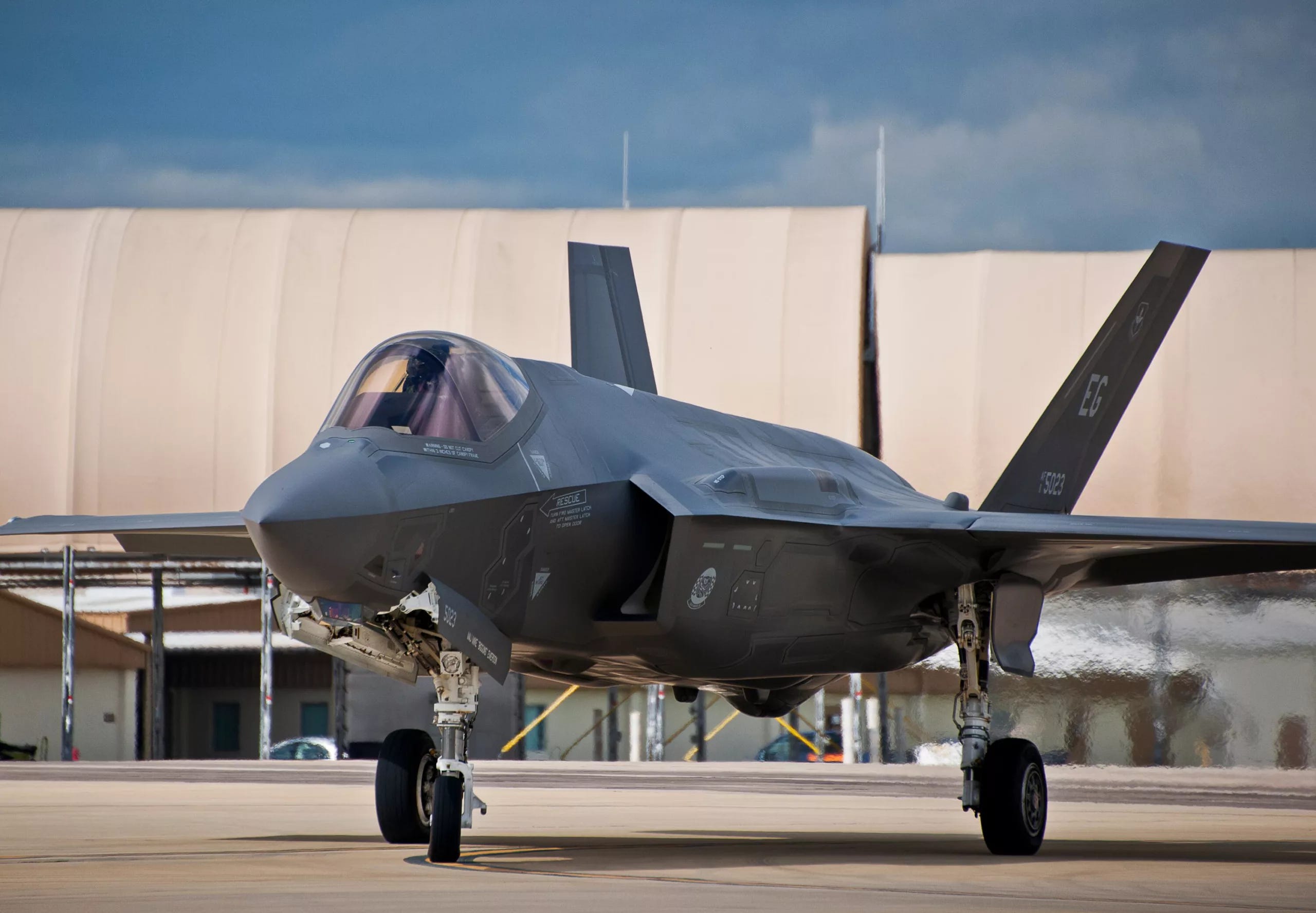
On November 18, 2025, during Saudi Crown Prince Mohammed bin Salman’s visit to Washington, President Donald Trump announced his intention to move forward with the approval of selling F‑35 fighter jets to Saudi Arabia.
This marked a shift from previous administrations, which had hesitated to sell such advanced stealth aircraft to Arab states out of concern for preserving Israel’s Qualitative Military Edge (QME). On the surface, the announcement signals new flexibility in how Washington engages with its regional allies.
However, significant legal and procedural hurdles remain, including Congressional approval and stringent security safeguards.
The announcement was enthusiastically welcomed by Saudi media, a reaction Axios analyst Barak Ravid deemed exaggerated. He pointed to U.S. officials’ assurances that the deal would not undermine the QME enshrined in both U.S. and Israeli law.
Ravid’s comments and the U.S. announcement raise critical questions: What version of the F‑35 would Saudi Arabia receive so as not to compromise Israel’s qualitative edge? Would Riyadh receive a downgraded variant? What would its specific capabilities be? And how would the U.S. reconcile the deal with broader strategic and regional military balances?
What Do We Know About the F‑35?
The F‑35 Lightning II is a fifth-generation, multi-role stealth fighter jet developed by Lockheed Martin. Designed to conduct air-to-ground attacks, reconnaissance, and air defense missions within a single platform, the F‑35 is a comprehensive combat aircraft.
It is distinguished by its stealth capabilities and sensor fusion technology, giving pilots a 360-degree view of the battlespace. It also functions as an airborne data hub, relaying tactical information to friendly forces making it a powerful force multiplier in joint operations.
Technically, the jet measures approximately 15.7 meters in length, with a wingspan of 10.7 meters. It can reach altitudes above 15,000 meters and speeds of up to Mach 1.6. Combining high maneuverability, electronic warfare systems, and an intelligent logistics network for maintenance, the F‑35 is a strategic platform that can shift the balance of power in any conflict.
One Model or Multiple Variants?
The F‑35 comes in three primary variants tailored to different operational needs. Though they share about 80% of their core components, their capabilities vary based on takeoff and landing configurations and mission profiles.
F‑35A (Conventional Takeoff and Landing): The most widely used variant, optimized for air-to-air combat, ground attack, and multirole missions. Operators include the U.S., U.K., Italy, the Netherlands, Norway, Denmark, Australia, Japan, Israel, and Canada.
F‑35B (Short Takeoff/Vertical Landing): Built for operations from smaller bases or amphibious assault ships, offering flexibility for forward deployment. Used by the U.S. Marine Corps, U.K., Italy, Japan, and Singapore.
F‑35C (Carrier Variant): Designed for aircraft carrier operations, it features larger wings and specialized landing gear. Operated by the U.S. Navy and select allies.
All three variants offer supersonic speeds, advanced stealth, cutting-edge avionics, and extensive operational range. Each is powered by the Pratt & Whitney F135 turbofan engine.
Arab Pursuits of the F‑35
As of late 2024, nearly twenty countries had acquired various F‑35 models either as development partners or through Foreign Military Sales. However, no Arab country is among them. Israel remains the sole Middle Eastern operator of the aircraft.
Both the UAE and Qatar have previously sought to acquire the F‑35, but negotiations stalled due to U.S. concerns about technology security and Congressional commitments to Israel’s QME, ultimately blocking Arab access to the jet.
Now, Saudi Arabia is seeking to purchase 48 F‑35 aircraft. If the deal proceeds, it would make the Kingdom the first Arab state to operate the stealth fighter.
What About Israel’s F‑35A Variant?
Israel’s F‑35A “Adir” is not identical to the models sold to other nations. The Israeli Air Force operates one of the most advanced F‑35 variants, enhanced with features that make it nearly impossible to detect.
The aircraft can execute multiple missions air combat, ground attack, reconnaissance, and electronic warfare in a single sortie. Powered by the F135 engine, it reaches speeds of Mach 1.6 with a combat range of approximately 1,100 kilometers and can refuel mid-air.
It carries weapons internally to maintain stealth, including air-to-air missiles and precision-guided bombs, with the option of external hardpoints when stealth is not prioritized. Its integrated electronic suite offers a unified battlefield picture, aided by multi-sensor fusion and a helmet-mounted display that delivers real-time data to the pilot.
The “F‑35I” Adir includes several Israeli-specific upgrades such as indigenous electronic warfare systems, communications tools, and customized munitions, as well as modifications enabling long-range strike capabilities. Israel has already deployed the jet in thousands of combat missions.
What Is the QME Law?
Since the 1970s, Washington has treated Israel’s Qualitative Military Edge as a strategic imperative. This principle was codified into U.S. law in 2008.
Eight main mechanisms underpin the QME:
Preferential access to advanced weaponry.
Restrictions on arms sales to regional states.
Massive U.S. military aid to Israel.
Deep intelligence cooperation.
Joint missile defense initiatives.
Diplomatic support in international forums.
Pre-positioned U.S. military stockpiles in Israel.
Advanced joint research in military technologies such as AI, drones, electronic warfare, air defense, and long-term co-development projects.
Could Saudi Arabia Be an Exception?
According to Barak Ravid’s report on Axios, U.S. Secretary of State Marco Rubio assured Israeli Prime Minister Benjamin Netanyahu that the F‑35 deal with Saudi Arabia would not endanger Israel’s military edge. American and Israeli officials stated the Kingdom would receive a limited-capability version of the aircraft.
Rubio pledged to continue consulting with Israel to uphold U.S. law ensuring Israeli military superiority. “We’ve told the Israelis we are committed to QME and won’t violate it,” said one U.S. official.
The report also emphasizes that Trump’s endorsement does not equate to final approval. Deals of this nature undergo rigorous legal processes, including:
Formal notification to Congress by the State Department.
A QME assessment by the Pentagon.
Full Congressional authority to approve, amend, or block the sale.
In short, Congressional oversight is decisive no sale can proceed without its consent, regardless of presidential support. This underscores QME as a foundational principle in U.S. Middle East policy.
What Might the Saudi Version Look Like?
The U.S. may proceed with selling F‑35s to Saudi Arabia, but under constrained conditions. Any export model will likely be downgraded in compliance with QME assessments submitted by the Departments of Defense and State to Congress.
At this stage, Congress can impose both political and technical constraints such as banning sensitive technology, limiting software access, withholding advanced maintenance tools, or attaching conditions related to counterterrorism, human rights, or foreign policy, including normalization and joining the Abraham Accords.
As such, the Saudi variant will likely feature reduced stealth capabilities, restricted network integration with U.S. systems, downgraded AI and situational awareness software, and capped electronic warfare potential preserving Israel’s dominance in air and information domains.
The proposed Saudi–U.S. F‑35 deal appears more a political gesture and public relations move than a substantive shift in regional military dynamics. As with the UAE’s previous experience where Abu Dhabi ultimately withdrew after being offered a less capable version Saudi Arabia may discover that its jets, if delivered, fall far short of Israel’s superior “Adir” fleet.
