

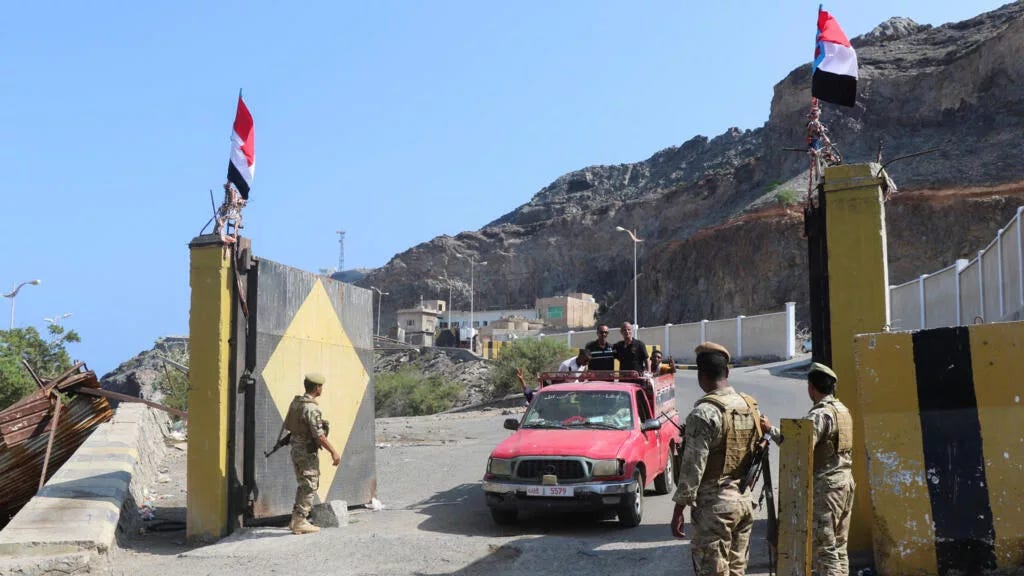
In recent days, southern Yemen has undergone significant geopolitical shifts, redrawing the contours of its political and military landscape. The Southern Transitional Council (STC), with clear backing and funding from the United Arab Emirates, has extended its influence across Hadramawt and vast stretches of the east, reaching the coastal city of Aden the seat of Yemen’s internationally recognized, Saudi-backed government for over a decade.
With these developments, Aden has effectively slipped from the government’s control. Most political and military leaders, including the Prime Minister and the President of the Presidential Leadership Council an eight-member body formed to share executive powers have departed.
A new political reality has thus emerged, with the STC now exerting near-total dominance amid an unprecedented institutional vacuum.
Tensions are further heightened by the STC’s increasingly explicit calls for secession and the revival of a “South Yemen” state signaling the possible opening of a new chapter of unrest, not only within Yemen but across the broader regional balance of power.
While the visible power struggle pits Riyadh and Abu Dhabi against each other in southern Yemen, a quieter but no less significant actor is observing closely: Israel. For Tel Aviv, the growing momentum toward secession presents a strategic opportunity to advance its security agenda. Though unacknowledged officially, Israel’s indirect involvement positions it as a key, if discreet, player in shaping southern Yemen’s future.
Israel’s growing interest in Yemen stems from the critical strategic importance of the Bab al-Mandeb Strait one of the world’s most vital maritime chokepoints connecting the Red Sea and the Indian Ocean.
Any disruption to navigation through this corridor is seen by Tel Aviv as a direct threat to its maritime trade, the security of Eilat Port, and a strategic vulnerability that could be exploited by adversaries especially Iran.
From this perspective, Israel does not view the crisis in Yemen as a localized conflict, but as an integral part of the broader Red Sea security equation and the wider regional struggle. Accordingly, its role has expanded from observer to influential player.
Israel’s Yemen Strategy: Containing the Houthis First
Since the outbreak of the Gaza war in October 2023, Yemen has emerged as one of the most complex arenas of confrontation for Israel. The Houthi movement has launched dozens of missile and drone attacks targeting Israeli territory and repeatedly struck Israeli and Israel-linked vessels in the Red Sea.
While Israel has managed to contain other fronts, Yemen remains volatile and unresolved a lingering security challenge.
Israel’s engagement in Yemen thus forms part of its broader confrontation with Iran. Viewing the Houthis as an extension of Iranian influence, Tel Aviv has pursued a dual-track approach: direct military strikes against the Houthis which began in May 2025 in response to missile attacks and support for the STC’s advance in the south to strategically weaken Houthi control.
This two-pronged strategy aims to reduce Houthi influence while bolstering Israel’s position in the regional contest with Tehran.
Secession vs. Normalization: A Strategic Shift
Since its formal inclusion in the internationally recognized Yemeni government under the 2019 Riyadh Agreement, the STC has operated with significant political and military autonomy.
The agreement granted the council representation on the Presidential Leadership Council and control of key ministries, enabling it to launch successive military campaigns and consolidate control over most of the south and east areas rich in natural resources and crucially located along maritime trade routes.
Following the Abraham Accords in 2020 and growing UAE-Israel alignment, Tel Aviv began engaging in the Yemeni crisis through its Emirati channel. Israel has since become an unofficial backer of the STC, under the banner of curbing Houthi influence and ensuring the security of the Red Sea, Bab al-Mandeb, and Yemen’s strategically located ports.
With the STC now firmly in control of much of the south, these covert alignments have begun to surface publicly. During a visit to the United States, STC President Aidarous al-Zoubaidi openly discussed the possibility of normalization and establishing official ties with Israel.
In comments reported by Maariv, he argued that an independent southern state would pave the way for joining the Abraham Accords and crafting an independent foreign policy.
In parallel, The Times revealed that direct communications have taken place between the STC and Israeli officials to discuss “shared concerns,” chief among them the fight against the Houthis. Western diplomats and UN Security Council members have also reportedly been informed that Yemeni unity is a thing of the past, and preparations for a southern state declaration are underway.
Yet the STC’s path founded in 2017 and aspiring to revive the pre-1990 southern state remains fraught with obstacles, chief among them Saudi opposition and Western skepticism over the destabilizing implications of secession.
A Strategic Gain for Israel
The prospect of southern Yemen’s secession, while deeply disruptive domestically, could serve Israel’s strategic interests. It would isolate the Houthis in the north, curtail their logistical access to the Red Sea, and bolster Israel’s position in safeguarding maritime security in the Bab al-Mandeb and the Gulf of Aden two of the world’s most sensitive maritime corridors.
Moreover, a newly independent southern state allied with Israel through the UAE-backed STC would mark a significant geopolitical gain. Such an alliance would limit Iranian influence in the Red Sea and constrain Houthi movements, strengthening Israel’s deterrence posture in one of the region’s most volatile theaters.
According to Israeli media, this scenario could also enhance Tel Aviv’s geostrategic footprint, enabling it to expand economic ties with emerging Arab partners while undermining Tehran’s maritime ambitions.
And What of the Houthis — and Iran Behind Them?
Analysts suggest that the deepening divisions within Yemen’s internationally recognized government and the growing rivalries between Saudi Arabia, the UAE, and Israel could ultimately benefit the Houthis. The fragmented front against them offers room for political and military maneuvering, easing direct confrontation.
At the very least, these divisions provide the Houthis with breathing space to maintain their grip on the north their traditional stronghold. Even if the Houthis lose southern access or resources, their core territorial control remains intact, allowing them to recalibrate their priorities rather than face existential defeat.
Yet should the south break away, the long-term implications could challenge Iran’s strategic calculus. A southern state would erode Tehran’s influence in the Red Sea a vital node in global shipping and constrain its reach in a critical geopolitical theater. Any short-term gains by the Houthis may come at the cost of Iran’s broader regional ambitions.
Saudi Arabia, Egypt, and the Perimeter States: What Comes Next?
The intensifying secessionist drive in southern Yemen poses a potential geopolitical earthquake, one that could redraw the regional map. Control over the south means control over Bab al-Mandeb a gateway through which over one-fifth of global trade passes. The area has become a linchpin of both regional and international security frameworks.
If Israeli influence expands into this vital maritime corridor, it could present an unprecedented threat to Arab national security. Tel Aviv’s ambitions appear to extend beyond conventional conflict, toward an expansive regional posture encapsulated in ideological visions of dominance “from the river to the sea.” This could shift the Red Sea from a shared Arab-international waterway to a zone of direct Israeli control.
In response, Saudi Arabia has long sought to curb southern secession by co-opting the STC into the government as part of the anti-Houthi coalition. But that strategy now appears to be unraveling, with the STC’s ambitions moving beyond power-sharing to an independent southern entity even if it means normalization with Israel.
Egypt, for its part, is particularly alarmed. Israeli expansion into the Red Sea via Yemen’s southern flank presents a nightmare scenario for Cairo’s national security, potentially forcing a strategic realignment across the region.
Southern Yemen is no longer a stage for internal conflict alone. It has become a geopolitical flashpoint where regional and global powers converge. Between the STC’s secessionist push, Israel’s quiet but growing presence, and the weakening of the internationally recognized government, Yemen is approaching a pivotal moment that could reshape alliances and power structures across the Middle East.
The consequences of this unfolding drama are likely to spill far beyond Yemen’s borders affecting Arab national security and international maritime stability. Any political or military escalation could become a defining test of regional equilibrium in the years ahead.
