

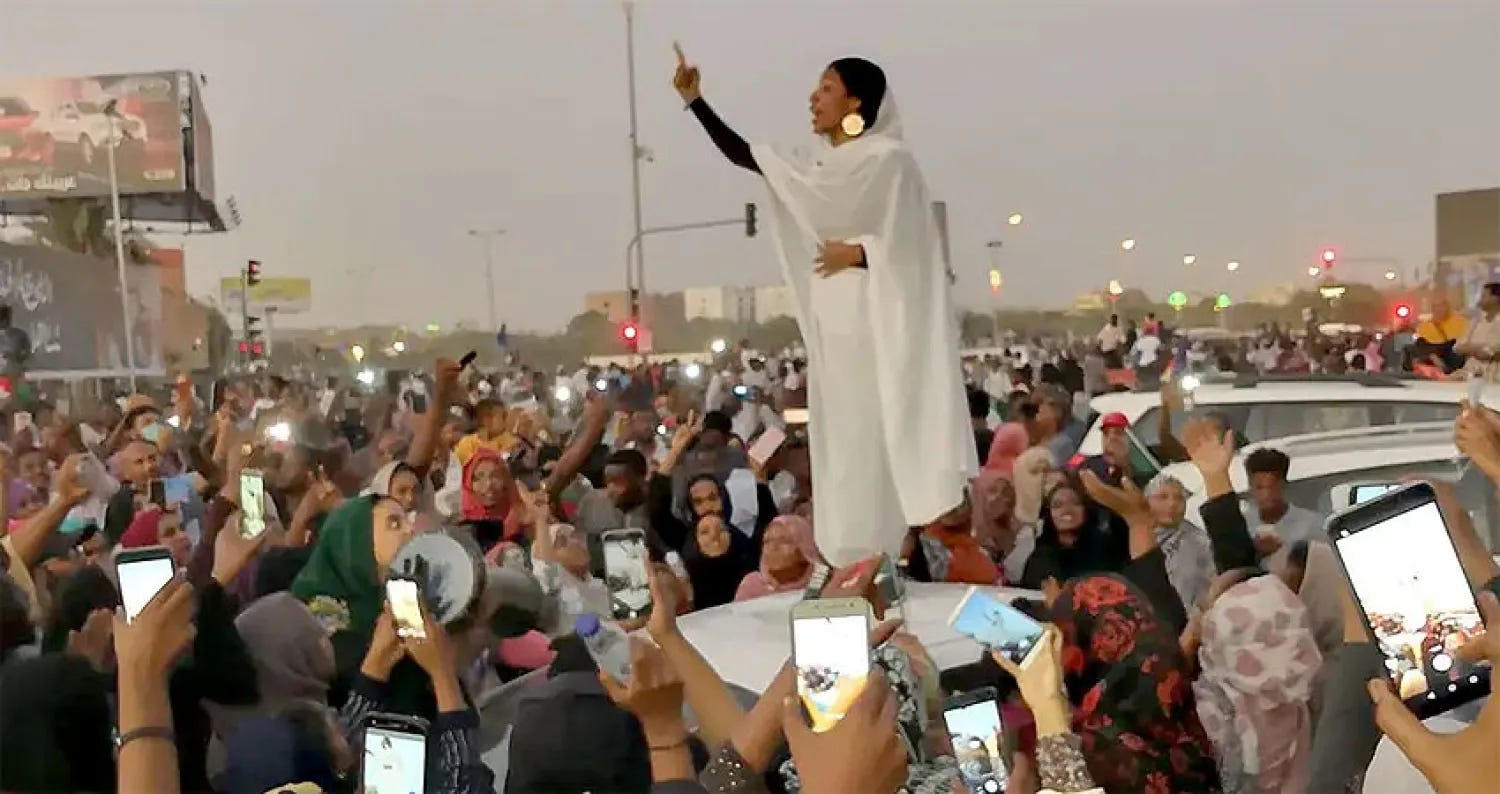
On this day in 2018, Sudanese citizens didn’t just take to the streets—they emerged from the depths of long-standing oppression. Millions marched, carrying in their hearts something heavier than slogans and more sincere than chants: the dream of freedom, the promise of peace, the yearning for justice, and the hope for a civilian state that reflects its people not the barrel of a gun.
They came together with one voice to declare that Omar al-Bashir’s era had ended, that the iron-fisted state must be dismantled, and that those who had ruled with brutality for decades must one day stand before the scales of justice, after subjecting the people to poverty, deprivation, and crushed dignity.
In those days, dreams touched the sky. Spirits ran high to the point of awe, hearts beat as one, and with every passing hour, a surge of adrenaline-fueled hope coursed through their veins.
Voices did not fall silent they roared like rivers, shaking the ground from Khartoum to Omdurman, from Port Sudan to the country’s farthest reaches. There was no North or South, East or West only one nation, one spirit, and one call: a new Sudan, democratic and civilian, free from military rule and the grip of theocracy.
Today, seven years on from that uprising born pure, like a dream the picture is far more painful. Many dreams have evaporated in the air of disappointment, and much of the hope that once floated in the clouds has come crashing down to the harsh terrain of reality.
The country has shifted from the path of a popular revolution to a battleground of generals, a war for power and spoils paid for solely by the Sudanese people, with their blood, safety, and future.
A painful and lingering question remains: what is left of the revolution? What traces of it still linger in the hearts of Sudanese people, beyond memory and nostalgia? Perhaps only a faint belief that this people who once dreamed so boldly still have it in them to dream again.
Contradictions and Bitter Ironies
Following the October 2021 coup when General Abdel Fattah al-Burhan, aided by the Rapid Support Forces (RSF) led by Mohamed Hamdan Dagalo (Hemetti), ousted the civilian government born of the revolution under Prime Minister Abdalla Hamdok Sudan entered a tunnel of weighty and tangled contradictions.
But it was in April 2023, with the eruption of war, that these contradictions reached their peak. The country became the scene of the most violent conflict in its modern history.
The most bitter irony? The two warring factions the army and the RSF now compete to present themselves as the revolution’s heirs or its guardians, even as their artillery obliterates the very dreams the revolution once carried. A war fought in the name of the nation, yet trampling it underfoot. Revolutionary slogans are raised even as their meaning is stripped bare.
Meanwhile, freedoms are experiencing one of their darkest chapters. Civic space has shrunk dramatically as militarization expands in areas controlled by both sides. The public sphere no longer breathes with the same energy it held in the early revolutionary days it is now choked by fear, surveillance, and the muzzle of guns.
Khartoum the beating heart of the revolution has been emptied by war, particularly in the neighborhoods that once led the protests. A mass exodus has displaced the youth who first sparked the uprising. Scattered in exile, they carry only memories, while the city is left hollow, like a silent witness to a revolution exhausted, though not dead.
The Return of the Old Guard
Observers note a glaring contradiction in the gradual re-emergence of figures from the former regime, many of whom have been released from prison and are regaining significant influence within the military establishment, particularly in Port Sudan. This reality runs counter to one of the revolution’s most powerful slogans: “The military to the barracks.”
Meanwhile, the street’s demand to dismantle the RSF widely known as the Janjaweed remains an unfulfilled revolutionary call, repeated in chants such as “Disband the Janjaweed!”
Worsening the tragedy, reports from rights groups and observers indicate the RSF has committed unprecedented violations in the areas it controls. The gulf between December’s dreams and today’s grim reality continues to widen, in ways more painful than anyone could have imagined.
Instead of being held accountable for their crimes crimes stained with the blood of Sudanese citizens these actors are being rewarded with government positions, power-sharing deals, and slices of state resources. It’s a grotesque scene that resets the entire political game back to square one.
December’s Aspirations-A Fallen Vision
In a special comment to Noon Post, lawyer Rana Abdelghaffar summarized the core demands of the December Revolution in its foundational slogans: freedom, peace, justice, and civilian rule. These demands were translated into legal and political terms in the 2019 Constitutional Declaration, which aimed to govern the transitional period.
Rana noted that the document partially succeeded in enshrining some of these demands—particularly those related to rights and freedoms and affirmed civilian governance, judicial independence, and accountability for abuses. These led to measures like the dismantling of the June 30 regime and reforms to repressive laws.
However, the document’s implementation remained partial and constrained by political trade-offs. It failed to fully reflect the revolutionary spirit or the aspirations of the street.
Regarding justice, the document pledged to end impunity and investigate grave crimes—including the violent dispersal of the sit-in outside army headquarters. But the lack of binding constitutional mechanisms and continued military dominance over the justice system severely undermined enforcement.
While the document guaranteed broad freedoms aligned with international standards, Rana said these guarantees remained “ink on paper” due to ongoing military rule, outdated laws, and unreformed institutions. Thus, December’s dreams remain suspended—caught between text and practice, between aspiration and reality.
Structural and Political Failures
Although the Constitutional Declaration laid out the principles of rule of law including judicial independence and separation of powers it was obstructed by executive and military dominance and the prolonged absence of a constitutional court.
While the declaration was a political pact backed regionally and internationally between the military and the Forces of Freedom and Change, it ultimately served military interests more than revolutionary demands.
This led to deep structural, legal, and institutional flaws: an imbalanced power-sharing agreement with the military, vague authorities, delayed complementary laws, the absence of a legislative council, and resistance from the deep state. All of this set the stage for the collapse of the transitional period.
Sudanese legal experts argue that the only way to prevent the revolution’s demands from being emptied of meaning is through a clear constitutionalization of its core principles chiefly, a civilian state, military subordination to civilian authority, criminalization of coups, protection of rights and freedoms, binding mechanisms for transitional justice, and sweeping legal and institutional reforms.
Only then can the revolution be more than just slogans and its gains turned into a lasting reality.
A Document on Pause
In an exclusive statement to Noon Post, Magdy Kanab, a former leader within the Forces of Freedom and Change, explored the roots of the crisis. He asserted that the goals laid out in the Constitutional Declaration were never achieved blaming both internal shortcomings among revolutionary forces and external factors, most notably the intersection of regional interests and their effects on domestic politics.
According to Kanab, the revolution effectively ended with the signing of the power-sharing agreement, transforming into a controlled change. A true revolution, he emphasized, brings deep social transformation something political forces failed to deliver.
He added that the iconic revolutionary slogans—“Freedom, Peace, Justice”—remain unrealized. The real test lies in the balance of power within the broader social struggle, which continues to shape the state, still trapped as a bureaucratic apparatus subservient to that imbalance.
He stressed that the revolution is not a fleeting explosion but a continuous process. For this reason, revolutionary forces cling to their slogans.
However, reviving the revolution amid a raging war seems nearly impossible. Achieving its goals would require a strong civilian bloc capable of leading the way something that is currently missing in Sudan’s fractured, war-torn political landscape.
The Gate of Questions and Grief
In the same vein, former spokesperson for the Omdurman Resistance Committees, Mohamed Taher, wrote on Facebook that December’s anniversary returns each year to open the gates of questions and sorrow alongside pride and honor.
Though the revolution did not achieve the hoped-for democratic transition, he argued, it succeeded in asking the right questions and confronting entrenched issues: militias, hate speech, national sovereignty, justice, and the right to life.
Taher emphasized that December marked the beginning of a continuing process of inquiry questions that all Sudanese are entitled to ask, with no one more privileged than another in their right to do so.
He added that the current war is not a result of December’s revolution, but rather of the old elite’s failure to reckon with its momentum and the region’s and world’s failure to co-opt its youth for their expansionist agendas. “What we live today is not the failure of December to ask the questions,” he wrote, “but our collective failure as Sudanese to provide the right answers.”
“No river or maritime projects, no militia state controlled externally, no military regime seeking internal and external legitimacy, and certainly no return to seat-sharing and elite consensus offer a way out for the Sudanese,” he continued.
Taher concluded that the questions sparked by December endure. They are no longer confined to the revolutionary bloc, but are now part of an open dialogue among all Sudanese about when, where, and how.
The persistence of protests even after the Constitutional Declaration, the civilian-military partnership, the transitional period, and the coup—proves that the revolutionary spirit remains alive. Popular resistance continues to remind Sudan: no authority or accord can silence the questions of freedom, justice, and sovereignty.