

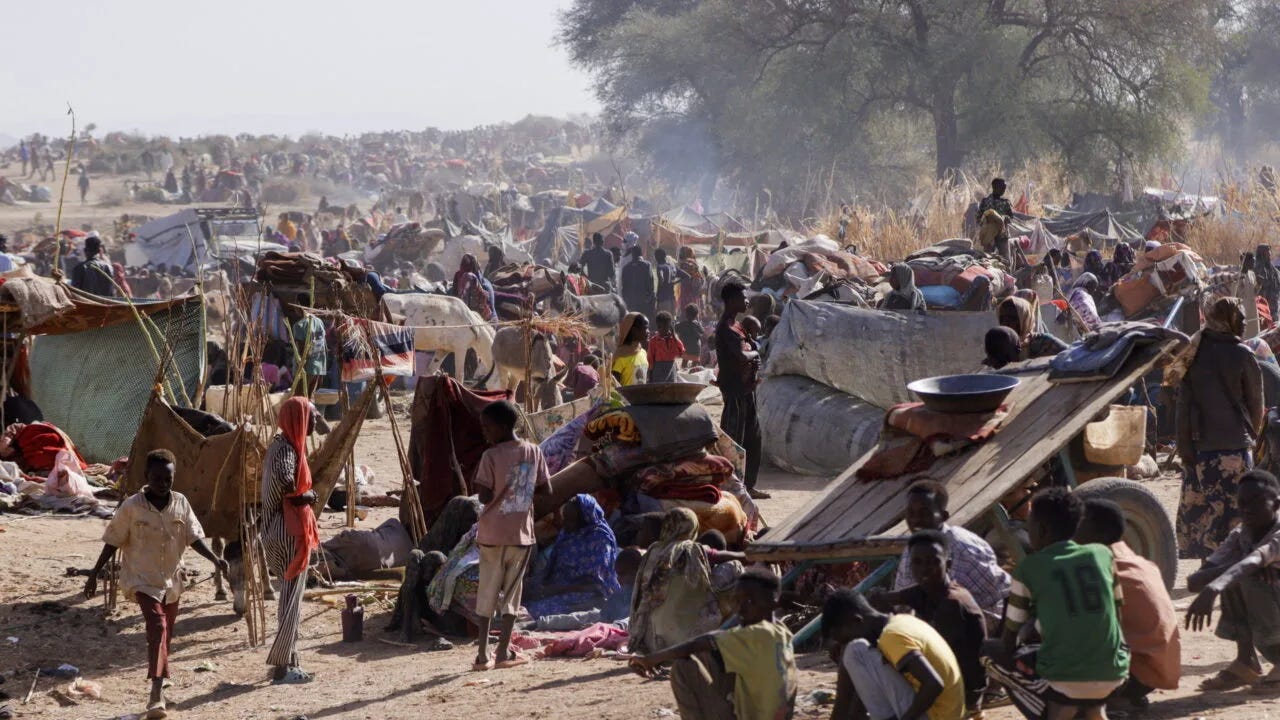
In 2025, Sudan experienced an extraordinary shift: war was no longer a transient military event but a structural force reshaping the state, reconfiguring politics, economics, and society, and imprinting its brutal rhythm on the everyday lives of citizens.
This year also starkly revealed the fragility of state institutions and their accumulated inability to manage overlapping conflicts, amid a widening divide between official authorities and various political forces, and a diminishing capacity to forge inclusive national agreements.
Economically and socially, the weight of war continued to burden markets, resources, and essential services, pushing vast segments of civilians to the brink of daily exhaustion, with direct impacts on food security and health. At the same time, military and social factors intensified as the chief determinants of the conflict’s trajectory and the shape of a Sudan forming under the strain of a protracted war with no clear end in sight.
Collapse of the Civil Political Scene
The year 2025 marked a definitive turning point for Sudan’s civil forces, exposing deep internal fissures. After nearly three years of war, the crisis was no longer just about civil actors being absent from decision‑making centers, but about their failure to form a cohesive political bloc capable of presenting a convincing alternative to a war‑weary homefront or even a broad civil consensus to halt the war and build peace.
In February 2025, the Coordination of Sudanese Democratic and Civil Forces, known as Taqaddum (Progress), announced its dissolution and split into two factions amid sharp disagreements over a proposal to form a parallel government.
The split was not sudden but the result of tensions dating back to the signing of the Addis Ababa Declaration with Rapid Support Forces (RSF) militia leader Mohamed Hamdan Dagalo (“Hemedti”) in early 2024 an act that weakened its standing with wide swathes of public opinion and opened the door to accusations of collusion and opposition to the army and the state.
The crisis deepened because Taqaddum had held its founding conference in Addis Ababa in May 2024 in an attempt to present itself as a unifying framework for civil forces; yet structural disagreements remained unresolved.
When its leadership convened in Entebbe in December 2024 under the chairmanship of Abdullah Hamdok, contradictions erupted publicly particularly with some Revolutionary Front factions endorsing the idea of a parallel government as a means to “extract legitimacy” from the Sudanese government, while others saw it as a step that would directly legalize division.
The split produced two factions: Sumud (Resilience) and Ta’sis (Foundation), with Sumud formed in February 2025 also under Hamdok’s leadership. Despite overlaps between Sumud and the Ta’sis alliance dominated by the RSF, observers described the split as a division between forces “aligned in goals but divergent in means,” with some describing it as little more than a redistribution of roles.
Simultaneously, the rhetoric of parallel governments shifted from idea to action. In February 2025, the Ta’sis alliance signed a political charter in Nairobi to pave the way for a government in areas under RSF control.
By late July, the contours of this government were unveiled in Nyala, featuring a presidential council led by Hemedti and including regional governors an effort to entrench a parallel political authority based on military control rather than popular mandate or international recognition.
This initiative received no recognition from any state and drew clear warnings from the UN Security Council, which expressed concern that such steps could exacerbate the conflict and deepen the risk of national fragmentation.
More importantly, the controversy surrounding parallel governments uncovered the fragility of the notion of “civilians as an alternative,” as some of their components slipped into a logic of territorial carve‑up rather than state restoration.
In December 2025, the African Union and IGAD indefinitely postponed talks in Djibouti between Sudanese parties due to disagreements over political participation. Meanwhile in Nairobi, Sudanese political parties and the Abdelwahid Mohamed Nur‑led Sudan Liberation Movement signed a declaration of principles that labeled the National Congress and Islamic Movement as terrorist organizations while conspicuously omitting reference to the RSF militia.
On the regional and international fronts, Sudan filed a case at the International Court of Justice against the United Arab Emirates over violations against civilians; the court rejected the suit for lack of jurisdiction.
Other proposed tracks failed to recalibrate the political landscape: the Quad Mechanism’s ceasefire initiative floundered amid internal disagreements, particularly Sudan’s government refusal to include the UAE. Later, Saudi efforts surfaced after Crown Prince Mohammed bin Salman’s meeting with Donald Trump and General Burhan’s visits to Saudi Arabia, Turkey, and Egypt.
A War of Attrition Expands to the Margins
Militarily, 2025 witnessed notable battlefield shifts that redrew the conflict map without ending the war. In early January, the Sudanese army announced it had retaken Wad Madani in Al Jazirah state after advancing in parts of Sinnar and White Nile states an advance initially seen as a turning point in the central region.
From March through May, battles in Khartoum State escalated to unprecedented levels, culminating in the army’s declaration of full control in May 2025 and closure of the Khartoum front. The conflict then appeared to enter a new phase, shifting military weight from the center to the peripheries, especially the states of Kordofan and Darfur.
In this context, the army continued advances in North Kordofan in February and March, regaining control of Umm Rawaba and Al Rahad and reopening the national highway between Kosti and El Obeid after prolonged closure breaking a months‑long siege of El Obeid and reconnecting central and western Sudan. Yet this also revealed that the conflict was not concluded but geographically redistributed.
Meanwhile, Kordofan emerged as the new center of military gravity. In May 2025, the RSF militia captured El Nehoud in West Kordofan, then seized Bara and Al Fasher in October, and by December had taken Babnusa and the Heglig oil fields.
The RSF effectively controlled the entirety of West Kordofan and all five Darfur states, maintaining sieges on Dalanj and Kadugli in South Kordofan establishing a military reality based on regional dominance.
2025 also saw unprecedented expansion in the use of drones as a central tool of warfare. The UAE‑supported RSF employed long‑range attack drones believed to be Chinese‑made, extending operations far beyond traditional frontlines.
Drone strikes reached Port Sudan in May, having previously targeted critical infrastructure—including power stations—in states such as White Nile, River Nile, Northern State, Omdurman, and Al Fasher.
In parallel, sieges became a weapon as lethal as conventional arms. The year‑long siege of Al Fasher triggered a severe hunger crisis, with food shortages, supply cutoffs, and blocked humanitarian access. Since June, the World Food Programme warned of deepening deterioration as medicines ran out and the health system collapsed.
By August, communal kitchens had closed due to lack of food, forcing residents among them more than 130,000 children in a city of over 260,000 to eat animal fodder after enduring approximately 16 months under siege.
The most dangerous evolution of the conflict was its transition from direct military confrontation to tactics aimed at civilians and the social fabric itself. In April 2025, the RSF launched a large‑scale attack on the Zamzam IDP camp, displacing tens of thousands into besieged Al Fasher and resulting in reports of more than 1,000 civilian deaths.
The Abu Shouk camp suffered a series of attacks that killed hundreds during the first half of the year. Despite a UN call for a weeklong humanitarian truce in June, the army agreed and the RSF refused, indicating that attrition had overtaken humanitarian considerations.
The Year of Crushing Economic Blows
Economically, Sudan entered 2025 with virtually no effective levers of control. Financial weight shifted from the state to the parallel market as the Sudanese pound plunged amid the government’s inability to access real resources and its reliance on money printing to cover current and war expenditures.
According to market tracking, the dollar exchange rate rose from about 2,560 pounds in January to 2,850 in April, 3,400 in August, peaked at 3,700 in September, and then eased slightly to 3,600 by December.
This collapse stemmed directly from expansive fiscal policies in the absence of production; authorities increased the money supply without backing, deepening the gap between official and parallel rates and stripping the central bank of meaningful intervention capability.
The parallel market became the de facto determinant of the pound’s value, commodity prices, and even wages reflecting the transfer of economic power from formal institutions to informal networks.
Inflation was the other face of the crisis, exceeding 140 percent in May 2025 year‑on‑year and driving a relentless rise in consumer prices. With incomes eroded, broad segments of the population fell into extreme poverty.
In November 2025, Social Welfare and Labor Minister Moatasem Ahmed Saleh acknowledged that 71 percent of Sudanese were below the poverty line an official admission of deepening social collapse.
Commercial activity sharply declined not only due to weak demand but also rising import costs, disrupted supply routes, and reduced interregional transport. Port Sudan, the main conduit for foreign trade, was hit by the war’s fallout and instability, directly shrinking import volumes, raising costs of imported goods, and fueling domestic price pressures.
Despite this reality, the government increased customs tariffs during the year to offset falling revenues. Official decisions raised the dollar’s customs value from 2,486 to 2,827 pounds by the end of 2025, directly increasing prices of imported goods from food to medicine further burdening consumers without achieving sustained financial stability.
The labor market was not spared: World Bank estimates pointed to unprecedented unemployment as the private sector contracted, thousands of small and medium enterprises shut down, and workers in trade and services were laid off. As the formal economy shrank, precarious and informal work expanded, leaving workers without social protection or job stability.
The agricultural sector supposed to be a bedrock of resilience suffered significant depletion, with planted areas dropping to 35 percent during the 2024–2025 season compared with previous years due to insecurity, high input costs, financing difficulties, and farmer displacement in Kordofan, Darfur, and Al Jazirah.
Despite the rising importance of remittances, their impact was largely eroded by exchange rate deterioration: funds arriving in hard currency quickly lost value in local markets, transforming from a relative lifeline into a means merely to delay household collapse.
Amid the general economic unraveling, gold became a glaring paradox in the war economy. The state turned toward it as a quick source of foreign currency while other sectors crumbled. The Sudanese Mineral Resources Company announced that gold production in 2025 reached about 70.15 tons 113 percent of the annual target of 62.02 tons.
Official data showed that traditional mining accounted for the lion’s share, producing 58.376 tons, underscoring the expansion of an informal, unregulated grassroots economy versus the limited contribution of major companies.
Yet despite these large figures, export revenues remained modest: only 12.507 tons of “free gold” were exported, yielding roughly $1.3 billion. This stark gap between total production and official exports reflects ongoing structural distortions smuggling, multiple off‑bank marketing channels, and weak trust between producers and the state.
Authorities sought to tighten export controls through banks to ensure foreign currency inflows to the treasury, a policy reflective of efforts to harness war‑time gold for fiscal support.
Geopolitically, the picture is even more complex. Official statistics do not include gold produced in mines under RSF control or in areas dominated by Abdelwahid Mohamed Nur’s Sudan Liberation Movement in Darfur or Abdel Aziz Al‑Hilu’s SPLM‑Northern in South Kordofan. This means significant portions of Sudan’s gold wealth remain outside official oversight—integrated directly into the war economy and its financing.
This reality led to erratic official policy decisions. On November 5, 2025, the Central Bank of Sudan reversed a ban on companies exporting gold after the ban triggered a crisis between state institutions and exporters, nearly paralyzing export activity.
This reversal illustrates the limited capacity of the state to enforce strict policies in a highly sensitive sector that the struggling wartime economy depends on, while also exposing the fragility of economic management and its failure to transform gold from a war resource into a genuine lever of financial stability.
The Harshest Face of War
Humanitarian conditions in 2025 unfolded against the heavy legacy of two years of war, marked by contradictory dynamics. The army’s recapture of central Sudan states initially spurred a broad wave of returns, particularly from neighboring countries. Yet this momentum soon waned as the focus of fighting shifted to western Sudan, making the year a tug‑of‑war between return and displacement rather than one of genuine stability.
United Nations and International Organization for Migration data indicate that 2025 was the first year to show a relative decline in internally displaced persons (IDPs) since the war began: from about 11.5 million in January to around 9.3 million by December.
By late November 2025, UN reports estimated that roughly 3.3 million people returned during the year, including around 350,000 from Egypt. Mid‑December IOM figures showed total returnees exceeding 3 million, with 81 percent returning internally and 19 percent across borders suggesting most returns were within Sudan.
In contrast, the number of Sudanese refugees abroad continued to rise: by the end of December 2025, an estimated 4.3 million were displaced outside the country, up from about 3.8 million at the end of 2024, with the largest concentrations in Egypt, South Sudan, and Chad, and smaller groups in Ethiopia and Uganda.
After the RSF capture of Bara, more than 50,445 people were displaced in the Kordofan states between October 25 and December 17, 2025. By December, UN reports indicated that El Obeid alone had received over 200,000 IDPs from West Kordofan. By year’s end, displacement tracking data showed that the three Kordofan states hosted more than one million IDPs, including long‑term and newly displaced populations linked to escalating clashes.
In Darfur, displacement peaked after the fall of Al Fasher: between October 26 and December 8, 2025, about 107,294 people (24,221 families) fled the city and surrounding villages in the largest displacement wave in the region that year—reproducing the humanitarian crisis in its most brutal form.
Amid these demographic upheavals, the health system was among the most severely affected sectors. In 2025 alone, the World Health Organization documented 65 attacks on healthcare facilities in Sudan, resulting in more than 1,620 deaths and 276 injuries among patients and medical staff making Sudan one of the countries with the highest number of attacks on health infrastructure worldwide that year.
Since the war’s onset in April 2023 through the end of 2025, 201 attacks were documented, causing 1,858 deaths and 490 injuries.
The attack on the Saudi Hospital in Al Fasher stands as the peak of this trend. According to the WHO, the hospital was struck four times in October 2025, killing about 75 people. On October 28, the agency documented a total of approximately 460 deaths patients, their relatives, and medical staff describing the assault as the deadliest on a medical facility since the war began. Far from isolated, this incident was part of a broader pattern that rendered hospitals unsafe.
WHO and Doctors Without Borders estimates indicate that 70–80 percent of healthcare facilities in conflict zones were closed or operating at minimal capacity during 2025 due to bombardment, staff shortages, and shortages of medical supplies and fuel. This collapse contributed to outbreaks of diseases such as cholera, especially in Khartoum and displacement areas, with near‑total health response failure.
