

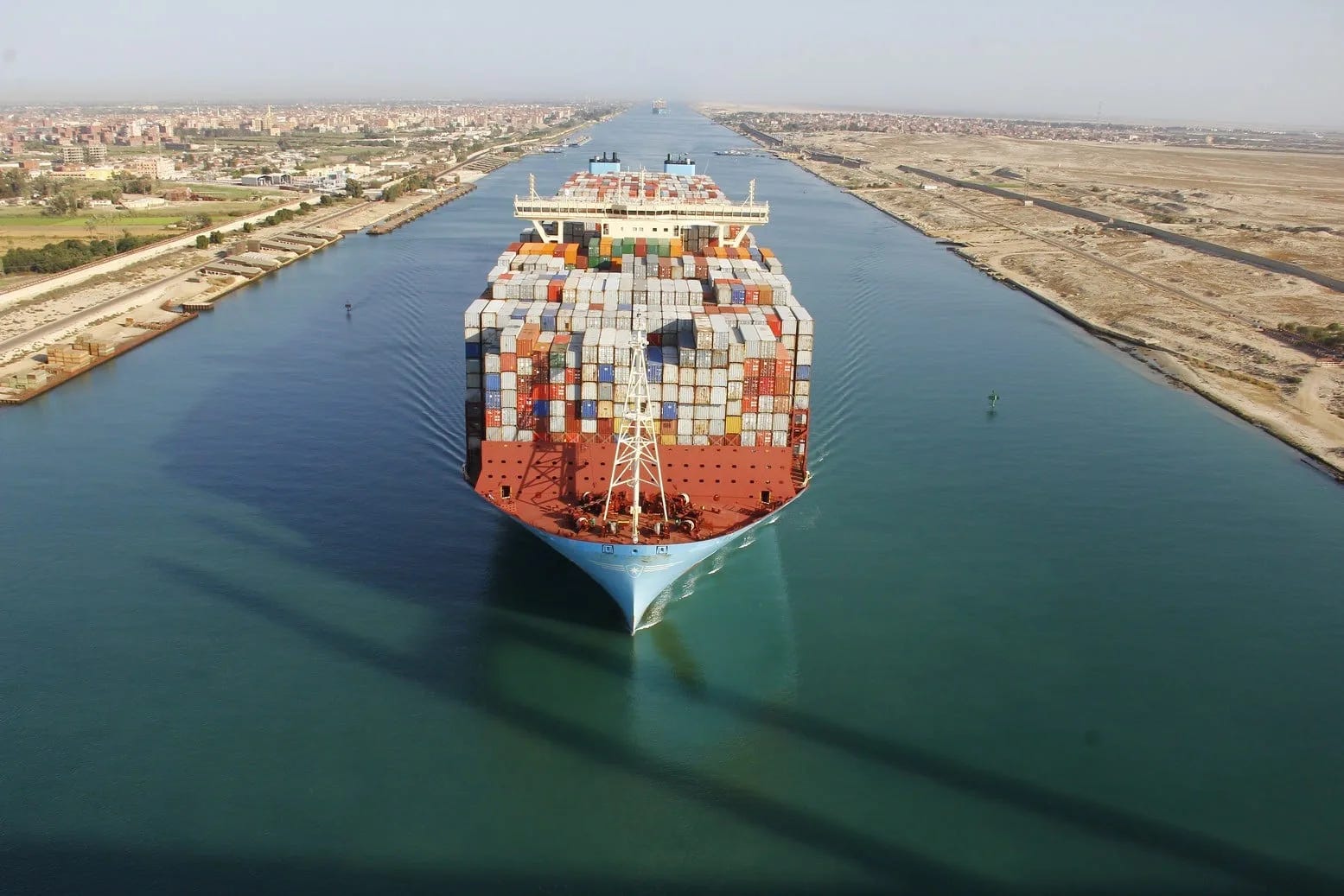
The controversy surrounding the Suez Canal one of the world’s most critical waterways and a cornerstone of Egypt’s economy rarely fades before reemerging in new forms. At times, it surfaces in the form of proposals to lease or mortgage the canal; at others, discussions revolve around amending its legal framework to allow for increased foreign investment. Yet, the latest debate has taken a more sensitive and potentially perilous turn than any before it.
Businessman Hassan Heikal, son of the late writer Mohamed Hassanein Heikal, recently proposed a plan to address Egypt’s spiraling debt crisis particularly domestic debt through what he called a “grand swap.” The idea involves exchanging a portion of the debt for a strategic state-owned asset, chief among them the Suez Canal Authority.
According to Egypt’s Ministry of Planning, the country’s external debt rose by $6 billion since the beginning of 2025, reaching $161.2 billion by the end of June. Domestic debt also climbed by 3.5%, hitting 11.057 trillion Egyptian pounds, or roughly $233.2 billion.
The Suez Canal occupies an extraordinary place in the Egyptian collective consciousness. It is far more than a global shipping lane; it is a national symbol tied to a long history of struggle and sacrifice, and it remains a central source of hope for sustainable economic returns.
Unsurprisingly, proposals of this nature have sparked a wave of public anger and anxiety, given the profound implications for Egypt’s economic sovereignty.
This debate raises fundamental questions: What is the true scope of this proposal? Is it a viable solution to Egypt’s worsening debt crisis, or does it risk opening the door to even more complex political and economic dilemmas?
The Proposal in Detail
Appearing on the television channel Cairo and the People on January 11, Hassan Heikal outlined the core features of his controversial proposal. The plan calls for transferring ownership of the Suez Canal Authority from the Ministry of Finance to the Central Bank of Egypt, framing it as an unconventional exit from the deepening debt crisis.
The proposal is premised on conducting a comprehensive valuation of the authority by Egypt’s Central Auditing Organization in collaboration with an international firm. Heikal estimates the canal’s value at roughly $200 billion, based on an average annual revenue of $10 billion in recent years excluding periods of disruption and crisis.
He emphasized that the plan would not impact depositors’ funds. The Central Bank would continue paying interest to banks using the same mechanism currently employed by the Ministry of Finance, leveraging the canal’s estimated 6% annual yield in US dollars.
To cover any remaining gap, Heikal suggests raising the required reserve ratio for banks to 18%, ensuring financial system stability without imposing direct burdens on the banking sector.
In a more flexible scenario, he proposes valuing the Suez Canal Authority at $100 billion in exchange for writing off around 5 trillion Egyptian pounds in domestic debt. Should the canal’s annual revenues exceed $10 billion, profits would be shared between the Central Bank and the Ministry of Finance.
The proposal also calls for lowering interest rates to around 16%, citing international precedents of central banks stepping in during crises, such as the 2008 global financial meltdown. Heikal insists that the Central Bank’s legal and financial framework can accommodate this exceptional role.
Sharp Criticism
Despite Heikal’s expectations, the proposal failed to gain traction, even among economic circles and business leaders who share his general ideological outlook. Instead, it faced a deluge of fierce criticism, with detractors arguing that it blurs the line between debt management and the liquidation of sovereign assets.
Egyptian academic Magdy Magdy rejected the idea outright, calling it a “dangerous descent from debt management to the dissolution of the state.” Including the Suez Canal in debt equations, he argued, reflects “flawed reasoning that strips the state of its institutional essence.”
The canal, he emphasized, is an invaluable strategic and geopolitical asset not merely an economic resource and is therefore non-negotiable.
Hisham Ezz Al-Arab, CEO of Commercial International Bank, described the proposal as akin to a “declaration of state bankruptcy.” He warned of its potential impact on both domestic and international confidence, particularly given that foreign investors hold around 40% of government treasury bills.
He also questioned how bondholders, particularly those holding Eurobonds, might respond if their debts were exchanged for assets. While he conceded the idea may appear theoretically appealing, he deemed it impractical without clear answers regarding its consequences.
Nagy El-Shahaby, a member of the Senate and head of the Democratic Generation Party, asserted that the so-called “grand swap” does not offer a real solution but merely transfers the problem from the financial domain to one of asset forfeiture.
Domestic debt, he argued, while burdensome, remains a national liability that can be restructured through sound monetary and fiscal policy unlike the irreversible loss of strategic assets, which directly threatens national security.
Alyaa El-Mahdi, an economics professor at Cairo University, summed up the criticism in a striking Facebook post: “Don’t call it the grand swap call it the grand gamble.”
A Lifeline Weighed Down by Debt
The Suez Canal is one of the main pillars of the Egyptian economy and a critical source of hard currency. In the 2024/2025 fiscal year, it generated approximately $11.6 billion in revenue, ranking among the top contributors to the national treasury.
Yet this strategic importance is increasingly clouded by financial ambiguity. Limited transparency surrounds the economic authority managing the canal, including the scale of its debt, prompting the government in recent years to explore new investment and financing mechanisms to ease mounting pressure.
Financial disclosures reveal enduring challenges. In May 2019, sources reported that the Ministry of Finance had repaid debts owed by the Suez Canal Authority to local banks, after it failed to meet payments totaling $600 million in December 2017 and June and December 2018.
Earlier, in August 2016, the Ministry of Finance was asked to settle 102 billion pounds in debts related to the canal. Additionally, the authority was responsible for repaying $2 billion in foreign currency loans secured in October 2015.
Compounding these financial burdens is a steep revenue decline for the second consecutive year. A recent Central Bank report revealed a 45.5% drop in canal revenues during the 2024/2025 fiscal year, falling to approximately $3.6 billion from $6.6 billion the year before marking the steepest decline in two decades.
Compared to 2022/2023, when revenues hit $8.8 billion, the decline approaches 59%, underscoring the mounting strain on one of Egypt’s most vital income streams.
This comes despite the canal’s continued central role in global trade, with around 50 ships transiting daily accounting for nearly 12% of global trade, 30% of container traffic, 5% of oil, 8% of gas, and 10% of petroleum products.
A Red Line
In recent years, rumors and speculative reports regarding the ownership and future of the Suez Canal have gained traction. In 2018, claims circulated that 51% of the canal might be sold to China or the UAE to service debts allegations swiftly denied by the Egyptian government, which reiterated that the Suez Canal Authority owns 100% of the canal and that it is not subject to sale or sovereign partnership.
Between 2021 and 2023, similar claims resurfaced on social media, suggesting a potential deal with the UAE or Saudi Arabia worth $50 billion. At the time, Suez Canal Authority head Admiral Osama Rabie firmly denied the reports, pointing to the canal’s record $9.4 billion in revenue in 2023 as evidence that there was no need to sell off assets or consider ownership transfers.
In December 2022, Mohab Mamish declared, “The Suez Canal is a red line that cannot be crossed,” assuring the public that it is “in safe hands and inviolable.” He added that protecting the canal is a non-negotiable position of President Abdel Fattah el-Sisi, stating unequivocally: “Rest assured the Suez Canal is in safe hands, and not a grain of our land will be compromised.”
Madbouly’s Controversial Pledge
Egyptians began the new year with cautious economic optimism following bold remarks by Prime Minister Mostafa Madbouly on December 24. He announced that the government is preparing a comprehensive package of measures final details pending that aims to reduce public debt to levels unseen in five decades.
Madbouly said the public debt-to-GDP ratio had already fallen to 84%, down from 96% two years ago, though he provided no further details on how this reduction was achieved.
According to his statements, Egypt’s external debt is projected to fall from $161.2 billion at the end of last year to just $12 billion matching levels recorded in 1975.
These projections have raised eyebrows, with many questioning the feasibility of such a dramatic decline, especially given the economic headwinds Egypt continues to face and the unprecedented rise in public debt in recent years.
The Dreaded Scenario: Swapping Assets for Debt
Madbouly’s remarks triggered widespread speculation about the means by which such debt reduction could be achieved, setting the stage for Hassan Heikal’s controversial proposal. But economists have warned that trading state assets for debt could lead to the dismantling of national holdings and destabilize Egypt’s economy.
Broadcaster Mohamed Ali Khair outlined what he sees as the only two plausible pathways to such a steep reduction:
Direct cash repayment a near-impossible task given total debt of nearly $380 billion and a GDP of about $420 billion.
Massive GDP growth, raising output to roughly $550 billion a herculean feat given stagnant dollar-denominated GDP in recent years.
Khair said he inquired officially about the possibility of selling state assets to raise liquidity, and the response was a categorical rejection. He concluded by urging the public to await what he called a “detailed roadmap” outlining exactly how the government intends to achieve this unprecedented debt reduction.