

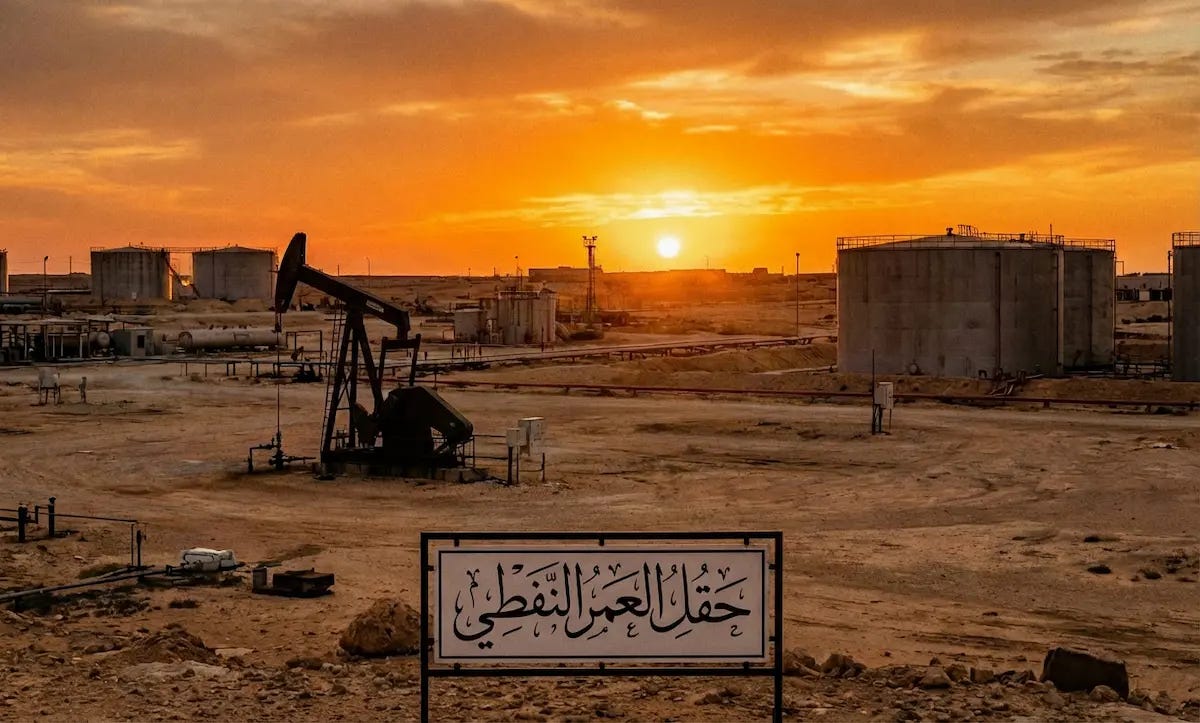
In a swift and pivotal shift, the Syrian state regained control on January 18, 2026, of key oil- and gas-rich areas east of the Euphrates River most notably, the Al-Omar oil field (the largest in the country) and the Conoco gas field in Deir ez-Zor province.
This development followed a series of rapid clashes with the Syrian Democratic Forces (SDF), which were soon followed by a ceasefire and an agreement to fully integrate the SDF into Syrian state institutions.
The shift marks the end of years-long SDF control over Syria’s oil wealth and signals a major turning point in the country’s management of its natural resources. The oil sector, after all, was once a cornerstone of Syria’s economy, accounting for roughly 20% of its GDP in 2010.
Syria’s New Energy Map
Throughout the war, the bulk of Syria’s oil and gas fields remained concentrated in the country’s northeast and eastern regions territories that had long slipped from Damascus’s control since the era of the ousted regime under Bashar al-Assad.
Roughly a quarter of Syria’s territory, lying east of the Euphrates including resource-rich Deir ez-Zor had been under SDF control with U.S. backing. This area encompassed the most important oil fields in the country.
According to World Bank estimates, the SDF controlled between 80% and 90% of Syria’s oil production in recent years. In contrast, the Syrian state was left with only scattered, small fields that contributed minimally to national output.
Now, with the Syrian army’s advance in the east and the unification deal with the SDF, most of these oil-rich and strategically significant regions have returned to government hands.
Official sources confirm that government forces, along with allied Arab tribal militias, now control the majority of Deir ez-Zor province Syria’s primary producer of both oil and wheat spanning more than 150 kilometers along the eastern banks of the Euphrates all the way to the Iraqi border.
With this sweeping territorial reclamation, the SDF has lost its most vital source of local revenue once used to finance its autonomous administration — while the oil wealth it had retained now returns to a state treasury long depleted by sanctions and war.
Damascus has also solidified control over the city of Tabqa and the Euphrates Dam in western Raqqa, along with other vital facilities. With this, all oil and gas infrastructure in Syria’s eastern provinces — Deir ez-Zor, Hasakah, and Raqqa — is now under central government administration.
For the first time since the outbreak of war, Syria is now effectively in control of all its oil and gas resources.
Key Oil and Gas Fields East of the Euphrates
The reclaimed territories are home to the majority of Syria’s largest oil and gas fields. Below is an overview of the most prominent fields and their estimated production capacity:
Al-Omar Oil Field: The largest in Syria, located east of Deir ez-Zor, currently producing around 20,000 barrels per day down from 80,000 bpd in the 1990s.
Al-Tanak Oil Field: The second-largest field in Deir ez-Zor and one of the SDF’s major assets prior to the takeover. Recent production figures are unavailable, but it remains a key source of crude.
Al-Jafra Oil Field: Also in eastern Deir ez-Zor, output has dropped from about 2,000 bpd before the war to just 1,000 bpd under SDF control.
Conoco Gas Field: Located east of Deir ez-Zor, it was once Syria’s largest gas processing plant, with a pre-war capacity of around 13 million cubic meters per day. It has been offline for years due to damage and halted investment under SDF rule.
Rmelan and Suwaidiyah Fields (Hasakah Province): These house over 1,300 oil wells and 25 gas wells. At their pre-war peak, they produced around 90,000 bpd. Current output has plummeted to just 9,000 bpd due to depletion and aging infrastructure.
Raqqa Oil Fields: Including the Thawra field southwest of Raqqa and several smaller fields nearby (Wahb, Fahd, Dbaysan, Qusayr, Abu al-Qattat, and Abu Qattash near Al-Rasafah), which historically yielded only a few thousand bpd. Combined output now stands at around 2,000 bpd.
Syria’s oil sector has suffered a dramatic collapse over the course of the war. From a pre-crisis output of 385,000 barrels per day in 2010, production plummeted to between 24,000 and 34,000 bpd at the height of the conflict (2014–2019).
As the war dragged on and sanctions intensified, production fell even further, hovering around 40,000 bpd by 2023. This decline transformed Syria from a key oil exporter into a dependent importer relying heavily on foreign shipments, particularly from Iran, which reportedly supplied up to 100,000 bpd to bridge the gap under the former regime.
Gains and Challenges
Even before the most recent military developments, the energy sector had shown signs of modest recovery amid political shifts and early cooperation between Damascus and the SDF.
Overall oil production had risen to around 110,000 barrels per day, with approximately 100,000 bpd coming from SDF-held fields, compared to just 10,000 bpd from state-controlled areas. With the SDF now integrated into the state apparatus, this entire output is presumed to fall under Damascus’s control.
Syria’s proven oil reserves are estimated at 2.5 billion barrels mostly heavy, high-sulfur crude. While this presents a potential long-term opportunity for increased production, it would require modern technologies and substantial investment. Experts also warn that prolonged war and primitive extraction methods may have damaged some of the underground reserves.
On the gas front, Syria currently produces around 7 million cubic meters of natural gas per day. However, the country’s power grid needs approximately 18 million m³ daily to operate efficiently.
The bulk of current gas production comes from central Syrian fields already under government control. The former SDF-held fields had contributed just 1.1 million m³ per day prior to their recovery. Once rehabilitated and reintegrated, these gas fields could substantially boost domestic output.
In fact, Syria’s Ministry of Energy has signed a memorandum of understanding with US-based ConocoPhillips and Novaterra to increase gas production by upgrading existing fields and exploring new ones. The plan aims to raise daily output by 4 to 5 million cubic meters within a year. Combined with ongoing gas imports from allies such as Azerbaijan and Qatar, this initiative could provide temporary relief to Syria’s chronic power shortages.
While regaining control of the country’s oil and gas resources marks a major economic windfall, it also poses serious challenges. Syria’s energy infrastructure has sustained extensive damage from years of war, sabotage, and unregulated extraction.
A United Nations report estimated total direct and indirect losses in Syria’s oil and gas sector at more than $115 billion between 2011 and 2023.
Syria’s reassertion of control over its eastern oil and gas fields marks a strategic turning point shifting the country’s natural wealth from a state of paralysis and fragmentation toward renewed state utilization.
Although current production at 110,000 barrels per day remains well below pre-war levels, the consolidation of resources under central authority gives Damascus a rare opportunity to revive its energy sector and generate much-needed revenue in tandem with national reconstruction efforts.