

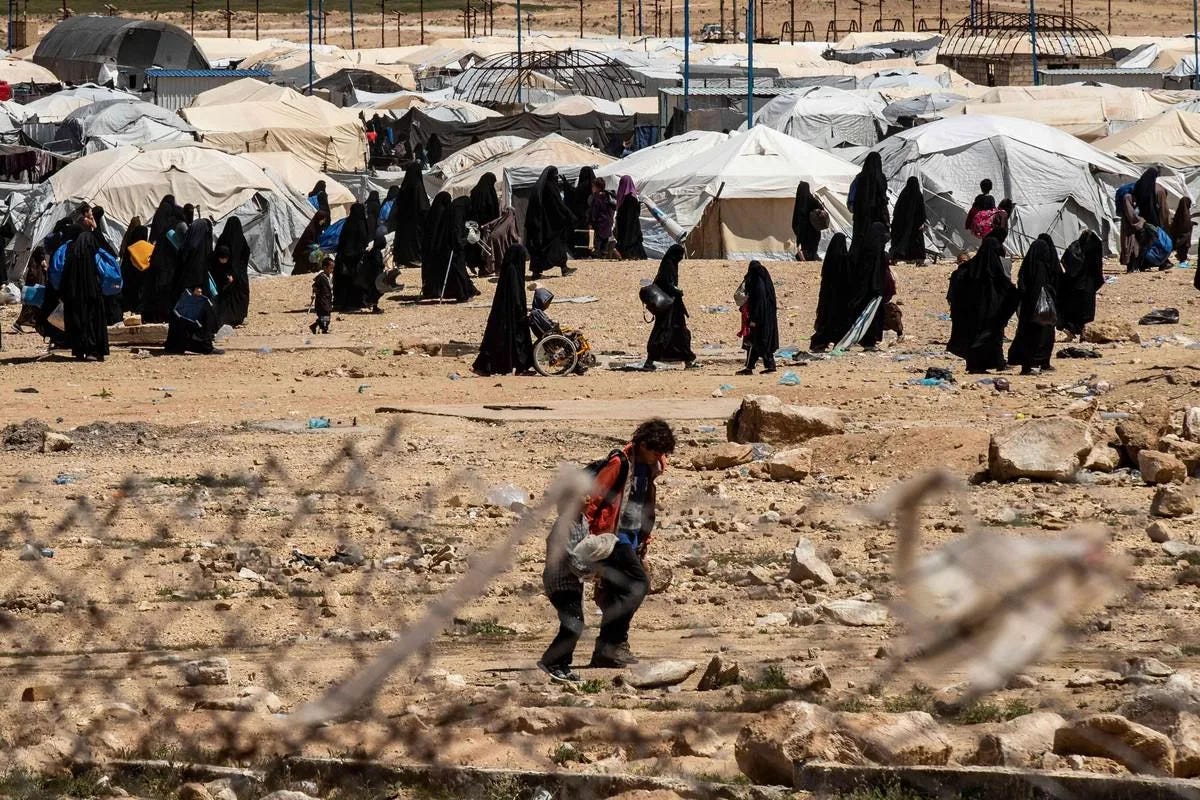
In a sudden and startling turn of events, the notorious al-Hol camp in southern Hasakah has been virtually emptied of its residents in recent days. The development follows the camp’s recent handover to Syrian government forces after the withdrawal of the Syrian Democratic Forces (SDF), which had retreated following major battlefield setbacks in Raqqa and Deir ez-Zor at the hands of the Syrian army.
The evacuation unfolded in an unexpected and opaque manner, raising urgent questions about how and why it occurred.
As the SDF pulled out, the first escape attempts began in a camp already teetering on the edge of chaos. Within weeks, that disorder culminated in a near-total evacuation. Just a month ago, al-Hol housed approximately 23,400 people. Today, fewer than 1,500 remain most of them Syrians, alongside a small number of Iraqis.
Chaos at the Camp
Exclusive information obtained by Noon Post from five sources inside al-Hol sheds light on what transpired during the SDF’s departure last month.
On January 20, Syrian army forces began moving toward the camp. Guards affiliated with the SDF, stationed in the “Security Affairs” building within the so-called “Foreigners’ Section,” reportedly set fire to their headquarters, smashed computers, and removed surveillance camera records before abandoning the site. The incident occurred at around 2 a.m.
Gunfire soon erupted near the camp’s gate. Later, six bodies of Arab SDF members were discovered. One source alleged that Kurdish SDF units opened fire on them as they attempted to leave. Subsequently, retreating SDF elements reportedly fired on a group of residents from the nearby town of al-Hol, killing two civilians.
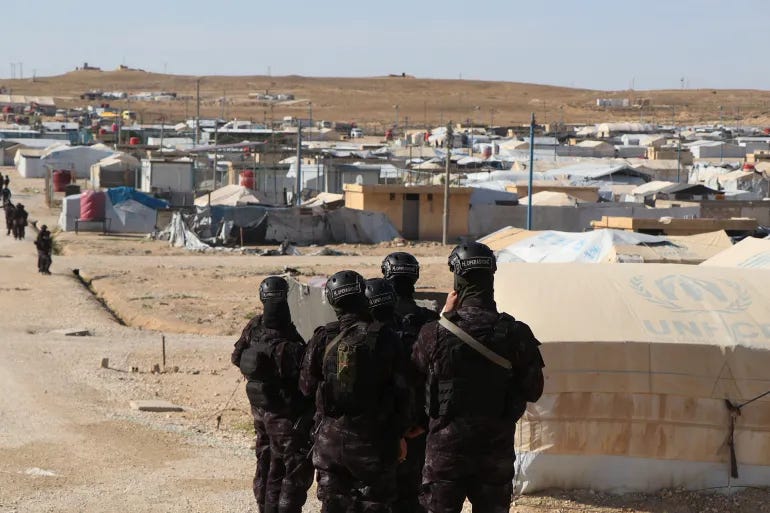
In the ensuing turmoil, dozens of Syrian and foreign families fled the camp, reaching the town of al-Hol and the nearby village of Abu Hujayrah.
At dawn on January 21, a Syrian army force arrived and encircled the camp. Large crowds from surrounding areas stormed the site that morning, looting its contents before Syrian Internal Security Forces arrived and formally assumed control.
ISIS Families Leave the Camp
Sources told Noon Post that on January 23, a group of Syrian Ministry of Defense soldiers described as “muhajireen,” or foreign fighters entered the camp for an inspection tour. They distributed food baskets to foreign women housed in their designated section.
That same night marked the first large-scale, organized smuggling operation. According to sources, it was led by a foreign commander in the Syrian army known as “Abu al-Hasan.” The camp’s northern fence was opened, and foreign women began exiting. The operation was coordinated with vehicles arriving from the town of al-Hol. A tracer round fired into the sky at midnight reportedly signaled the start.
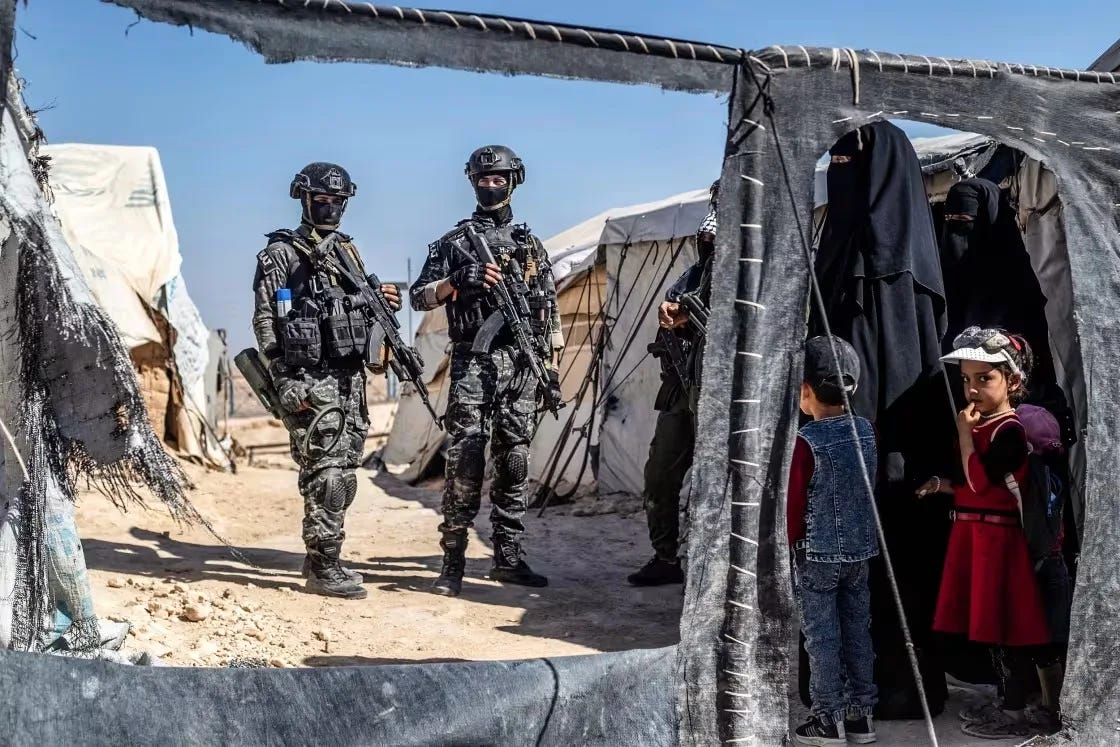
Over the next two days, January 24–25, the evacuation of foreign women continued. They were first transported to mosques in al-Hol and Abu Hujayrah, then transferred by car toward Idlib province, according to the sources.
Notably, Syrian Internal Security Forces did not intervene. Smuggling operations continued until February 9, by which point the “Foreigners’ Section” also known as the “Muhajirat Visa” was completely empty. It had previously housed around 6,300 women and children from 42 nationalities, all family members of ISIS fighters.
Only Iraqis Remain
The evacuation extended beyond ISIS families. The majority of remaining Syrian and Iraqi families also departed after the camp’s gates were effectively opened earlier this week.
“Bashar,” a former resident from southern Aleppo countryside, told Noon Post: “When the foreign women left, most of the camp’s residents left with them. Syrian security forces did not stop anyone.” He added that authorities urged residents to leave quickly and that departures occurred at night.
By Thursday, February 12, residents had cut openings in the northern and western fences and left. Some even summoned trucks from al-Hol to transport their belongings.
By Sunday evening, February 15, only about 400 Iraqis remained, along with a small number of Syrians from Deir ez-Zor. Sources say Syrian authorities intend to transfer Iraqi detainees to an open camp in northern Aleppo countryside.
Iraqis were reportedly informed that those with relatives or shelter inside Syria could leave; those unwilling to do so would await transfer to the Aleppo camp.
An Iraqi resident told Noon Post that returning to Iraq posed grave risks. “We fear the Popular Mobilization Forces there. They treat every Iraqi coming from al-Hol as an ISIS member,” he said, referring to conditions at al-Jadaa camp in Nineveh, where Iraqi returnees are held. “We have no real options. Staying in Syria is difficult, but there are no alternatives.”
Family Disintegration
Previous transfers of Iraqi nationals organized by the SDF in coordination with Iraqi authorities have led to the breakup of numerous families. Over the years, marriages between Syrians and Iraqis inside the camp resulted in children being separated from one parent when repatriations occurred.
Most of these unions ended in divorce and family fragmentation, leaving children divided between two countries. The phenomenon also highlights the uncertain future of children born to Syrian mothers and foreign fathers, as well as those who are the offspring of ISIS fighters raising profound questions about state policy and societal reintegration.
Who Lived in al-Hol?
The SDF long leveraged al-Hol as a symbol of its counterterrorism credentials on the international stage, branding all its residents under that label while benefiting from international funding and aid.
In reality, the majority of residents were displaced civilians who fled battles between the former Syrian regime and ISIS, or clashes between the SDF and the group. They were subsequently confined in the camp.
Residents fell broadly into three categories:
Syrian displaced persons forcibly placed in the camp since 2017.
Iraqi displaced persons who fled fighting between ISIS, Iraqi forces, and the Popular Mobilization Forces.
Foreign families alongside some Syrians and Iraqis linked to ISIS fighters and supporters. This group comprised roughly half the camp’s population. Foreign women were segregated into a separate section.
Within that section, hardline women established an internal ISIS apparatus, including a religious police force (hisbah), strict surveillance over other women, and financial networks channeling remittances from supporters abroad. At times, they formed assassination cells targeting women who defied their authority. Documented killings of Syrian, Iraqi, and foreign women—and even some men—were attributed to these extremist factions.
Deliberate Evacuation or Chaotic Process?
Based on available evidence, the abrupt evacuation appears to have been carried out with Syrian government acquiescence, yet executed in a highly chaotic manner. No official statements have been issued by Damascus or by the international coalition, nor were departure records systematically kept an omission that raises alarm given the presence of hardened ISIS affiliates among those who left.
Most of the foreign women were reportedly transported to Idlib province, while others were sent to Aleppo via foreign fighters within the Syrian army.
It appears the Syrian government is intent on closing al-Hol by any means both to shed the burden it represents and to end the protracted humanitarian catastrophe inside. For years, the camp also served as a propaganda tool for ISIS supporters, who solicited donations under the banner of “saving the captives of al-Hol.”
In its latest issue, ISIS’s al-Naba newspaper attacked the Syrian state under the headline “Shabiha and al-Hol.” Yet following the release of the women, pro-ISIS media outlets have appeared confused alternately attributing the operation to sleeper cells or unnamed actors. The incident is unlikely to alter ISIS’s posture toward the Syrian government.
An Albanian Girl Returns to Europe
In a striking development, Albania’s Foreign Ministry announced the repatriation of an Albanian citizen from Syria who had been held in al-Hol.
According to Albanian journalist Adrian Shtuni, the young woman, Eva Duman, was eight years old when her father, Shkelzen Duman, took her and her younger brother, Endri, to Syria in February 2014 without their mother’s knowledge. Her father, who joined ISIS, was killed months later. Her brother was repatriated in October 2020 in coordination with international organizations.
Eva remained in al-Hol, reportedly resisting earlier repatriation efforts. After 12 years in the camp, she was finally returned to Albania in coordination with Turkish authorities.
Some foreign women are now reportedly seeking to leave Syria by contacting their embassies. Yet several countries remain unwilling to receive them, leaving their future uncertain.
UN Suspends Activities
The United Nations High Commissioner for Refugees (UNHCR) suspended its operations inside al-Hol following what it described as a security incident at the camp’s main gate. In an internal memo dated February 14, the agency reported that a group of residents staged a protest before moving toward the UN assembly area and throwing stones at a building.
UN teams evacuated staff through emergency exits and confirmed their safety, as did nearby NGO personnel. All activities and field movements inside the camp were suspended, and UN and NGO teams departed the site later that day.
At present, fewer than 1,500 people remain inside al-Hol. Many are packing their belongings and returning to their home regions in Aleppo and Deir ez-Zor. Meanwhile, Syrian Internal Security Forces continue efforts to secure the camp against large crowds from surrounding areas who have, for days, attempted to loot what remains.
