

In complex wars where military considerations intertwine with questions of identity, and where politics intersects with doctrine, as is the case in the Iranian-American confrontation battles are not always decided through large-scale strikes. At times, they are settled by hitting the most sensitive points within a state’s structure: the joints whose targeting strikes directly at its beating heart and vital nerve, even if the rest of the geography remains far from the flames.
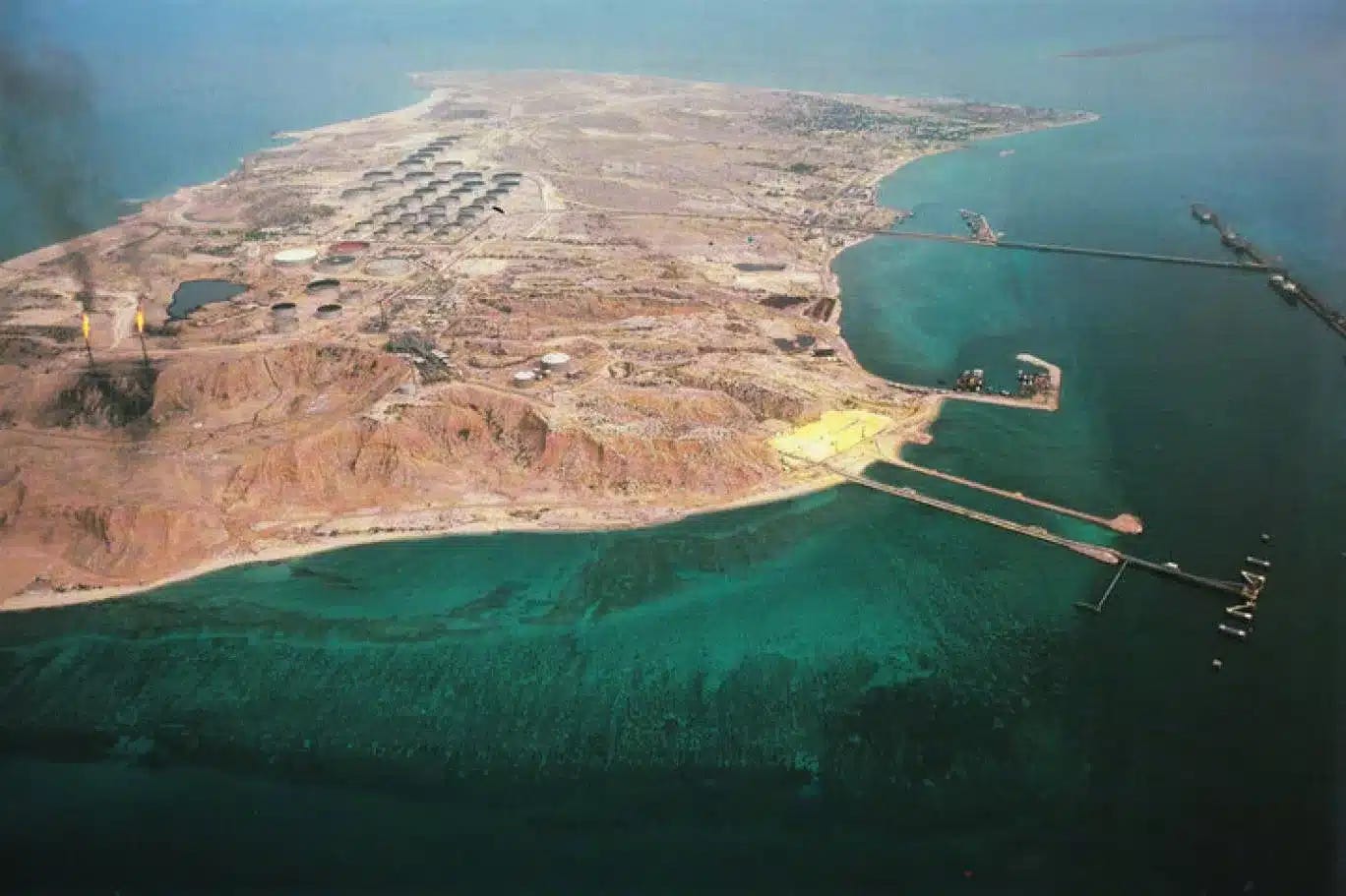
In the Iranian case, Kharg Island stands out as one of the most significant of these strategic nodes. It represents an extraordinarily vital artery in the equation of the Iranian state. Consequently, Washington’s threat to target it cannot be seen merely as a fleeting battlefield development, but rather as a qualitative shift that may carry decisive implications for the trajectory of the war and lay the groundwork for a new phase in shaping both the course of the confrontation and its future limits.
U.S. President Donald Trump announced personally, through a post on social media, that military sites on the island had been targeted. He confirmed that the strikes had resulted in the complete destruction of those military objectives.
At the same time, however, he noted that oil infrastructure was not included in the target bank at this stage, though he left the option open linking its activation to Tehran’s conduct regarding what he described as threats to freedom of navigation and the safety of vessels in the Strait of Hormuz.
Talk of targeting Kharg comes at a moment when both Tehran and Washington appear to be facing an extremely tense situation. Iran is grappling with the escalating costs of war and the growing depletion of its military capabilities. The United States, for its part, faces mounting pressures as well both in terms of military fatigue and the rise of domestic criticism tied to the absence of a clear vision for managing the war, in addition to the fluctuation of its declared objectives from one phase to another.
Accordingly, targeting Kharg Island would not be limited to its immediate military dimensions. Rather, it raises a host of fundamental questions about the political and strategic consequences that could follow: whether this development will push the war toward further escalation, or instead become a major pressure point for redefining the rules of engagement and outlining possible paths for the future of this confrontation.
What Does “Kharg” Represent for Iranians?
The danger of targeting Kharg Island stems from its central position in Iran’s economic structure. The island represents the beating heart of Iranian oil exports and the most critical economic lung that enables the Iranian economy to maintain its minimum vital functions.
It is Iran’s largest oil terminal, through which the vast majority of the country’s oil exports—around 90 percent—pass, placing it at the forefront of the pillars upon which the national economy rests.
For that reason, any military strike on the island cannot be interpreted as a limited or localized blow. Instead, it would constitute a direct assault on Iran’s most vital economic lifeline, effectively pushing the economy toward acute suffocation and depriving more than ninety million Iranians of the most essential resource in the state’s financial and livelihood cycle.
Beyond the enormous material losses that would likely follow potentially amounting to millions of dollars per day as oil revenues halt such repercussions would inevitably ripple across the state’s various sectors and exert a profound impact on the cohesion and stability of the domestic front.
For all these reasons, the island is regarded within Iranian strategic calculations as a major strategic asset and an extremely sensitive red line. The Iranian system would find it difficult to tolerate any approach toward it, particularly given the heavy memory left by attacks on the island during the Iran-Iraq War, and the deep economic and psychological costs associated with those assaults costs that remain embedded in Iranian collective consciousness.
Trump’s Dilemma
Turning to the Kharg Island card reflects the magnitude of the dilemma Trump faces in managing this war. The mere threat of striking such a sensitive point does not appear detached from growing internal and external pressures surrounding him. Given the risks this step could pose to the global oil market and the international economy along with the potential implications for the future of the Strait of Hormuz it signals that Washington may find itself in an extremely delicate position, prompting it to search for more effective instruments of pressure at a highly complex moment.
This dilemma deepens as criticism of the U.S. administration grows due to the lack of a clear strategy for the war, the ambiguity of its objectives, and the rising economic, military, and human costs. Moreover, the American expectation of a swift resolution or an early collapse of the Iranian regime has not materialized.
This has forced the administration to reassess its calculations, particularly in light of Tehran’s ability to absorb the initial strikes, repair its domestic front, and demonstrate a level of resilience that surprised its adversaries.
Thus, the use of the Kharg card alongside amphibious deployments and special forces mobilization can be understood as an attempt to pressure Iran in hopes of compelling it to yield, thereby achieving a political victory that could be marketed domestically and internationally. Such an outcome might ease the mounting pressure on Trump and provide him with a face-saving exit from the conflict.
What If the Island Is Targeted?
To begin with, Iran is the third-largest oil producer within OPEC, contributing roughly 4.5 percent of global oil supplies through production of about 3.3 million barrels of crude per day, in addition to nearly 1.3 million barrels per day of condensates and other petroleum liquids. Any disruption to its export capacity would therefore have consequences extending beyond its national borders to the balance of the global energy market.
Estimates suggest that targeting Kharg Island could remove around 1.3 million barrels per day from the global market the bulk of Iran’s oil exports. Such a disruption could trigger sharp spikes in crude prices, with forecasts indicating that Brent crude might surge beyond $150 per barrel and potentially approach $200 under more severe projections.
The repercussions of such a scenario would not stop at the immediate loss of supply. They could extend to broader reverberations affecting energy infrastructure across the Middle East, as well as potential risks threatening the viability of the Strait of Hormuz and the stability of maritime navigation through it. Any escalation of this kind would therefore place significant pressure on global energy security and international trade alike.
Ending the War—or Prolonging It?
In light of recent developments, American threats of escalation appear closer this time to a practical trajectory that goes beyond deterrent messaging and media statements particularly with the successive military indicators reflecting a notable rise in operational readiness.
From this perspective, the threat to use the Kharg card can be interpreted either as part of a political pressure strategy through which Washington seeks to strike the Iranian system at one of its most sensitive points, or as a prelude to an actual shift from deterrence to implementation should Tehran continue to ignore these signals.
If this path is translated into action through the military tools currently being assembled in the region, it would suggest that the Trump administration is moving toward adopting the most hardline option in managing the confrontation, after the conflict has effectively turned into a war of attrition a contest of endurance in which defeat awaits whoever cries out first.
Based on these dynamics, the war appears open to two main scenarios.
The first is that the Iranian regime opts for a calibrated retreat one that is not presented as outright surrender, but rather framed as political or negotiating concessions that can be marketed domestically and internationally as flexibility aimed at ending the war and limiting its costs for Iran, neighboring states, the wider region, and even the broader international system.
Within this scenario, Tehran may judge that containing the losses after coming under pressure that threatens its economic lung and vital heart is less costly than sliding into an open-ended confrontation whose trajectory cannot be controlled.
The second scenario is that the Iranian regime adopts a more radical approach grounded in the logic of existential confrontation rather than mere competition for influence, embracing what might be described as a “Samson option.” This would open the door to scorched-earth policies and comprehensive escalation.
In such a case, the region could face a wave of instability whose outcomes would be difficult to contain particularly given the cards Tehran possesses that could disrupt global trade and threaten the security of vital maritime routes, foremost among them the Strait of Hormuz and the Bab el-Mandeb Strait.
The result could be a broad paralysis in global commerce and a violent shock to energy markets potentially among the most severe in modern history.
In sum, throughout decades of conflict with Iran stretching back to the 1980s, the United States has consistently been careful to avoid approaching the oil facilities on Kharg Island. Washington has long recognized the sensitivity of such a step and the repercussions it could trigger beyond the boundaries of the bilateral confrontation. Even during the most tense moments from the 1979 hostage crisis to the Tanker War and its aftermath the United States relied on traditional pressure tools, foremost among them sanctions and containment, without sliding into targeting Iran’s most important oil port, which remained, despite everything, outside the scope of direct confrontation.
Nevertheless, although many assessments still consider it unlikely that the United States would resort to this option given its high costs and regional and international consequences, such assumptions no longer appear as absolute under the current political context.
With a figure like Trump in leadership marked by an escalatory instinct and a tendency toward disruptive choices facing an Iranian approach that views the situation as an existential war rather than a mere struggle for influence, the margin for surprise becomes wider. Long-standing assumptions are increasingly subject to reconsideration, leaving the door open to all scenarios even the most extreme.
