

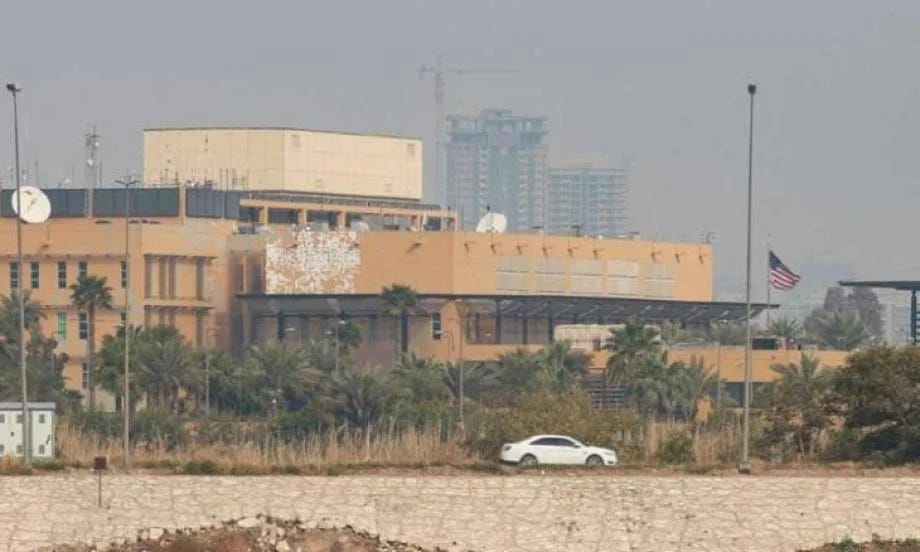
In a highly telling sign of the widening regional confrontation, the targeting of the U.S. Embassy in Baghdad at dawn on Tuesday, March 17, underscores a trajectory of gradual escalation in the U.S.-Israeli war against Iran. It also reveals that the conflict is beginning to extend beyond its immediate actors into more volatile and sensitive arenas.
According to Iraqi security sources, the attack was carried out using rockets and no fewer than five drones launched from the outskirts of the capital. It has been described as the most intense assault on the U.S. Embassy since the outbreak of the war. Reuters, citing a witness, reported that at least three drones headed toward the embassy; air defenses intercepted two, while the third struck inside the compound, leaving visible scenes of fire and rising smoke.
This attack did not occur in isolation, but rather as part of a broader wave targeting the Green Zone and sensitive facilities within the governmental and diplomatic complex, including the Al-Rashid Hotel, which hosts the European Union mission and several European embassies.
The targeting of the U.S. Embassy—given its sovereign and political symbolism—cannot be viewed as a standalone security incident. Instead, it represents a direct message that the war has entered a new phase, one in which traditional restraints are receding in favor of expansion and reciprocal pressure. This raises the likelihood of a more serious, wide-scale regional escalation.
Not Merely a Symbolic Message
Since the outbreak of the war in late February, operations carried out by Iran-aligned factions inside Iraq had largely been symbolic, focusing on harassing U.S. targets across Iraqi provinces. These actions functioned more as warning signals than as attempts to inflict significant, direct losses.
However, this latest attack on the U.S. Embassy has gone beyond its usual symbolic limits, targeting the most prominent representation of American sovereignty in Iraq and resulting in tangible damage, including fires around the embassy compound. Media outlets described it as the most severe attack of its kind since the war began.
Perhaps the most significant message conveyed by this operation is that fortified American installations including political headquarters, foremost among them the embassy are no longer beyond reach. U.S. interests across Iraq have effectively become legitimate targets, reflecting a shift from symbolic pressure to a more daring and dangerous phase in the rules of engagement.
With this operation, Iraq transitions from being a secondary theater of war serving as a support front for Tehran to a directly engaged party in the confrontation. The targeting of the U.S. Embassy in Baghdad, alongside the hotel housing European diplomats, signals that Iraq has clearly and openly entered the battlefield, no longer merely a supportive environment or a secondary arena for exchanging messages.
It appears that Iran-aligned factions in Iraq have adopted a calculated and gradual escalation strategy in their involvement. They initially targeted military sites in an effort to exhaust U.S. capabilities within Iraq, before raising the level of engagement to its highest point by striking the U.S. Embassy itself an act laden with profound political and security implications.
In the same context, Iraq’s direct involvement in the war can be seen as a response to the assassination of the military spokesperson for Iraq’s Kataib Hezbollah, known as Abu Ali al-Askari. This response carries a distinctly retaliatory character, sending a clear message: any U.S. or Israeli targeting of factions inside Iraq will be met with an increase in the cost of the American presence not only at military bases but also in Baghdad itself, at the heart of U.S. diplomatic presence.
Expanding the Scope of the Conflict
Iraq’s involvement in this manner reflects a direct Iranian message to the United States: the confrontation will not remain confined to its immediate actors but will expand into multiple regional arenas. This underscores Tehran’s possession of a clear offensive depth through its network of allied groups across the region, capable of mobilization whenever required by the dynamics of the conflict.
The process began with Hezbollah’s direct involvement, and now the Iraqi front is moving beyond warning signals to become an influential theater in the confrontation. Meanwhile, the Houthi card remains present in Iranian calculations, particularly regarding potential developments in the Strait of Hormuz and the Bab al-Mandeb two highly sensitive strategic corridors.
Iran’s core message today is that even under direct pressure within its own territory, it retains regional levers capable of achieving its objectives beyond its borders. Observers note that this carries particular strategic importance: wars marked by asymmetry in power and resources are not determined solely by the number of targets struck within Iran, but also by Tehran’s and its allies’ ability to distribute the cost of confrontation across embassies, bases, and vital energy corridors throughout the region.
The Failure of U.S. Deterrence Strategy
The targeting of the U.S. Embassy in Baghdad following earlier attacks on American military bases reveals a clear weakness in the effectiveness of Washington’s deterrence strategy inside Iraq. It suggests that this approach is no longer sufficient to guarantee the protection of Americans themselves from Iran-linked forces, a deeply consequential message in military terms.
Despite the limited direct human and military losses, the political and symbolic significance of these attacks far outweighs their field results. They place the United States in a deeply embarrassing position: a superpower unable to protect its most fortified facilities and its most prominent symbols of sovereignty inside Iraq.
Since its entry into Iraq more than two decades ago, Washington has built a significant part of its presence on the premise of deterrence preventing adversaries from approaching its vital interests. Today, however, that assumption appears more fragile than ever, potentially necessitating profound reassessments regarding the future of U.S. deployment and positioning within Iraq.
The United States Between Two Options
What stands out in this development is that the American presence in Iraq is increasingly becoming a political and security burden rather than a manageable temporary condition. The situation has moved beyond limited harassment or symbolic provocations, now striking at the core of U.S. presence and directly threatening its continuity.
If this escalation continues—whether briefly or over a prolonged period it will likely force the United States to confront two difficult options.
The first is to pursue broader escalation against Iran-aligned factions, a path that would carry heavy repercussions for the entire Iraqi landscape and place the Iraqi government in an extremely delicate position both domestically and internationally. This could negatively impact the safety of Americans inside Iraq and Washington’s broader regional interests.
The second option is for the United States to reduce its presence inside Iraq, even if temporarily, until the trajectory of the confrontation with Iran becomes clearer, or to reposition its forces in areas less exposed to targeting by Iran-backed factions.
However, this scenario while potentially reducing immediate risks carries significant political weight. It could be interpreted as a clear American retreat and a success for Iran in imposing its agenda and raising the cost of U.S. presence to an unsustainable level.
With this escalation, the U.S. war against Iran enters a highly sensitive phase, having moved beyond its traditionally limited framework into a direct, multi-front war of attrition. As the scope of confrontation widens and new fronts emerge, fears are growing that the region may slide further toward an open regional war one whose outcomes remain deeply complex and difficult to predict.
