

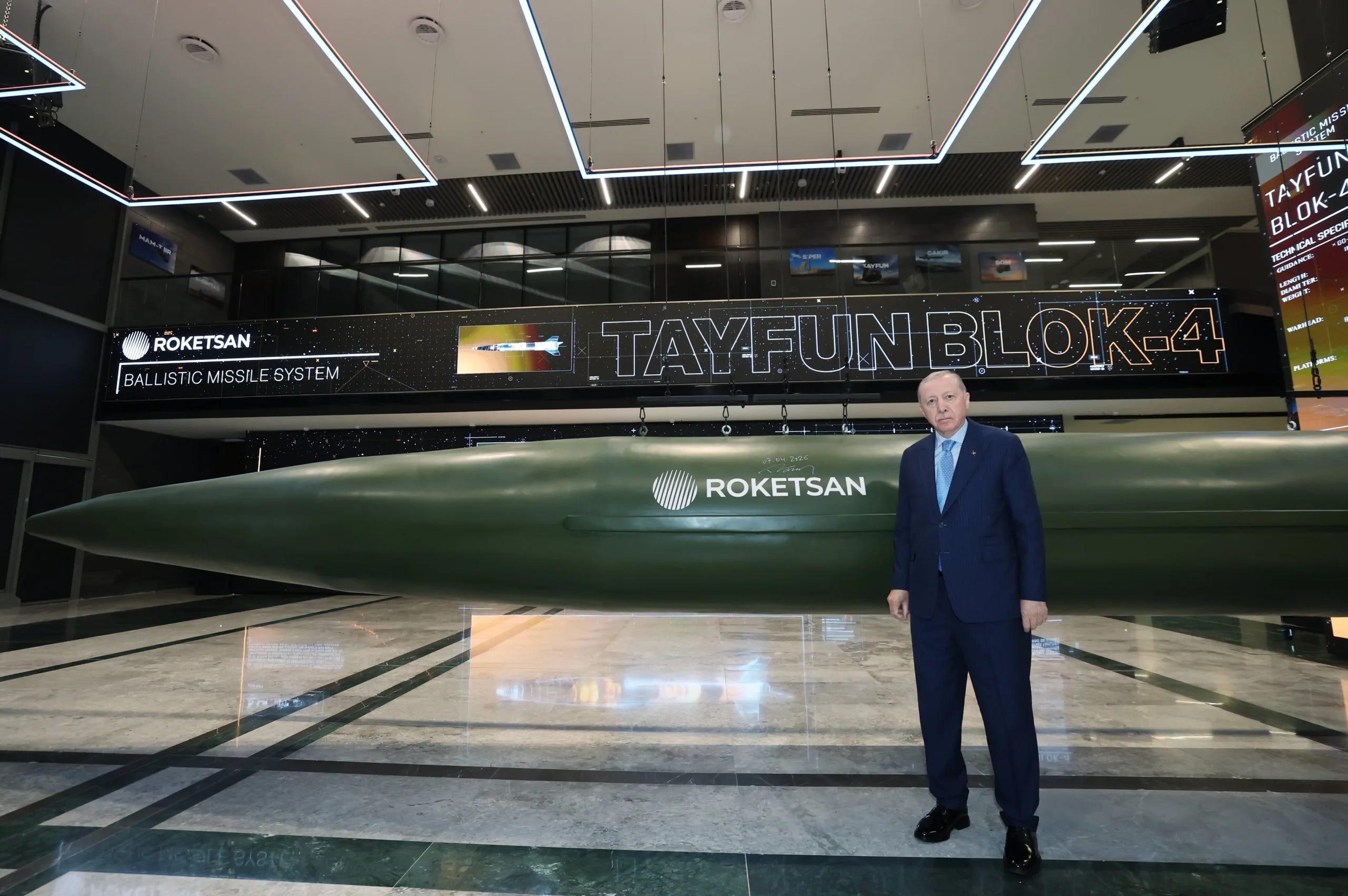
Ankara has unveiled a new chapter in the regional balance of power. On Tuesday, President Recep Tayyip Erdoğan signed off on the “Tayfun Block-4” missile at Roketsan facilities in the capital, Ankara, alongside the opening of new production lines. The move amounts to a political declaration cloaked in military form one that transcends technical development and ventures into redefining Turkey’s position within a rapidly shifting regional environment.
The missile, part of an advanced generation of ballistic systems, carries implications that extend beyond its operational capabilities. It is tied to an accelerated trajectory toward strengthening defense autonomy and building a more flexible and impactful deterrent capacity.
This comes at a time of heightened confrontation between the United States and Israel on one side and Iran on the other granting the announcement added weight in an exceptionally sensitive moment.
“Tayfun Block-4” opens a broader window into the transformation of Ankara’s strategic doctrine, where military industry intertwines with political signaling, and deterrence calculations in the Eastern Mediterranean and the Middle East are being reshaped within a more complex and competitive framework.
A Rising Trajectory
The development of the Tayfun missile reflects a gradual and deliberate transformation in Turkey’s defense industry capabilities. Its first public chapter began in 2022, with a test launch from Rize on the Black Sea, during which the missile traveled over 561 kilometers in 456 seconds.
Initially rooted in the legacy of the short-range “Bora” missile, the first iteration of Tayfun featured relatively limited specifications: approximately 6.5 meters in length and weighing around 2,300 kilograms. It demonstrated notable accuracy within roughly five meters across a range estimated between 500 and 800 kilometers, according to test results.
This trajectory accelerated markedly with the unveiling of the latest version, “Block-4,” at the International Defense Industry Fair in 2025. Roketsan presented a larger and more advanced model, measuring around 10 meters in length and weighing nearly seven tons. This increase enabled greater fuel capacity and a heavier warhead, expanding its operational reach.
While no precise official range has been disclosed, converging estimates suggest it exceeds 1,000 kilometers, with some Western analyses pointing to even longer distances. Speed stands out as a key advantage: the missile travels at over five times the speed of sound and follows a quasi-ballistic trajectory, granting flexibility in altitude and maneuverability complicating interception by conventional air defense systems.
“Tayfun Block-4” relies on a solid-fuel engine and an upgraded guidance system combining inertial navigation with satellite-based corrections. This enhances targeting accuracy and reduces the margin of error to under five meters, according to specialized estimates.
Mobile launch platforms mounted on heavy trucks allow for flexible deployment tactics rapid positioning, execution, and withdrawal reducing the likelihood of detection prior to launch.
The warhead is designed for explosive fragmentation, with potential upgrades to include penetration capabilities targeting fortified installations or maritime assets.
A comparison across different versions highlights the scale of advancement achieved in a short period. While earlier models were categorized as short-range missiles with relatively limited payload and range, the “Block-4” variant places the system in a higher operational category, with clear improvements in speed, accuracy, and trajectory flexibility. This evolution reflects a shift in the role the system can play within Turkey’s military doctrine.
In this context, “Tayfun Block-4” represents a significant milestone in Turkey’s defense manufacturing journey. The convergence of high speed, precision, and maneuverability creates a system that is difficult to counter with traditional defenses.
This development places Turkey among a limited group of countries possessing advanced missile capabilities at this level, enhancing its ability to impose more complex deterrence equations and equipping it with rapid and decisive tools in a region marked by accelerating threats and shifting balances of power.
A Limited Club
The development of hypersonic and high-speed missile systems underscores the limited number of countries that have reached this level of military technology. As of mid-2025, such capabilities remain confined to a narrow circle of major powers.
Available data indicates that Russia leads this domain with several operational models, including “Kinzhal” and “Avangard,” followed by China, which has developed comparable systems. The United States continues to pursue multiple programs within an intensifying technological race.
Beyond these powers, other countries including India, Germany, Japan, North Korea, South Korea, France, Brazil, Iran, Australia, and Canada are advancing along varying development paths, reflecting growing global interest in this class of weapons.
In this context, Iran announced in 2023 the “Fattah” missile, with a range approaching 1,400 kilometers, signaling its ambition to enter this complex field. Turkey’s entry through “Tayfun Block-4” positions it prominently within a highly sensitive competitive environment and makes it the first NATO member after the United States to test a ballistic missile with such characteristics potentially prompting a reassessment of power balances within the alliance and its surrounding region.
Multiple Messages
Turkey’s move conveys a layered set of geostrategic messages that extend beyond the immediate military dimension, reshaping Ankara’s position within its network of international and regional relationships. These signals emerge amid profound shifts in Turkey’s national security philosophy, where reliance on indigenous capabilities has moved to the forefront of political and military decision-making.
The first message is directed clearly at the United States, against the backdrop of longstanding divergences within NATO particularly over air defense systems and arms procurement.
These tensions have driven Ankara to accelerate the development of its defense industries, a point emphasized by President Erdoğan during the inauguration of Roketsan facilities, where he highlighted the sharp increase in domestic production over the past two decades.
The new missile reflects a push toward independent deterrence tools covering a wide geographic scope, underscoring Ankara’s aim to establish a more balanced partnership within the alliance based on equitable burden-sharing and decision-making.
A parallel message is directed toward Russia, within a complex relationship that blends cooperation and competition. While Ankara and Moscow remain engaged across multiple theaters from the Black Sea to broader regional issues the development of “Tayfun” signals Turkey’s determination to build an independent deterrent grounded in domestic technology.
The missile’s reliance on solid fuel and advanced guidance systems illustrates a distinct development path, offering greater operational flexibility and rapid response capability, and reinforcing Turkey’s ability to act outside external military frameworks.
Regionally, the message targets neighboring states in the Eastern Mediterranean and the Middle East, where Turkey seeks to consolidate its position as a key military actor in security and energy dynamics. Official statements suggest that developing systems like “Tayfun” is part of a broader vision to enhance defense autonomy and project influence across multiple operational theaters.
These capabilities, according to assessments, enable Ankara to extend its deterrence reach to relatively distant targets, imposing new equations in regional power balances.
A fourth message is directed inward toward NATO itself. Ankara aims to redefine its role within the alliance, shifting from a consumer to a producer of security. Erdoğan pointed to a comprehensive project to strengthen a multi-layered air defense system integrating domestic platforms with advanced detection capabilities, thereby increasing operational independence.
Within this framework, “Tayfun Block-4” forms part of a broader architecture designed to integrate defensive and offensive capabilities, enhancing Turkey’s standing within NATO as a contributor to security production rather than merely a recipient.
In this broader context, the timing of the missile’s announcement transcends its technical dimension, reflecting a deliberate use of military tools to express political positions. Ankara is leveraging its missile capabilities as an indirect diplomatic instrument to redraw the contours of its relationships with major powers and assert its presence in a volatile and highly competitive regional landscape.
President Erdoğan’s visit to Roketsan facilities carried significance beyond ceremony, signaling a clear trajectory toward expanding defense production. During the event, he announced a package of major investments, including approximately $1 billion for completed facilities and additional projects nearing $3 billion.
These facilities are expected to multiply missile system production several times over, including “Tayfun” and domestically developed air defense systems.
How Is the Balance of Deterrence Changing?
Deterrence hinges on a state’s ability to inflict damage exceeding an adversary’s tolerance, combined with speed of execution and precision. The introduction of “Tayfun Block-4” into service marks a new phase in the balance of power surrounding Turkey, particularly within the medium-range domain, long considered a sensitive equilibrium zone among regional actors.
While Israel and Iran retain long-range capabilities beyond this scope, the new Turkish missile reshapes the landscape within a radius extending to roughly 1,000 kilometers and beyond.
In the Greek case, the missile places the entirety of Greek territory including key Aegean islands within direct targeting range. This grants Ankara additional leverage in any potential escalation, whether in maritime or aerial domains.
It is likely to prompt Greece to strengthen its defense systems and deepen cooperation with European and regional partners in an effort to offset the gap created by Turkey’s advancing missile capabilities.
In the South Caucasus, “Tayfun Block-4” reconfigures the balance with Armenia, whose missile systems are limited in range compared to Turkey’s new capabilities. This provides Ankara with additional leverage in sensitive regional issues, including transport corridors and dynamics related to the Nagorno-Karabakh conflict. It may also push Yerevan to deepen ties with its traditional allies in search of a counterbalancing deterrent.
Regarding Israel, the Turkish missile introduces a new dimension to an already complex relationship, granting Ankara the option to target strategically significant installations in the event of escalating tensions. While Israel possesses long-range missile capabilities, Turkey’s entry into this domain reinforces the notion of mutual deterrence and compels a reassessment of alliance structures and defensive deployments in the Eastern Mediterranean.
As for Iran long reliant on an extensive missile arsenal to project regional influence it now faces a more complex equation with the emergence of a Turkish system characterized by high speed and advanced precision.
This provides Ankara with the capacity for rapid and accurate response should its interests be threatened, complementing its multi-layered air defense projects and enhancing its ability to address missile threats in both defensive and offensive contexts.
A Tool of Negotiation
Beyond its role as a qualitative addition to military capabilities, the missile emerges as a tool of influence within the negotiation tracks in which Turkey is engaged across multiple fronts. When hard power reaches a certain threshold of readiness and precision, it becomes an implicit factor shaping political decision-making, granting policymakers broader room to maneuver in managing complex issues.
In this context, missile development intersects with a network of ongoing challenges, from relations with the United States and Russia to interactions with the European Union and regional actors.
In dealings with Washington, this development adds a new dimension to negotiations over arms procurement and coordination within NATO particularly regarding fighter jets and security arrangements in Syria. Possessing advanced missile capabilities strengthens Ankara’s negotiating position and reduces its dependence on a single strategic pathway.
At the same time, it introduces new calculations, including the potential for counter-pressures such as sanctions or technology transfer restrictions.
In managing relations with Moscow, deterrence tools intertwine with the complex nature of bilateral ties. Turkey, already engaged with Russia across overlapping arenas, now holds an additional card that enhances its maneuverability.
This leverage can be used to maintain a delicate balance of interests, though it requires careful management to avoid escalation that could destabilize broader regional arrangements.
Regionally, military capability intersects with influence across theaters such as Libya, Syria, Iraq, and the Eastern Mediterranean. Possessing a precise and rapid missile capability provides a deterrent umbrella for Turkey’s military presence and strengthens its position in energy disputes and maritime boundary negotiations, where economic interests are deeply intertwined with power dynamics.
In this framework, military capability becomes a shaping force in the positions of other actors, both in negotiation and crisis management.
Within this broader picture, “Tayfun Block-4” emerges as a tool redefining the relationship between power and diplomacy in Turkish policy. As Ankara seeks to expand its decision-making autonomy, it is deploying these capabilities to strengthen its position at the negotiating table, enabling it to craft its options from a more balanced footing.
The effectiveness of this leverage, however, will depend on how it is managed: used with flexibility and strategic awareness, it can yield gains; used impulsively, it risks driving the region toward more complex and volatile trajectories.
