

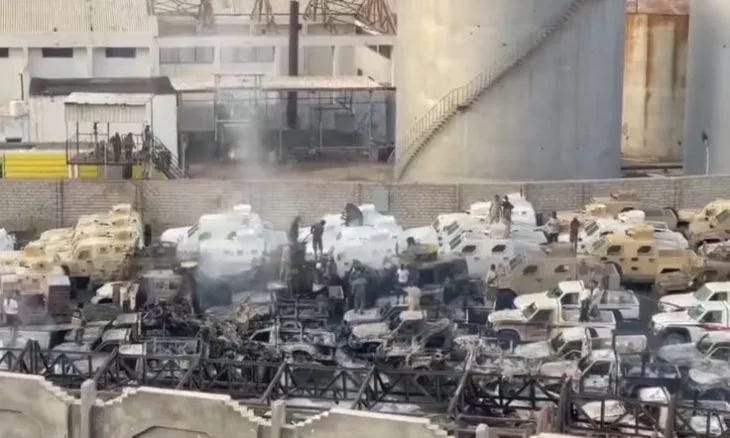
Amid heightened tensions sweeping across southern Yemeni provinces in recent days, the Saudi-led Coalition to Support Legitimacy in Yemen launched a precision airstrike targeting what it described as “foreign military support” at Mukalla Port in Hadhramaut governorate in eastern Yemen. The strike followed an official request to evacuate the port to protect civilians.
According to the Saudi Press Agency, the coalition command detected two vessels that arrived at Mukalla Port from Fujairah on Saturday and Sunday, December 27 and 28, without obtaining official clearance. The vessels allegedly disabled their tracking systems and offloaded shipments of weapons believed to be intended for Southern Transitional Council (STC) forces an act seen as contributing to conflict escalation and regional instability.
In the same context, Coalition spokesperson Brigadier General Turki al-Maliki announced that the military operation was carried out in response to a formal request by Yemen’s Presidential Leadership Council (PLC) President Rashad al-Alimi, who cited what he called “grave and horrific human rights violations” committed by armed STC-affiliated groups.
Amid these rapid developments, President Al-Alimi issued escalatory decisions demanding the complete withdrawal of UAE forces from all Yemeni territories within 24 hours, declaring a nationwide state of emergency for 90 days starting today. He also announced the cancellation of the joint defense agreement with the UAE and imposed an air and land blockade on all Yemeni ports and entry points for 72 hours.
Al-Alimi affirmed that these measures were intended to protect civilians and safeguard the legal status of the Yemeni state, following what he described as confirmed reports that the UAE had shipped two weapons-laden vessels from Fujairah to Mukalla.
These unprecedented developments have cast a shadow of uncertainty over the Yemeni landscape, raising the specter of a new phase of conflict in the south, one that could redefine the balance of power and influence. What makes this moment particularly significant is that the Saudi-Emirati rift has, for the first time since the coalition’s launch in 2015, spilled into the open, shedding the cloak of backchannel diplomacy.
An Unprecedented Escalation: Naming the UAE Publicly
A statement issued by the Saudi Ministry of Foreign Affairs in response to the Mukalla operation carried strong political overtones, marking a clear shift in Riyadh’s approach to the Yemeni file and, more pointedly, to its partnership with the UAE. The statement featured several pivotal points:
– For the first time, Saudi Arabia explicitly named the UAE, accusing it of pressuring the STC to launch military operations near the kingdom’s southern borders, specifically in Hadhramaut and al-Mahra moves Riyadh considers a direct threat to its national security and to regional stability.
– Riyadh officially accused Abu Dhabi of actions that pose serious risks and contradict the foundational principles of the Coalition to Support Legitimacy in Yemen, undermining joint efforts to bring security and stability to the country.
– The Kingdom emphasized that any infringement upon its national security constitutes a red line, asserting that the UAE’s recent behavior falls within this category. Riyadh stated it would not hesitate to take all necessary steps to address and neutralize the threat.
– Saudi Arabia demanded that the UAE comply with the Yemeni government’s call to withdraw its military forces within 24 hours and cease all forms of military or financial support to any faction within Yemen.
– The statement concluded with a veiled warning about the future of bilateral relations, expressing hope that the UAE would take the necessary steps to preserve fraternal ties a clear indication that failure to do so could negatively impact their relationship.
A Shift in Saudi Strategy: What Changed?
This latest Saudi escalation in Yemen did not emerge in a vacuum. It represents the culmination of a steadily accelerating series of events that began in early December. On December 2, the UAE-backed STC launched a wide-scale military campaign dubbed “Promising Future,” which quickly morphed into a sweeping offensive aimed at asserting full control over the south.
By December 8, the STC had extended its influence over most southern provinces, including Aden the internationally recognized government’s temporary capital as well as Hadhramaut, known for its geographical and oil wealth, and al-Mahra, a region of strategic significance.
This power grab coincided with an unprecedented intensification of secessionist rhetoric, as the STC abandoned any pretense of power-sharing and openly declared its intent to resurrect the former South Yemen state. This marked a turning point in the Yemeni conflict, reframing it as not only a domestic struggle but a regional power contest.
In response, Riyadh broke its cautious silence. On December 25, the Foreign Ministry issued a statement blaming the STC—and implicitly the UAE for unilateral military actions in Hadhramaut and al-Mahra. The statement criticized these moves as uncoordinated with the PLC or coalition and harmful to Yemeni interests and legitimacy.
This was followed by an airstrike targeting the Hadhrami Elite Forces, accompanied by a pointed message from Saudi Defense Minister Prince Khalid bin Salman. He warned that internal divisions had weakened the national front against the Houthis and urged the STC to withdraw and hand over bases to the “Nation Shield Forces.”
The Saudi warnings escalated further into an explicit military threat to confront any STC movement in Hadhramaut, following Al-Alimi’s formal request to protect civilians and prevent further clashes.
Yet these warnings appeared to go unheeded. The UAE reportedly continued its military support to the STC, as evidenced by the arms shipments from Fujairah to Mukalla—an indication of Abu Dhabi’s disregard for Riyadh’s evolving position.
Recalling the Sudan experience, where UAE backing for the RSF militia under Hemeti sparked separatist ambitions, Saudi Arabia concluded that its red lines in Yemen had been crossed. It chose to abandon tacit coordination and intervene overtly to restore order and prevent a broader fragmentation of southern Yemen.
Lifting the Veil
By explicitly naming the UAE as a destabilizing actor in southern Yemen, Riyadh has ushered the crisis into a new, unprecedented phase. For the first time since the coalition’s inception, Yemen’s conflict theater is fully exposed—no more backstage maneuvering, no more ambiguity. The power dynamics and actors are now plainly visible, signaling a qualitative shift in the nature and trajectory of the conflict.
The result is a dual escalation military and political starting with the local authorities in Hadhramaut publicly endorsing President Al-Alimi’s sovereign decisions, including the cancellation of the joint defense pact with the UAE and the demand for its forces to vacate Yemeni territory.
The Hadhramaut administration expressed gratitude to the Saudi-led coalition and praised Riyadh’s continued efforts to support Yemen’s security and institutional recovery, affirming that Saudi Arabia remains a strategic pillar and essential guarantor of stability in the province and the country.
On the ground, the escalation swiftly translated into violence. Fierce clashes erupted between STC forces and the Hadhramaut Tribes Alliance, exposing the fragility of existing arrangements and the rapid descent of political disputes into armed conflict.
Simultaneously, STC Vice President Hani bin Buraik intensified his rhetoric against Saudi Arabia, accusing it on X (formerly Twitter) of launching an “official act of aggression” on Hadhramaut and its civilian port. He described the Mukalla airstrike as based on “flimsy pretexts” and a “blatant violation of international humanitarian law.”
In this complex and volatile landscape, the Yemeni crisis is entering a more intricate phase, one where de-escalation gives way to confrontation, and alliances are reshaped in real time. The rift within the coalition is no longer a quiet dispute it is an open contest for power on the ground.
What Does Riyadh Want?
Opening a new front in Yemen and presenting the UAE as a direct, public adversary is clearly not among Riyadh’s strategic priorities. The long-term political, military, and economic costs of such a move could be steep and misaligned with Saudi Arabia’s broader regional objectives.
Instead, through the Mukalla operation, the Kingdom appears to be pursuing a set of defined goals. Chief among them: redrawing the rules of engagement and publicly delineating its red lines in Yemen for the first time.
This approach seeks to recalibrate the conflict, preventing it from straying beyond the understandings that have governed the coalition’s operations since 2015. As part of this strategy, Saudi Arabia has begun disrupting the STC’s supply and support lines, viewing its escalating ambitions as diverging from previously agreed-upon frameworks.
Riyadh’s message to Abu Dhabi is unmistakably stern: its actions in southern Yemen are unacceptable, and the implications extend beyond Yemeni soil. Saudi concerns are not limited to Hadhramaut or al-Mahra they echo in Sudan, Somalia, and the broader Horn of Africa, where regional interests intersect.
Moreover, the Kingdom is signaling its readiness to employ hard power, not merely diplomacy, to protect its national security and strategic interests. This marks a significant shift, reflecting deepening frustration over what Riyadh sees as unacceptable Emirati overreach.
Yet Saudi Arabia has not closed the door on diplomacy. Repeated references to the UAE as a “brotherly state” in the Foreign Ministry’s statement suggest that escalation is not synonymous with rupture. The aim is to recalibrate the relationship, offering Abu Dhabi a chance to step back and reposition without incurring major political losses.
What Next?
Clearly, the UAE’s latest moves were not calibrated for this level of backlash. Its unilateral approach in Yemen underestimated Saudi sensitivity and misjudged the potential response. The call for Emirati troop withdrawal backed explicitly by Saudi Arabia—has placed Abu Dhabi in a politically and militarily delicate position.
For now, the UAE appears disinclined to enter into open confrontation with Riyadh. Its official silence and attempts to de-escalate through media messaging and diplomatic backchannels indicate a preference for damage control. Emphasizing its support for Yemeni legitimacy and good intentions, Abu Dhabi is seeking to contain the fallout.
Still, such a posture is not immune to retaliatory gestures symbolic or tactical moves aimed at saving face. These could include threats to dissolve the Coalition to Support Legitimacy or decouple Emirati-Saudi coordination, as hinted by STC sources in comments to UAE-based Sky News Arabia. Such outcomes would only benefit the Houthis and are unacceptable to either party.
Given this complex equation, it is unlikely that Riyadh will escalate further beyond its current threshold. Its messaging has been emphatic and wide-ranging, likely reaching its intended recipients, who must now reassess their positions and consider a new set of political and military calculations.
This precarious moment may also open the door for third-party mediation—Egyptian, Gulf, or American to step in and push for de-escalation. Both Riyadh and Abu Dhabi remain strategic allies of Washington and key players in the region. Allowing tensions to spiral unchecked serves no one’s interests.
Thus, these developments may usher in a new round of negotiations, with Riyadh’s concerns becoming central to any future roadmap for managing the Yemeni conflict.
In conclusion, this moment marks a pivotal turning point in the regional balance of power. The current crisis lays bare a fundamental shift: the conflict is no longer limited to adversaries, but has engulfed allies.
Whether by design or default, the landscape is being redrawn, and long-fragile understandings are giving way to a new logic one that will shape how power, conflict, and diplomacy are managed in the Middle East going forward.
