

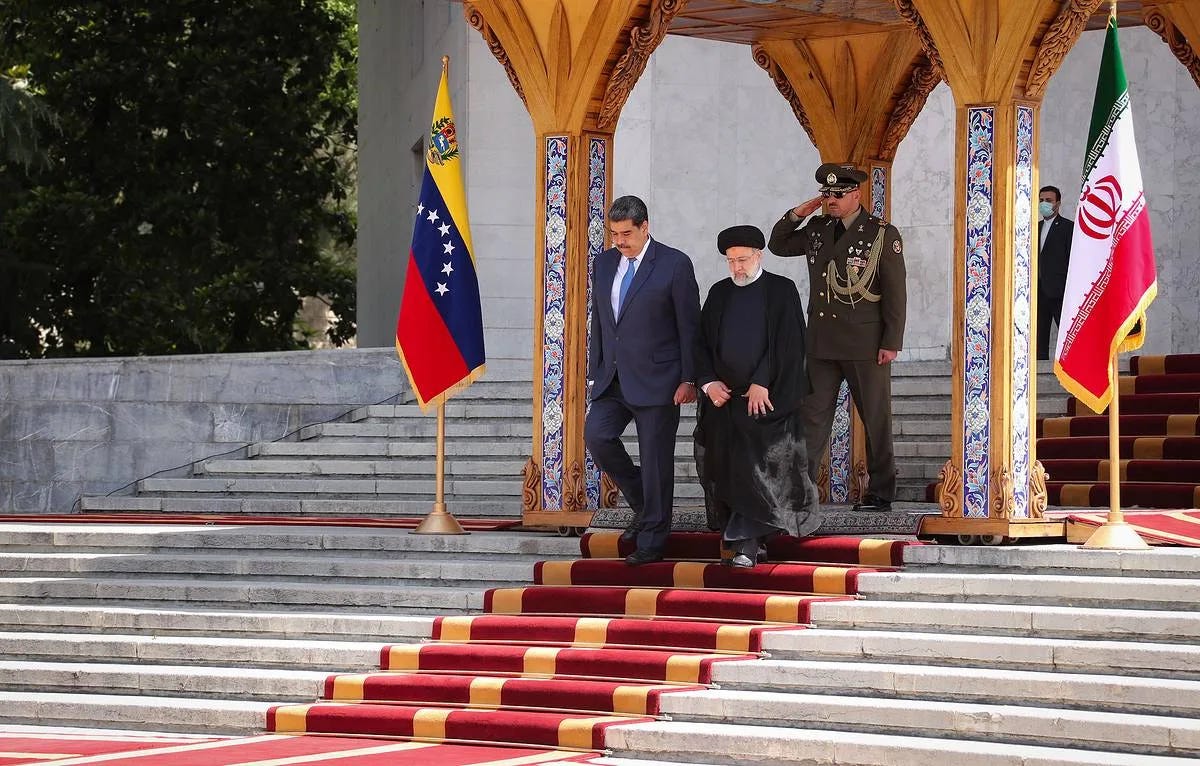
Despite the vast geographical distance, Iran and Venezuela have succeeded in forging a robust political and economic relationship one shaped more by shared international pressures than by traditional mutual interests. Sanctions, Western pressure, and a common desire to break free from isolation have formed the bedrock of this evolving alliance over recent years.
Since the early 2000s, relations between Tehran and Caracas have deepened steadily, driven by a shared political rhetoric hostile to American hegemony. This ideological alignment has translated into tangible cooperation on sensitive fronts, making the Iran-Venezuela relationship one of the most notable unconventional alliances in the global arena.
A Comprehensive Partnership
While Iranian-Venezuelan ties in the 1960s were largely limited to OPEC-related diplomatic exchanges focused on oil pricing and production, the relationship has since grown significantly more political.
The 1979 Islamic Revolution in Iran which severed Tehran’s diplomatic ties with Washington was followed two decades later by Venezuela’s Bolivarian Revolution under President Hugo Chávez. Although the two revolutions differed in origin and character, both drew from ideological frameworks centered on resistance to imperialism, colonialism, foreign intervention, globalization, and neoliberalism. This ideological common ground helped sustain bilateral ties despite significant cultural, linguistic, religious, and geographical differences.
Both Iran and Venezuela embraced national narratives rooted in enduring opposition to common external adversaries chiefly, U.S. dominance. The two countries maintained close coordination on the international stage, offering mutual support on issues of sovereignty and resistance to foreign intervention. This shared outlook bolstered their image as partners advocating for a multipolar world order, less beholden to American power.
Economically, the energy sector has been the cornerstone of this partnership. Venezuela, home to the world’s largest proven oil reserves, has seen its production capacity plummet under sanctions and chronic underinvestment. Iran stepped in at crucial moments, supplying fuel, assisting with refinery maintenance and operations, and offering technical support.
Their cooperation extended beyond oil into other industrial sectors, such as cement production, automobile assembly, and housing projects aimed at alleviating Venezuela’s domestic economic burdens.
In the face of sanctions, both nations found themselves in the same trench, seeking alternative mechanisms for trade including barter, unconventional shipping routes, and circumvention of the global financial system. This made their alliance something of a real-world laboratory for adapting to international economic pressure.
On the military front, cooperation remained cautious and controversial. Despite persistent allegations from Western governments, Tehran and Caracas maintained that their collaboration was limited to training, maintenance, and technical support falling short of a full-fledged military alliance to avoid further escalation.
Nonetheless, this partnership faced mounting challenges: sanctions undermined the implementation of key agreements, and the political upheaval in Venezuela following President Nicolás Maduro’s arrest on January 3, 2026, is poised to severely impact the trajectory of bilateral cooperation. Tehran now faces a grim scenario, with its relationship with Caracas rendered effectively comatose.
Intelligence Operations and Strategic Depth
Iran has also invested heavily in the intelligence dimension of its relationship with Caracas. Venezuelan territory evolved into a forward base for Iranian intelligence operations in Latin America, particularly in tracking U.S. and Israeli activities. This network was bolstered by the large Lebanese Hezbollah diaspora across Venezuela and the broader region—creating a complex intelligence environment for the United States.
Moreover, Iran developed ties with regional arms and drug trafficking networks, many of which targeted the U.S. directly. These connections significantly elevated the stakes of Tehran’s presence in the Western Hemisphere and contributed to Washington’s increasing concern over the strategic implications.
Maduro’s Fall and Its Impact on Iran
Maduro’s arrest cannot be viewed in isolation. It forms part of a broader U.S. strategy aimed at constraining Iranian influence beyond the Middle East. From Washington’s perspective, Venezuela had emerged in recent years as one of Tehran’s key entry points into the Western Hemisphere not only for evading sanctions through oil exports, but also as a symbolic challenge to U.S. dominance in Latin America, dating back to the Monroe Doctrine of 1823.
In this context, Maduro’s removal represents more than a domestic shift—it is a strategic opening for the United States to recalibrate the regional landscape and sever one of Iran’s crucial lifelines for breaking international isolation. Any new government in Caracas will likely be offered a “grand bargain”: cut ties with Iran in exchange for sanctions relief, reintegration into the global financial system, and access to Western investment.
This presents Iran with a stark dilemma. Losing Venezuela would signal a clear retreat in its efforts to expand influence beyond its immediate region and would mark another U.S. success in its multipronged pressure campaign. The future of Iranian-Venezuelan relations, then, hinges not solely on Caracas’s choices, but on Washington’s ability to convert this political transition into a strategic tool for global containment.
Can Iran Recover from Maduro’s Fall?
Maduro’s downfall poses a formidable test of Iran’s capacity to project power beyond its geographic neighborhood. Tehran is likely to pursue multiple tracks simultaneously, recognizing that the loss of Venezuela is not merely the loss of an ally but the collapse of a symbolic and strategic outpost in the Western Hemisphere.
Should a new Venezuelan government adopt an overtly anti-Iranian stance and align itself closely with the U.S., Iran will face one of its most complex foreign policy scenarios outside the Middle East.
The shift in Caracas would not just signify a lost partnership, but the transformation of Venezuela into a U.S.-dominated arena one potentially used to politically and economically tighten the noose on Tehran, especially within global energy markets.
In response, Iran may abandon any lingering hopes of preserving its strategic partnership and pivot toward damage control. This could involve seeking legal mechanisms to freeze or safeguard existing agreements, maintaining backchannel communication with economic entities in Venezuela, and avoiding overt political engagement with the new regime.
At the same time, Tehran will likely avoid direct confrontation with Caracas’s new leadership to prevent handing Washington an additional pretext for escalating pressure. Instead, it may opt for a tactical withdrawal, minimizing its public footprint while working quietly to prevent the transition from becoming a sweeping symbolic victory for the U.S.
Regionally, Iran may compensate for the loss of Caracas by shifting its focus to Latin American countries less sensitive to U.S. influence, pursuing low-cost economic and technological collaborations. Strategically, the greater challenge will be to contain the psychological and political fallout from Venezuela’s exit from the Iranian orbit—and to push back against the narrative that Iranian influence in the Western Hemisphere was fleeting and circumstantial.
Ultimately, Iran’s response to a hostile government in Venezuela will be defined less by confrontation and more by calculated retreat an exercise in crisis management aimed at preserving core interests while awaiting future global shifts that might reopen doors to influence.