

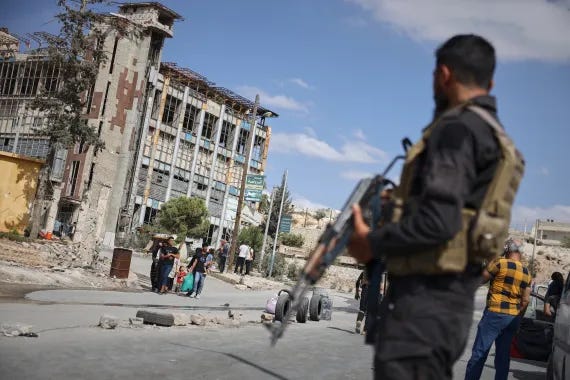
Tensions have flared once again in the northern Syrian city of Aleppo at the start of 2026, following fierce clashes between the Syrian army and the US-backed Syrian Democratic Forces (SDF) in the predominantly Kurdish neighborhoods of Sheikh Maqsoud and Ashrafieh.
The renewed fighting on January 6 led to casualties, including among civilians, marking one of the most intense bouts of violence in Aleppo since the fall of the Assad regime.
Why Did the Clashes Resume?
The escalation came after a period of uneasy calm that followed a temporary truce brokered in late December. That fragile quiet unraveled when the SDF began launching indiscriminate rocket and mortar attacks on neighborhoods of Aleppo under government control.
Observers point to the collapse of the latest US-mediated negotiations which aimed to integrate the SDF into the Syrian army as the spark that reignited the conflict amid a stalled political process.
On January 8, for the third day in a row, the SDF intensified its military activity in the province, targeting the Lirmoun industrial zone and the Shihan roundabout with heavy machine gun fire.
Syrian authorities accused the SDF of a “major escalation,” attacking army positions and residential areas in Aleppo, and committing a series of massacres against civilians in recent weeks.
According to the Ministry of Information, SDF attacks on government-held areas in recent months have left more than 20 civilians dead and at least 150 wounded. The ministry also reported the deaths of at least 25 Syrian soldiers.
This is not the first time the SDF has triggered unrest in Aleppo. Similar escalations took place in October and December of 2025. On both occasions, the Syrian government responded in kind, followed by lulls in fighting that stretched back to April of that year.
This time, however, Damascus responded more decisively from the outset. It declared that a ceasefire would only be possible if all SDF fighters withdrew entirely from Aleppo.
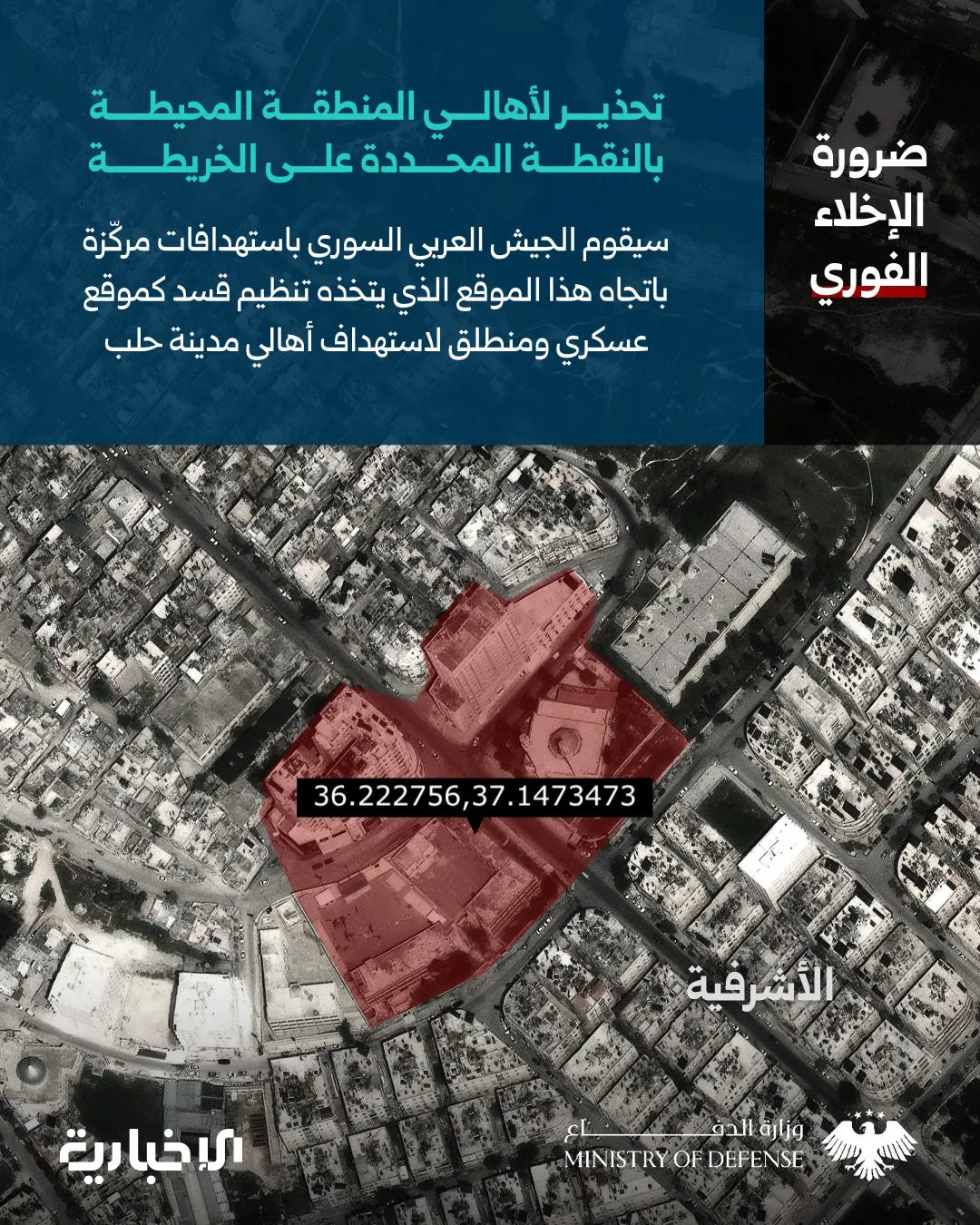
The Syrian army has already announced that all SDF military sites in Sheikh Maqsoud and Ashrafieh are now considered “legitimate military targets,” urging residents to evacuate through humanitarian corridors ahead of the operation.
Why Aleppo?
The neighborhoods of Sheikh Maqsoud and Ashrafieh have become focal points of the conflict due to their unique demographic and geographic characteristics. Though predominantly Kurdish, they lie within the city limits of Aleppo but have remained outside the control of the Syrian state.
Kurdish armed units never withdrew from the area, despite an agreement reached in March 2025 between Damascus and the Autonomous Administration requiring SDF fighters to leave Aleppo by April. The SDF maintained its grip on this enclave in open defiance of state authority.
For the Syrian government, continued SDF control of an isolated pocket in the heart of Aleppo is a direct challenge to national sovereignty and state authority.
The issue is further complicated by the SDF’s insistence on its autonomous governance project and its refusal to fully integrate into Syria’s post-conflict national institutions—a stance Damascus rejects, seeing it as incompatible with the unified state that is supposed to emerge after the regime’s fall.
Why Now?
Analysts say the government’s decision to pursue a full-scale military solution against the SDF in Aleppo stems from a confluence of factors, including:
1. The Expiration of the Political Solution
The move came after all attempts to integrate the SDF into the Syrian army—per the March 10, 2025 agreement—had been exhausted. The deadline for implementing the deal passed at the end of 2025 without any progress.
Moreover, the latest round of US-brokered talks between Damascus and the SDF in early 2026 ended in failure, dashing hopes for a peaceful resolution and prompting the government to conclude that military action was inevitable.
2. Escalating Attacks on Civilians
The decision was also driven by the SDF’s continued targeting of civilians and infrastructure in Aleppo.
By intensifying its shelling of populated areas, the SDF sought to pressure the Syrian government in the country’s second-largest city—economically and demographically—turning the conflict from a political issue into a humanitarian and security crisis.
3. Testing Israeli Involvement
Another factor is Damascus’ desire to gauge the extent of potential Israeli interference. Israel has long been accused of supporting anti-government groups, including the SDF, during the war.
The Aleppo operation comes just weeks after a new negotiation track opened between Syria and “Israel” mediated by the US aimed at de-escalating tensions in southern Syria. Damascus reportedly made non-intervention by Tel Aviv a precondition for any understanding.
Humanitarian Impact
The military escalation has imposed a severe humanitarian toll on civilians trapped in the combat zones.
From the first day of SDF shelling, civilians were killed and dozens injured, sparking widespread panic.
By the evening of January 7, Aleppo’s Department of Social Affairs reported the displacement of over 45,000 people from the conflict-affected neighborhoods.
Most of the displaced fled on foot toward northwestern rural Aleppo, heading toward Afrin near the Turkish border.
However, not everyone was able to escape. Heavy bombardments prevented many families from leaving, forcing them to shelter in basements and makeshift bunkers.
Some were evacuated to temporary shelters in safer parts of Aleppo using buses deployed by Syrian Civil Defense teams.
Internal security forces and civil defense units were deployed to secure evacuation routes from Sheikh Maqsoud and Ashrafieh via Zohour Street.
Aleppo’s governorate suspended all educational and government operations on January 7 and 8 to safeguard residents.
The Civil Aviation Authority halted all flights to and from Aleppo International Airport for 24 hours starting January 7 due to the security situation.
The Aleppo–Turkey international highway was closed, operations at factories in Lirmoun’s industrial zone were halted, and main roads leading to the city center were effectively paralyzed.
Military Capabilities of Both Sides
On the ground, the Syrian government enjoys a clear advantage in firepower and weaponry in this direct confrontation.
The Syrian army has deployed armored units and heavy reinforcements to Aleppo and is actively using tanks, artillery, and multiple rocket launchers to target SDF positions in Sheikh Maqsoud and Ashrafieh. It also has access to combat drones.
In contrast, the SDF suffers from limited capabilities in Aleppo. Their arsenal is largely confined to rifles and light machine guns, with no access to armored vehicles or heavy artillery.
Kurdish officials acknowledged that the SDF’s presence in Aleppo primarily consists of internal security forces (Asayish) and a few hundred fighters equipped only with personal weapons. Despite this, they’ve leveraged the urban terrain and pre-built fortifications to repel attacks.
Still, military analysts and security sources agree that the balance of power clearly favors the Syrian army, thanks to its superior firepower and numbers. Government forces have mobilized enough troops to fully encircle and isolate the Kurdish enclave.
Observers believe the army is awaiting the evacuation of most remaining civilians before launching a decisive assault to “cleanse” and retake the neighborhoods.
Reuters quoted Syrian security officials as saying they expect a major offensive to be launched soon to end what they described as an “abnormal situation” in Aleppo.
Military analysts similarly believe that Damascus now has a prime opportunity to conclude the battle swiftly and with minimal losses, especially after weakening SDF defenses through sustained bombardment and severing their supply lines.
Still, analysts caution that the core of the crisis will persist unless the delayed integration agreement with the SDF is fully implemented. Damascus remains determined to reassert full sovereignty over all Syrian territory and to bring all factions under the command of the national army while the SDF continues to resist abandoning its autonomous governance project.