

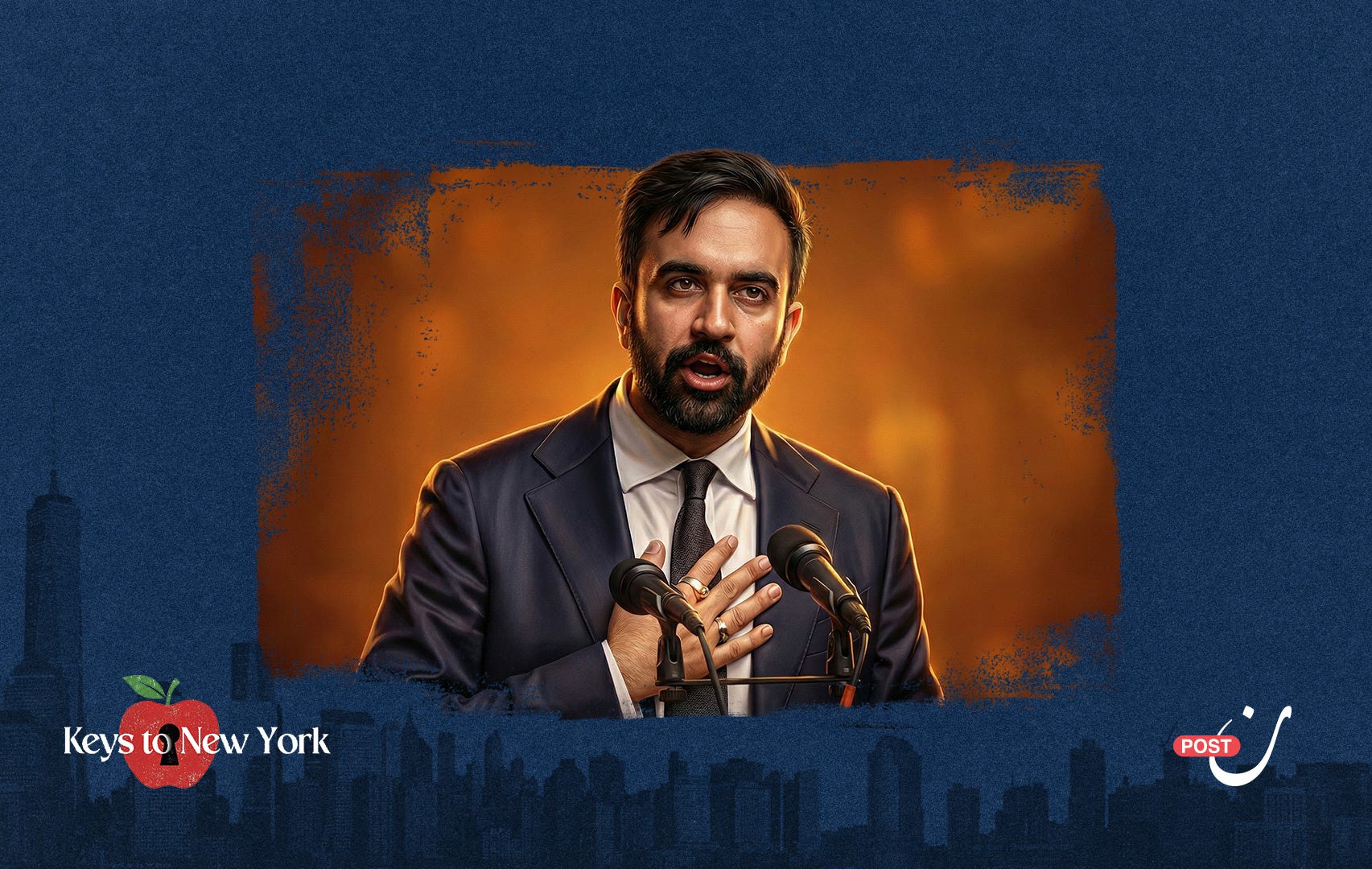
“The Big Apple” or “The City That Never Sleeps” New York is now handing over its keys to a young man of immigrant roots, a practicing Muslim with a socialist ideology. He represents a fundamentally different model from any of his predecessors in a city with a truly global identity.
This article sheds light on Zohran Mamdani’s program as the new Mayor of New York, exploring what he can realistically achieve, what lies beyond his authority, and whether he can genuinely reshape the face of this iconic city. We assess his potential impact on issues relevant to Arabs and Muslims from immigration, religious freedom, and national belonging to his relationship with Trump and whether the latter can derail the ambitious young mayor chosen by New York.
We also examine the complex dynamic between Mamdani and the city’s Jewish community one of the largest outside Israel and trace recent shifts within the Democratic Party. Are these changes tied to our region, or are they mere side effects of America’s political turbulence?
A former Dutch colony once called “New Netherland,” New York today is one of the world’s most dynamic and complex cities, with a population nearing 8.5 million, a workforce of over 300,000, a police force of nearly 35,000, and a budget exceeding $120 billion. Its GDP rivals that of ten countries combined, reaching $1.3 trillion. Millions of children attend its public schools, and just as many ride its public transit daily.
Mamdani now oversees all this with considerable authority. His campaign carried lofty promises—some labeled them dreamy, others saw real hope for change. Since assuming office in January 2026 for a four-year term, the question remains: can Mamdani deliver on his promises? What are his powers? What constraints does he face? What forces may help—or hinder—his agenda? This article explores these questions in depth.
Between the City Council and the Governor: Who Holds the Mayor in Check?
Mamdani is not new to politics. Despite his youth, he has served in public office since 2021 as a state assemblyman representing Astoria in Queens. But the mayoralty is a different beast altogether he is now the city’s chief executive, with vast powers.
He appoints and dismisses commissioners of about 30 key city agencies police, fire, transportation, finance, cultural affairs, small business services, and many more. He also oversees more than 200 committees and councils that govern housing, complaints, economic development, infrastructure, and beyond.
His role impacts city contracts and includes appointing judges to criminal and family courts, and temporarily to civil courts. Mamdani also sits on the boards of public libraries, museums, arts centers, parks, hospitals, and the city’s health corporation.
Yet despite his sweeping powers, the mayor remains one actor within a broader system of checks and balances. The State Legislature in Albany, composed of the State Senate and Assembly, operates much like a state-level Congress. Above all stands the Governor, whose jurisdiction includes New York City.
The relationship between city and state is fraught, shaped by shifting alliances and competing interests. Mayors have often clashed not with federal Republican governments, but with their own state’s Democratic leadership. Former Mayor Bill de Blasio (2014–2021) was famously stymied by Governor Andrew Cuomo (2011–2021)—ironically, Mamdani’s rival in the mayoral race who blocked de Blasio’s proposal to tax the wealthy to fund universal pre-K, striking a deal with state Republicans instead.
In contrast, former Mayor Michael Bloomberg understood these constraints well. Rather than confront the city’s power brokers, he focused on non-controversial goals: environmental reform, youth employment, and public health achieving success without altering the city’s deeper power structures.
Mamdani enjoys notable support from Governor Kathy Hochul and legislative leaders like State Senate Majority Leader Andrea Stewart-Cousins and Assembly Speaker Carl Heastie, who backed his campaign. But support is not guaranteed compliance.
Hochul is up for re-election in 2026 and may avoid alienating powerful donors by endorsing steep tax hikes. Moreover, Mamdani’s influence wanes outside New York City, limiting his leverage with legislators representing other districts.
Crucially, the City Council—New York’s legislative body—plays a pivotal role. Under the city’s separation of powers model, only the Council can pass laws on housing, labor, tech, safety, health, environment, and other daily concerns. The mayor may propose and sign bills—or veto them. The Council, however, can override a mayoral veto with a two-thirds vote.
Tensions are frequent. The Council has repeatedly overridden mayoral vetoes—on wage laws, business regulations, and police policies. Mayor Eric Adams’s objection to restricting liquor licenses in the Bronx, for instance, was dismissed due to public and commercial pressure.
Ultimately, the mayor must function as a central cog in the city’s machinery—success depends on compromise and coalition-building, not unilateral control.
From Top to Bottom: The Tax Debate
Taxes formed the cornerstone of Mamdani’s campaign. The fervent socialist pledged to raise taxes on the city’s ultra-wealthy figures like Michael Bloomberg, Ralph Lauren, Rupert Murdoch, Julia Koch, Stephen Schwarzman, and Chase Coleman. Many funded efforts to defeat him, pouring $40 million into campaigns supporting rivals like Andrew Cuomo and Curtis Sliwa via PACs like “Fix the City” and “Defend New York.”
While some of this opposition was rooted in pro-Israel and anti-Muslim sentiment, the lion’s share stemmed from Mamdani’s aggressive tax platform: $5 billion in levies on major corporations and capital gains, and a new tax on individuals earning over $1 million annually.
Yet Mamdani lacks unilateral authority to implement these hikes. While he controls the city’s budgetary planning, significant tax changes require approval from the Governor and both chambers of the State Legislature. Raising the corporate tax from 7.5% to 11.5%, for instance, hinges on his ability to forge alliances in Albany.
Critics argue that higher taxes will drive out businesses and residents. Some, like millionaire grocer John Catsimatidis, have threatened to relocate to New Jersey or Florida. Opponents claim this could tarnish New York’s global financial reputation.
Housing: New York’s Core Crisis
Skyrocketing rents plague New Yorkers, two-thirds of whom are renters. Citywide, housing costs are double the national average, and inflation continues to erode affordability. Although laws cap rent increases in certain pre-1974 buildings with six or more units, housing remains a flashpoint.
Mamdani pledged to freeze rent hikes during his term—a promise that helped him defeat Cuomo in the Democratic primary. He also vowed to build 200,000 permanently affordable housing units over the next decade and expand public housing programs.
As mayor, Mamdani appoints the nine-member Rent Guidelines Board, which sets annual rent adjustments. Though theoretically plausible, a rent freeze could backfire if not carefully managed, hurting small landlords struggling with inflation-driven maintenance costs. With nearly 1 million such units citywide, balance is critical.
Previous mayors have often sided with landlords. Mayor Eric Adams’s board approved a 4.5% increase on two-year leases and 3% on one-year leases—a move that Mamdani used as a rallying cry. Still, rent freezes are possible: Bill de Blasio enacted three during his tenure.
Public Transit: Right or Revenue Source?
Mamdani’s boldest transport pledge was free bus service. Public transit is New York’s lifeline, costing $21 billion annually, funded through fares, tolls, and taxes. Eliminating fares could create a shortfall of $600–800 million, requiring state-level approval and cross-agency support.
Mayor Eric Adams piloted free service on five bus routes from 2023 to 2024. The program ended due to high costs and traffic congestion, despite a 30% ridership boost. The state’s transportation authorities—and not the mayor—control most transit policy, complicating further efforts.
While Mamdani envisions free buses citywide, a limited rollout in low-income areas appears more feasible. His rival Cuomo criticized universal free transit as a burden that would benefit the wealthy unnecessarily.
Groceries and Basic Goods: Soviet Redux or Social Justice?
Mamdani also promised subsidized grocery stores offering low-cost essentials a $140 million annual commitment requiring City Council approval. Critics labeled it Soviet-style policy. Mamdani counters that city-owned stores, supported by public land and wholesale pricing, would serve each borough without undermining private grocers.
The concept isn’t new: New York already supports food security programs amid rising prices and widespread food insecurity. Cities like Madison, St. Paul, Chicago, and Atlanta run similar initiatives. Atlanta’s Mayor Andre Dickens defended his city’s public grocery plan, citing private-sector failures to meet the needs of marginalized communities.
Wages and Early Childhood Care
Mamdani proposed raising the minimum wage to $30/hour by 2030 double the current $15 baseline set in 2018. Critics warn of job losses and a shift to informal labor markets, but proponents argue it’s vital amid soaring living costs.
Another key proposal is free early childhood care (from six weeks to five years old), costing up to $6 billion annually. It enjoys the backing of Governor Hochul, who pledged to prioritize the plan in the next state budget.
Four Years to Test the Dream
According to Lynn Weikart, author of Mayor Michael Bloomberg: Limits of Power and professor of public administration at James Madison University, successful mayoral leadership requires smart staffing, realistic goal-setting, and deliverable outcomes. Recklessly challenging the system, she warns, invites institutional resistance.
This is precisely what Mamdani has set out to defy.
His victory rattled mainstream media and power centers. Critics hoped to discredit him, fueled by Islamophobia, xenophobia, and disdain for socialism. Yet beneath the pessimism lies real fear not that Mamdani will fail, but that he might succeed.
Success would not only transform Mamdani’s legacy but also empower the communities he represents. If he can upend the rules and turn New York into a city for all its people—not just the super-rich—it would be historic.
Skeptics cite the city’s entrenched elite and decades of failed reform. But Mamdani’s supporters argue that his promises are practical and necessary. Economist Maliha Safri, author of Solidarity Cities: Confronting Racial Capitalism and the Path to Change, says New York’s history from its unionized era in the 1930s–60s to its neoliberal turn in the 1970s shows it can be reclaimed by the people.
To her, Mamdani’s labor-inspired, anti-racist vision marks a return to democratic urban governance. While some of his goals exceed traditional mayoral powers, careful appointments, strategic alliances, and political savvy may allow Mamdani to deliver real change.
Whether New York becomes a city for its people or remains a playground for the elite may well be decided in the next four years.
