

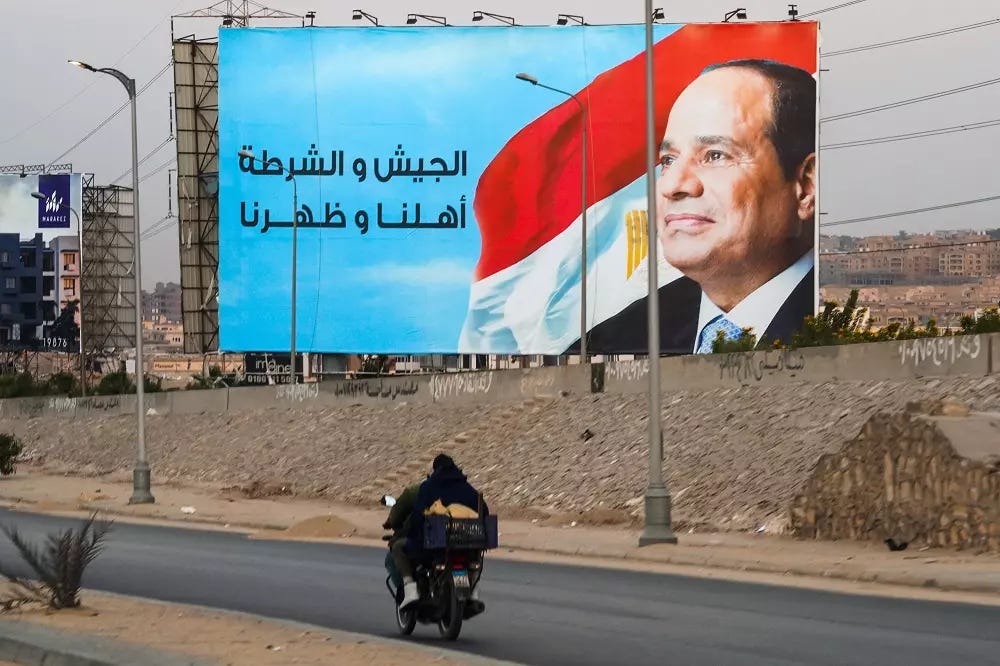
The January 25 Revolution was not a passing event in modern Egyptian history; it was a political and social earthquake that, in a matter of days, overturned entrenched assumptions about security control and the regime’s ability to manage the streets.
At a moment that opened wide horizons of liberty and justice for Egyptians, it also delivered a shocking revelation to the authorities: that society was capable of breaking the barrier of fear, self‑organizing, and disrupting the governing apparatus even in the face of powerful security institutions.
Since then, the deep state has treated the January Revolution as a harsh test that reshaped its vision of governance and the boundaries of the public sphere. Especially after 2013, January became a governing reference for security and political thinking, and Sisi began constructing a system of governance whose primary objective was to break the logic of “the square” before it could form again and ensure that January would never be repeated.
Thus, after 2013 the regime did not merely restore traditional instruments of control; it set out to comprehensively redesign the structure of the state and society, deriving lessons from January on four interconnected levels: security, law, media, and civil society.
On the security front, the regime restructured its agencies and expanded their powers, creating specialized units for monitoring and rapid intervention, integrating advanced technology into surveillance systems that allowed for a shift from reactive response to proactive control.
On the legal front, it enacted a package of restrictive laws on protests and public activity, supported by judicial and security mechanisms that guarantee swift deterrence and harsher punishments.
In the media sphere, control over traditional outlets tightened and the digital space was regulated, criminalizing any discourse capable of mobilization. In parallel, civil society was reengineered through a comprehensive regime of licensing and oversight that privileges associations aligned with state objectives and marginalizes or confines independent human‑rights and political organizations.
What has happened since 2013 is not a return to the pre‑January 2011 status quo, but a new model of governance based on the securitization of the entire public sphere, the dismantling of tools for societal organization, and the prevention of any unregulated mass political moments.
The regime’s aim was not only to prevent a recurrence of January 2011 but to prevent society from imagining it in the first place making January a constant guide in all policies of prohibition, control, and the comprehensive redesign of the state and society.
How the Regime Prevented a Repeat of the Revolution
After the January 2011 uprising, the regime recognized that controlling the state and the public sphere could not rely solely on traditional security force. Mass protests had revealed society’s capacity for self‑organization and direct challenge to authority.
Post‑2013 strategies focused on key areas including establishing new security institutions, adjusting the mandates of existing agencies, and developing specialized units for monitoring protests and rapid deployment — integrating technology into surveillance to detect potential popular mobilization before it takes shape.
Alongside this, the regime sought to regulate the public sphere by issuing laws and procedures that limit sudden mass gatherings, enhance its dominance over the media, and monopolize political influence, aiming to prevent the public or any political actor from reproducing the January experience. Below are the main policies and measures the regime adopted based on January’s lessons:
Expansion of Private Security Companies in Regulating Public Space
The January 25 Revolution revealed that reliance on traditional security alone was insufficient; such agencies could not predict mass movement or control public space, exposing fundamental weaknesses. In response, after 2013 the regime intensified the monitoring of public spaces in major cities especially in universities, markets, and squares by permitting private security firms to operate under the Interior Ministry’s supervision with defined flexibility and powers.
Egypt saw a significant expansion of private security after 2013. Before the revolution, the state alone was responsible for security, but the relative weakness of the police after January led the regime to authorize the registration of around 250 security companies, with 50 under direct Interior Ministry oversight.
Many were run by figures with police or military backgrounds. Some, like Falcon Security, expanded their role into universities to suppress protests as part of the state’s strategy to rely on flexible security arms.
Private security became a central component of the new architecture for controlling public space, enabling the state to broaden surveillance and regulation particularly in sensitive arenas such as universities providing nimble forces for daily enforcement and rapid intervention.
Security Agencies Empowered
After 2013, the legal and institutional restructuring of security agencies went hand in hand with explicit political rhetoric that provided direct cover for the use of force on the streets. Alongside expanding officers’ powers in the field granting broader authority for search, arrest, and control judicial accountability mechanisms during protest dispersals were effectively diminished.
This approach was evident in public statements by Sisi, in which he declared that officers who use tear gas or shotgun rounds during protests even if resulting in injuries or deaths would not be held accountable. Legally, this was reflected in Protest Law No. 107, which gave security wide authority to ban and disperse gatherings by force, even if peaceful. Subsequent legislation further enhanced surveillance, intervention, and detention powers.
In July 2018, the parliament passed a law granting military officers immunity for acts committed in previous periods and limited their future criminal liability shielding them even while traveling abroad. The expansion of security powers thus became a cornerstone of the post‑2013 strategy to prevent a repeat of January, merging legislation, field practice, and political discourse into an integrated system.
Reshaping the Military
Since seizing power, Abdel Fattah el‑Sisi has sought to tighten control over the armed forces and restructure them, drawing from a core lesson of 2011 when the army did not stand with the regime’s head as much as it defended the military institution itself.
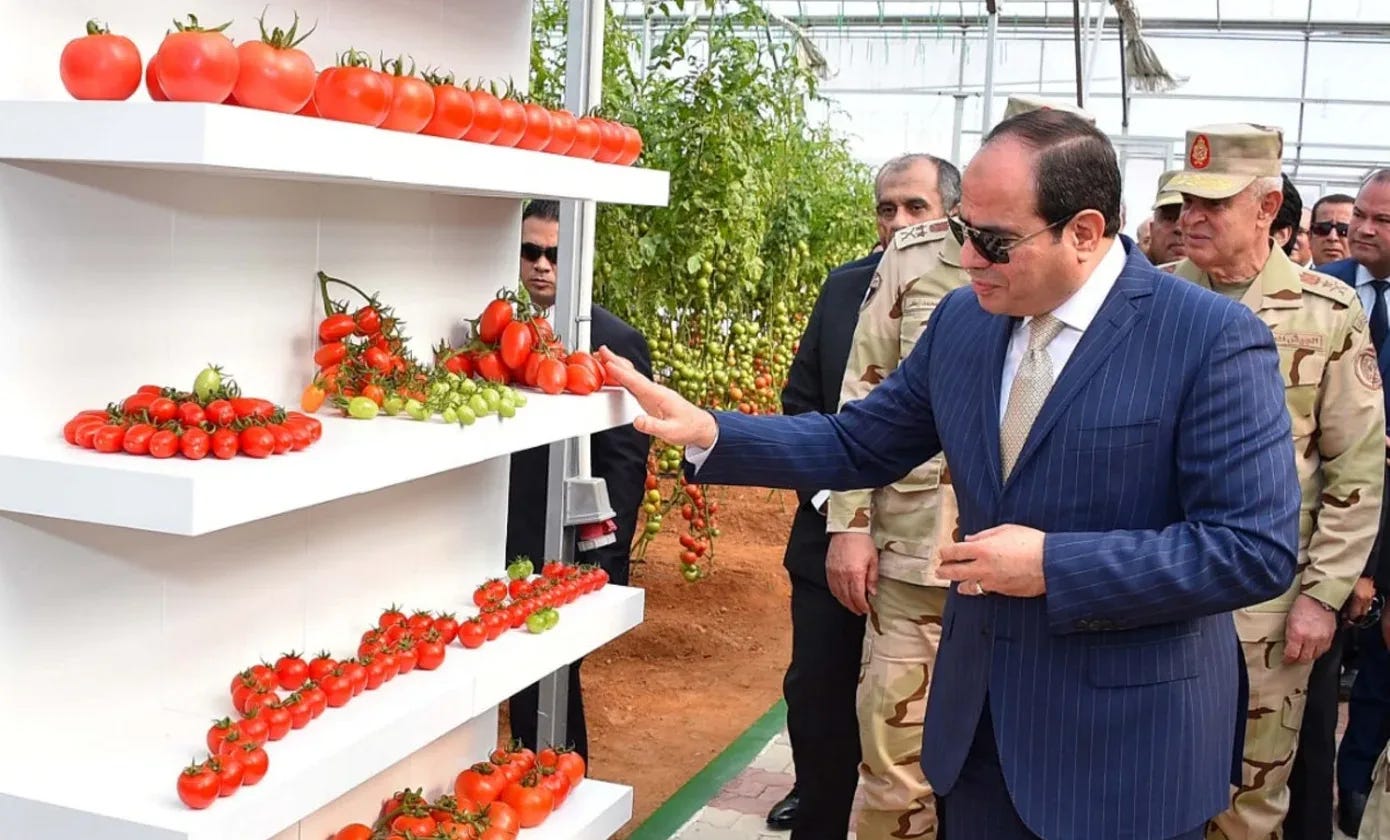
Based on this lesson, Sisi sought to rebalance power within the military by rotating leadership, shortening tenures for senior commanders in key posts, and creating a military intelligence authority limiting centers of influence and blocking a repeat of the Mubarak scenario.
Simultaneously, Sisi strengthened the army’s direct connection to the state’s power structure by expanding its economic role and tying the interests of its leadership and investments to the survival and stability of the regime.
Through these policies, the armed forces were reintegrated more tightly into the governance system as guarantors of Sisi’s hold on power, not as actors who might repeat past conduct with Mubarak.
Proactive Security Control
The January 2011 experience demonstrated that mass movements can expand rapidly beyond the response capacity of traditional security agencies. This drove the regime after 2013 to adopt a new security approach based on specialized small units capable of rapid, flexible intervention across multiple sites in short order.
Within this framework, special police units were created to operate proactively, combining field monitoring with intelligence analysis to detect mobilization cues before they materialize, assessing crowd size and vulnerabilities.
This approach manifested in units like “Black Cobra” forces and special police units deployed in Tahrir Square and key provinces, with preplanned intervention strategies for potential scenarios.
In 2014 the strategy expanded with the establishment of rapid intervention units within the army, alongside rapid deployment units under the Interior Ministry, aimed at countering protests more effectively than in January.
These forces received specialized training for street protests and used lighter vehicles than traditional armored ones, granting greater maneuverability in narrow streets and faster responses to sudden developments.
This modernization contributed to building an integrated security system that blends conventional agencies and newly established units, relying on proactive control and rapid intervention to prevent any protest from growing into a wide mass movement like January 2011.
Yet this model produced a clear paradox in the public sphere: an intensified security presence in squares and streets that does not reflect entrenched stability but rather its fragility. The daily display of force and heavy deployment reveal a structural anxiety about repeating January a constant attempt at prior control over a reality that remains susceptible to disruption.
Digital Surveillance
After the January 25 uprising, the regime realized that traditional monitoring and analysis methods could no longer keep pace with transformations driven by the spread of the internet and social media, where the digital sphere became a central arena for organization, mobilization, and information dissemination beyond direct security control.
In this context, after 2013 the authorities enhanced capabilities to monitor digital activity, using advanced software and systems to track content they deemed incendiary or threatening to national security. Expert reports indicate that the Interior Ministry developed dedicated units and systems to follow social networks and media platforms within a shift toward proactive regulation of the digital realm.
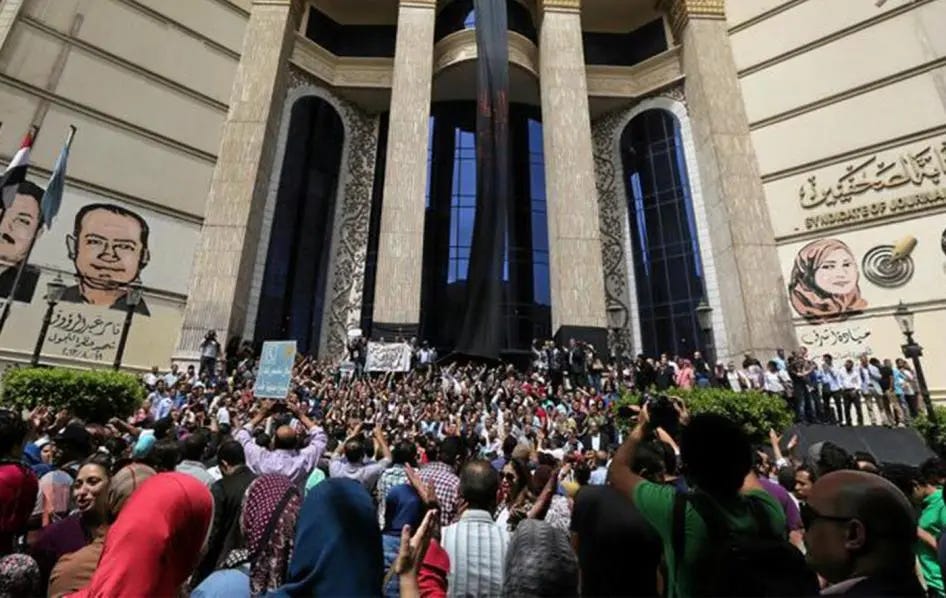
Alongside the development of monitoring tools, the regime pursued a more direct strategy to assert control over the online space by blocking websites. Since mid‑2017, it has conducted a broad campaign to ban hundreds of websites, including independent news outlets and human‑rights platforms.
According to international reports, the number of blocked sites reached into the hundreds part of a policy aimed at reducing independent information circulation and limiting the digital sphere as a platform for mobilization. Thus, controlling the digital space after 2013 became integral to a broader strategy of restructuring the public sphere.
Legalizing Repression
The January protests showed that tens of thousands could mobilize in Cairo and the provinces, and that the right to protest could become an effective tool of pressure on the regime. This led authorities to conclude that security control alone was insufficient to regulate the streets or prevent unexpected repetition.
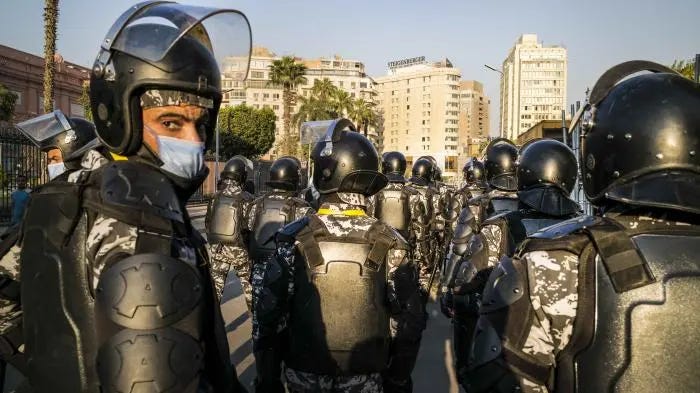
Thus, after 2013 the regime built a strict legal framework that precedes and restricts protest action. It enacted a suite of restrictive laws that turned protesting from a right into a high‑risk legal venture, emptying the public sphere of any possibility of mass mobilization, even in symbolic forms.
This logic was apparent in Protest Law No. 107, which imposed stringent restrictions on organizing demonstrations including requiring advance permits, specifying designated routes and locations, criminalizing any unpermitted gathering, and imposing financial and criminal penalties on violators.
At the same time, the regime developed an integrated legal and judicial deterrence system that included, in addition to protest law, anti‑terrorism and cybercrime legislation. Control thus extended beyond legal prohibition to creating a general climate of fear and uncertainty.
This was achieved through expanded use of pretrial detention and lengthy periods of preventive custody, especially in politically charged cases. In this context, security, intelligence, and prosecution authorities coordinated closely, meaning that the regime did not rely solely on security force but also leveraged the legal framework and established new judicial institutions to regulate civil society and dismantle the logic of January.
Subjugating Civil Society
The January 2011 uprising showed that civil society including associations, unions, youth spaces, and professional groups can become a powerful engine for mass mobilization and channel social discontent into organized action. This insight led the regime after 2013 to regard cohesive civil society as a threat, intervening to redefine it and dismantle its organizational capacity.
This policy began with stringent legal and administrative controls on NGOs and civic institutions, based on prior licensing, multiple security clearances, strict oversight of domestic and foreign funding, and limiting civic activity to narrow service‑oriented frames. Any direct or indirect political engagement was prohibited.
Simultaneously, institutions within the public sphere professional unions, universities, student associations, and parties were reconfigured to ensure control and reduce independence, restricting their roles to spheres that do not allow for mobilization or independent political discourse.
Egypt experienced a contraction in spaces available to civil society, with many Islamic charitable associations and civil groups raided or dissolved. Social movements faded, most parties born of January were dismantled, and independent unions were crushed — in the absence of truly independent courts or parliamentary oversight effectively demolishing civil society.
Alongside dismantlement and prohibition, the regime sponsored loyal youth groups domestically and abroad as counter‑mobilization tools and political support arms, integrating certain youth segments into entities directly overseen by the regime.
On the broader social level, these policies were accompanied by deliberate management of polarization and division within society sustaining fault lines between secular/Islamist, Salafi/Sufi, Muslim Brotherhood/army and, worse, immersing citizens in overlapping economic crises and daily anxieties, shifting public concern from politics to economic survival.
These combined strategies transformed the public sphere from an arena of interaction and organization into a fragmented, monitored space stripped of capacity for mass mobilization. What followed after 2013 was not merely a return to traditional modes of control but a comprehensive redesign of civil society and the public sphere rooted in a central lesson from the January Revolution: that organized society is a danger, whereas a divided and exhausted society is amenable to control and regulation.
Reengineering Public Consciousness
After the January 2011 uprising, the regime realized that the threat extended beyond the street to the pivotal role of media in mobilization and breaking the monopoly of the official narrative. Based on this lesson, authorities after 2013 adopted comprehensive strategies to reconfigure the media environment.
Before 2013, the Egyptian media landscape comprised about 142 newspapers, but post‑2013 control policies dramatically reduced this number some 40 percent of newspapers closed, leaving just 76 titles, while 19 television channels were shut down.
In traditional media, censorship tightened and media institutions were restructured to ensure alignment with the regime’s narrative. The regime also constrained independence in private media through acquisitions by companies and individuals close to state power, placing most outlets under direct or indirect regime influence.
The Supreme Council for Media Regulation became a central institutional tool in controlling media, with its head appointed directly by the president, stripping it of genuine independence.
At the same time, the regime focused on digital media after January proved that the online space was the beating heart of the revolution. It imposed strict legal and security controls to ban or restrict platforms that criticized government policies. The regime also supported content creators on social media to promote official narratives and defend government policies.
Beyond this, the regime turned drama, cinema, and television programs into central tools for reshaping public consciousness and entrenching the official narrative. Series such as “Al‑Ikhtiyar” (The Choice) portrayed a one‑dimensional depiction of the political and security struggle, elevating the army and security institutions as heroic defenders of the nation while casting opponents as existential threats.
The events of January and June 30 were reframed so that January was depicted as chaos and conspiracy, and June 30 as correction, with symbols of January tarnished and its political and symbolic impact erased from curricula and public discourse.
Post‑2013, from television to social platforms, from drama to school curricula, a unified narrative was woven, making media a central instrument for controlling the public sphere and preventing any alternative discourse.
In conclusion, the regime after 2013 did not seek to address the root causes of the January Revolution. Instead, it focused on building a state against January, embarking on a comprehensive redesign of the state and society.
January became a persistent reference point in every security law, every restructuring, and every discourse on stability which was never built on addressing the crisis’s roots but on dismantling the tools of organization and mobilization, replacing social consensus with control and domination.
The central question remains unanswered: Can this system endure long without genuine policies that address society’s demands? The regime closed the window of January, but it has yet to open a horizon beyond it.