

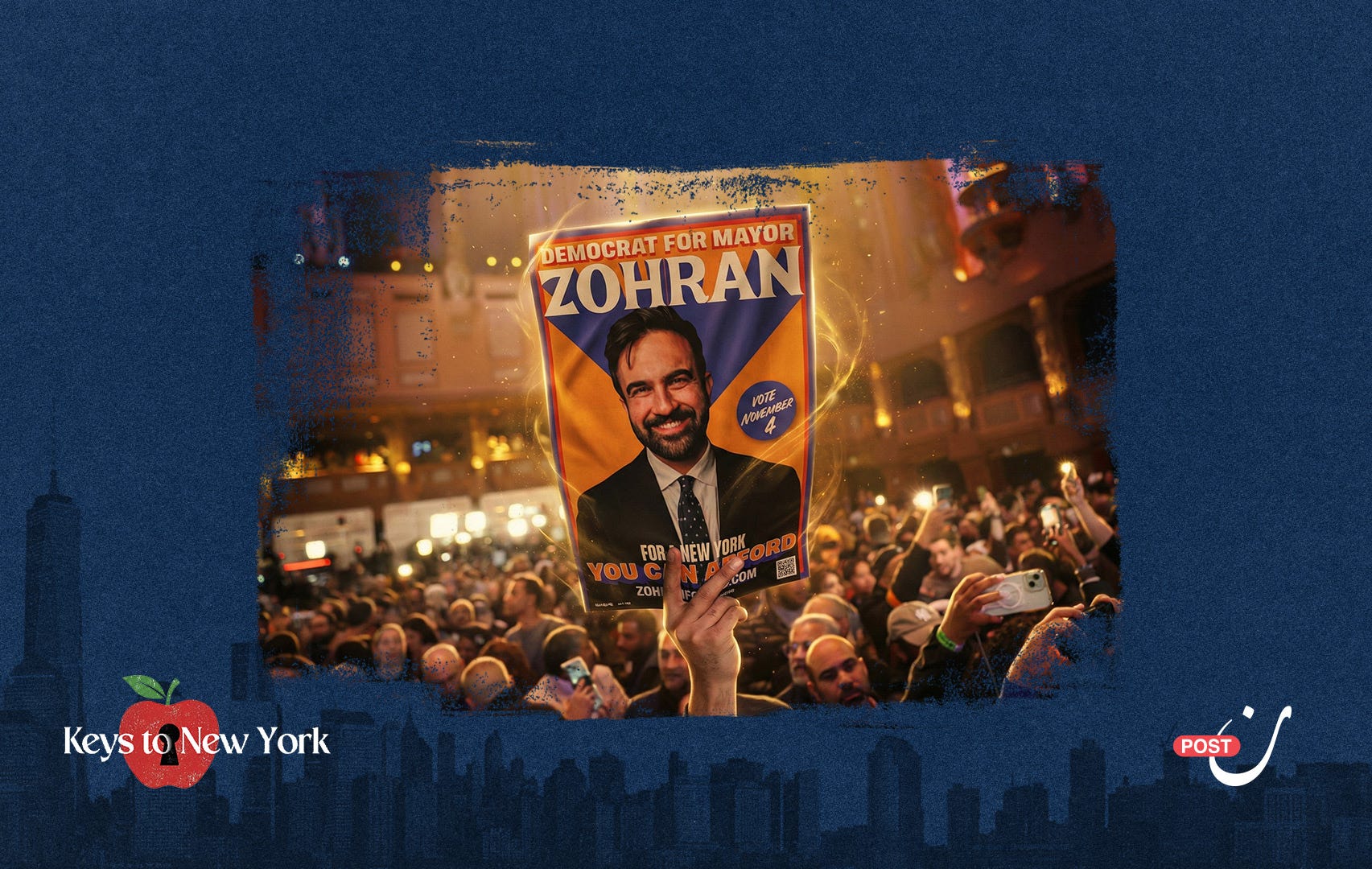
Zoran Mamdani’s election as mayor of New York City last November sent ripples far beyond the city itself. The son of Ugandan-Indian Muslim immigrants, a practicing Muslim, and an avowed socialist, Mamdani embodies multiple identities that challenge the traditional political narrative. His win, backed by a largely progressive base, says as much about the man as it does about the state of the Democratic Party in one of America’s most influential cities.
Mamdani’s victory, as a progressive leftist Democrat, speaks volumes about the Democratic Party’s ongoing internal struggle a battle that has intensified since October 7, 2023. While centrist and conservative Democrats view this shift with apprehension, liberals and progressives see it as a necessary evolution, a historical inevitability that the party must embrace to remain relevant in an era of sweeping global change. Otherwise, the Democrats risk losing their identity, uniqueness, and electoral base.
So, what does Mamdani’s win signify for the Democratic Party? Is the party undergoing a painful transformation toward a more progressive, globally attuned future? Or will conservative forces prevail, pulling it closer to Republican philosophies?
Are these shifts tied to Israel’s war on Gaza? Or are they rooted in economic stagnation and rampant inflation? Does Mamdani’s election mark the beginning of a lasting realignment? Or is the party merely bending to the storm, waiting to revert once the winds die down? This article explores these pressing questions.
Is This the Socialist Moment?
As a member of the Democratic Socialists of America (DSA), Mamdani championed a bold socialist agenda in a city strangled by racial capitalism. His platform calling for rent freezes, free public buses, state-run grocery stores, a higher minimum wage, and free childcare struck a powerful chord with urban voters.
These are people squeezed out of the housing market and labor force, with working-class and low-income families barely surviving in a city increasingly hostile to their existence.
In a tweet following the election, the DSA said Mamdani’s win accelerated the spread of its principles, reigniting hope for meaningful working-class political engagement. His youthful volunteer army, operating without significant backing from the Democratic establishment or centralized funding, pulled off an electoral upset: Mamdani secured over 2 million votes (50.4%), compared to 41.6% for independent Andrew Cuomo and 7.1% for Republican Curtis Sliwa.
The DSA, now boasting 80,000 active members across college campuses and workplaces nationwide, distances itself from the authoritarian socialist regimes of the Cold War era and from watered-down social democracy. It advocates for democratic planning that is both humane and economically pragmatic, rejecting both corporate domination and unrealistic idealism.
While refusing the “radical” label, the DSA believes incremental reforms aren’t enough. They understand that capitalism, deeply entrenched in the global economy, won’t collapse overnight. Their aim is not a revolution, but a shift in power from corporations to workers through realistic strategies.
The DSA has already scored major victories. Alexandria Ocasio-Cortez’s 2018 upset win over Joe Crowley and Mamdani’s own election to the New York State Assembly in 2021 are testaments to its grassroots strength. Figures like Bernie Sanders, though not a member, remain central to its ideological orbit, as does Rep. Rashida Tlaib of Michigan.
Yet Mamdani’s campaign was pragmatic. He distanced himself from some of the DSA’s more polarizing stances, particularly its call to defund the police. Once a vocal critic of law enforcement, Mamdani softened his stance during the campaign, offering instead a cooperative approach aimed at reform rather than abolition.
Even so, Mamdani’s win doesn’t necessarily signal a socialist surge nationwide. New York’s unique demographics a city of immigrants and working-class majorities—favor his brand of politics. In more conservative locales like Minneapolis, DSA-backed candidates have struggled. But in America’s major cities, Mamdani’s success is a harbinger of a larger shift.
A Party at War with Itself
Cuomo, the moderate Democrat Mamdani defeated, called the party’s internal tensions a “civil war” – a stark divide between centrists and the progressive wing. While the Democratic establishment has previously co-opted social democrats like former NYC Mayor Bill de Blasio, Mamdani’s unapologetically socialist message is far more jarring.
Many prominent Democrats, including Senate Minority Leader Chuck Schumer, remained silent during Mamdani’s campaign, worried that his anti-Israel and socialist leanings could damage the party ahead of the 2026 midterms. Others, like Rep. Tom Suozzi, openly criticized Mamdani as a well-meaning but misguided radical whose policies would drive the wealthy and businesses out of New York.
From Suozzi’s perspective, taxing the rich to fund social programs would push capital elsewhere. His solution? Strengthen unions, raise wages modestly, and make piecemeal improvements a strategy many younger Democrats see as outdated and insufficient.
Democratic strategist Tip Yang believes the party is watching Mamdani closely. After devastating losses in 2024, Mamdani may represent the future: a leader focused not on abstract ideological purity but on concrete, people-centered solutions. His willingness to engage even his fiercest critics sets him apart in a political climate marked by tribalism and cowardice.
Critics who call Mamdani a dreamer ignore a key fact: corporate profits have soared, doubling in just five years. His proposed corporate tax hike from 7.25% to 11.5% is modest in light of that windfall. As the ruling party in the city, Democrats risk existential crisis if they continue prioritizing capital over people.
The progressive group Justice Democrats echoed this sentiment, calling Mamdani’s win a wake-up call. The party has historically thrived when grounded in working-class concerns. By reconnecting with that base, they argue, Democrats can revitalize their mission without abandoning their core values.
Writing in The Guardian, Democratic scholar Robert Reich described the party as “virtually dead,” plagued by ideological confusion. Mamdani, he argued, offers a rare chance to unify Democrats around real issues. Reich blasted calls for “centrist moderation” as a smokescreen for corporate loyalty, accusing both Trump-era Republicans and establishment Democrats of authoritarianism in different clothes.
Youth and Immigrant Voters: The Party’s Missing Link
Mamdani’s rise reveals a generational rift within the party. Older centrists continue to cater to elites, while younger voters alienated by stagnant wages and widening inequality are turning left. A recent Gallup poll (September 2025) found that 66% of Democrats now view socialism favorably, while only 42% lean toward capitalism. Support for big corporations among Democrats plummeted to 17%, compared to 46% in 2010.
Youth disillusionment began with the 2016 election, deepened during COVID, and has been exacerbated by the party’s stance on Gaza. These frustrations have fueled support for the party’s left flank, which is more outspoken and aligned with international human rights.
Demographic change is another factor. New York is no longer a majority-white city. Latinx, Black Caribbean, African, and Asian communities now make up significant portions of the population and voted overwhelmingly for Mamdani. These voters have shifted the party’s electoral foundation over the past 40 years, yet establishment Democrats have largely failed to adapt.
Some, like Cuomo, have even mimicked Republican rhetoric on immigration. In contrast, Mamdani offered an inclusive message: “New York belongs to migrants and always will.” That message broke the party’s cycle of tokenism, instead affirming immigrants as central to the city’s identity.
As Rep. Alexandria Ocasio-Cortez told CNN, the party cannot continue to marginalize young people and communities of color and expect to survive. Mamdani’s win proves the cost of ignoring them.
When Gaza Shifted the Compass
Mamdani’s unflinching support for Palestinian rights was central to his campaign. He condemned Israel’s war in Gaza as a genocide and vowed to arrest Benjamin Netanyahu if he set foot in the city. This stance alienated party elites but resonated with the base. A Pew poll in March 2025 showed 69% of Democrats disapprove of Israeli policies in the occupied territories up from 53% in 2022.
Still, key Democratic leaders have continued supporting Israel. Cuomo and former Mayor Eric Adams both accused Mamdani of antisemitism a tactic seen as more about political survival and shielding corporate donors than genuine concern.
Even some Republicans have shifted. MAGA figures like Tucker Carlson and Steve Bannon now openly criticize Israel, forcing Trump to recalibrate. J.D. Vance, Trump’s running mate and potential 2028 contender, called criticism of Israel “healthy” and defended anti-Zionist speech.
The war has also fractured New York’s Jewish community. While pro-Israel groups mounted a fierce campaign against Mamdani, many young Jewish voters rejected this narrative, voting for him in large numbers. The myth of a monolithic Jewish vote long used to justify unconditional support for “Israel” has cracked.
A Party Shaken Awake
Mamdani’s victory over Cuomo, a seasoned political heavyweight and embodiment of establishment power, was more than an upset. It was a wake-up call to a party that believed old wisdom could withstand new realities. As the city’s demographics evolve and global crises reshape public consciousness, the Democratic Party faces a crossroads: cling to the past, or embrace a future defined by diversity, justice, and grassroots power.
The ascent of Mamdani and other progressives signals that change is not only possible it may be inevitable. The question now is whether the Democratic establishment is ready to listen.
