

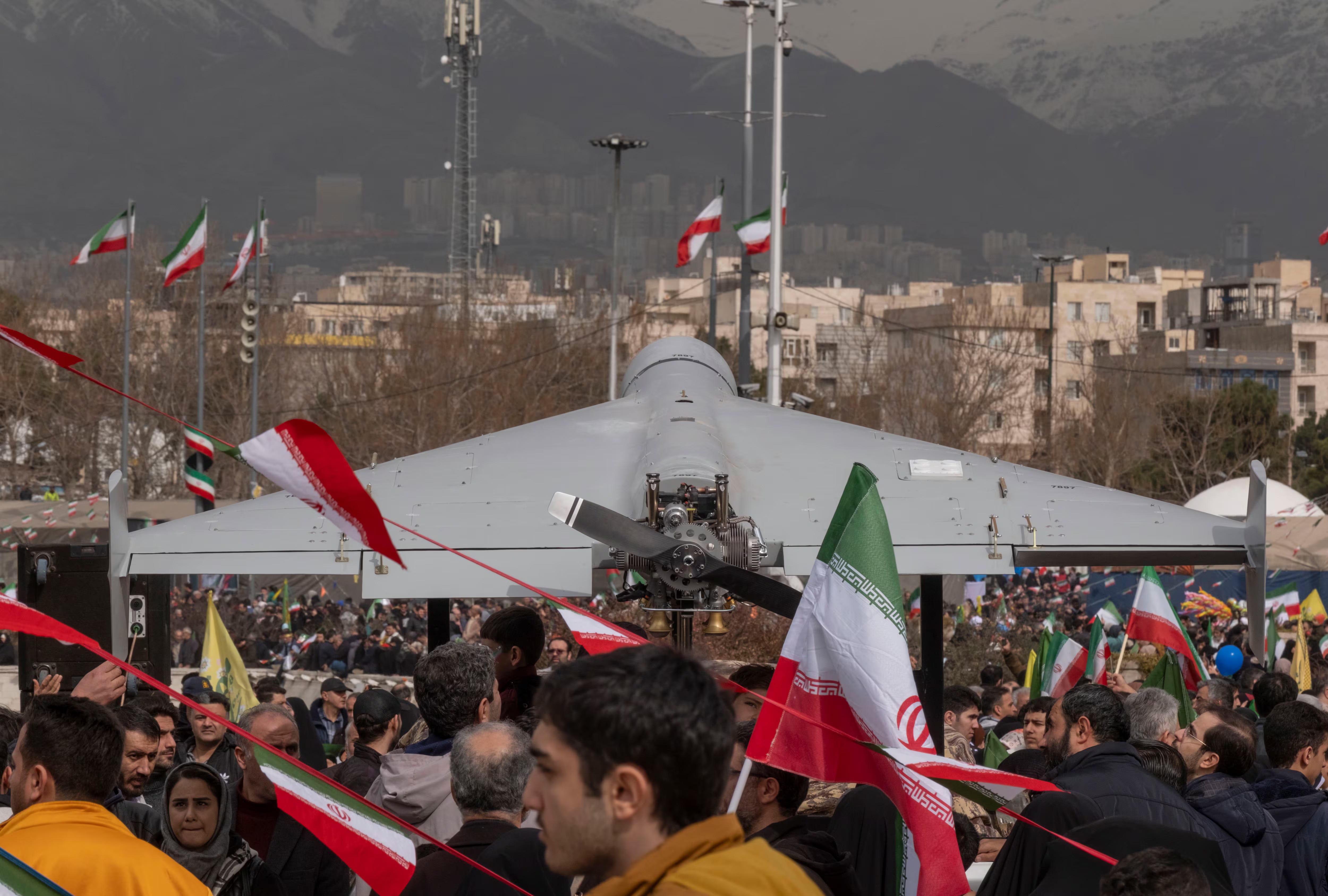
The term “ababil,” mentioned in Surah Al-Fil in the Holy Qur’an, evokes the image of successive, simultaneous attacks from multiple directions, descending from the sky as divine retribution against an enemy. Borrowing the term stripped of its sacred context we may use it metaphorically to understand the mechanism Iran employs in its aerial assaults: low-cost drones and comparatively inexpensive ballistic missiles launched against adversaries whose interception systems are far more costly.
This strategy—our own designation—has produced what the Jewish Institute for National Security of America (JINSA) describes as “The Eroding Shield: Air Defense Against Iran,” the title of its March 26 report documenting the cumulative losses inflicted by Iran on its adversaries up to that point in the war through drones and ballistic missiles.
Netanyahu’s Nightmare, Realized
Shortly after the end of the eight-year Iran–Iraq War which exposed Iran’s vulnerability to Iraqi Scud missile strikes launched from deep within Iraqi territory Iran recognized the urgency of reviving a project initiated under the Shah to develop indigenous ballistic missiles.
Ironically, “Project Flower” had originally been a joint initiative between the Shah’s Iran and the Israeli military, designed in the long term to carry nuclear payloads.
Iran began developing a ballistic missile based on North Korea’s Nodong-1 design, later named Shahab-3. With a range of 1,500 kilometers, the missile is capable of reaching Israel. Although Israeli intelligence became aware of the project as early as 1994, it failed to halt it before Iran successfully tested the missile in 2001. Nor did it act decisively before Iran’s missile program became fully operational within a few years.
In 1997, Benjamin Netanyahu warned that if Iran were allowed to acquire ballistic and nuclear capabilities, it could choke the global economy not merely pose an existential threat to Israel. Today, that warning appears, in his view, to have materialized in the form of Iran’s ballistic missile arsenal.
U.S. defense capabilities tested this imbalance in a war rehearsal in 2024 during Red Sea confrontations. Budget documents from fiscal year 2024 indicate that American defensive missiles cost roughly twice as much as the offensive missiles Iran supplied to the Houthis.
The following year, a Hudson Institute report offered further insights into Iran’s ballistic strategy. During the so-called Twelve-Day War, Israel exploited Iran’s largely open airspace to conduct preemptive strikes on ballistic missiles still on their launch platforms.
Nevertheless, Iran’s underground missile infrastructure known as “missile cities” preserved part of its arsenal. Over roughly nine months, Iran doubled its ballistic missile stockpile and adopted tactics refined during its April and October 2024 attacks on Israel.
In this year’s assaults, Iran demonstrated an ability to exhaust Israeli and American missile defense systems, particularly the Arrow system. In October alone, Iran launched around 200 ballistic missiles, concluding that saturation tactics significantly increased the likelihood of overwhelming Israel’s interceptor stockpiles. Approximately 35 of those missiles penetrated Israeli defenses, prompting the United States to rapidly deploy the THAAD missile defense system.
During the Twelve-Day War, U.S. forces expended roughly 150 THAAD interceptors and 80 SM-3 missiles defending Israel depleting nearly 25% of America’s interceptor inventory.
In the current war, according to JINSA, Iran has launched even more ballistic missiles, many equipped with cluster munitions containing between 24 and 80 submunitions. These have proven uniquely challenging for defense systems, flying at high altitudes and dispersing explosives over wide areas.
Even successfully intercepted missiles pose risks, as falling debris can still cause damage. Interceptors must strike targets before they re-enter Earth’s atmosphere, forcing Israel to rely more heavily on Arrow-3 interceptors, which operate exo-atmospherically systems the Israeli military has sometimes hesitated to deploy to preserve stockpiles.
Between March 13 and 22, Israel’s average hit rate rose to around 27%, compared to just 3% in the war’s first two weeks, largely due to cluster munitions. While Iran’s number of launch platforms reportedly dropped from 300 on March 3 to 160 by March 11, the report warns that the aerial threat remains far from contained.
It also estimates that the UAE and Kuwait have already used around 75% of their Patriot interceptor stocks, with Bahrain at 87% and Qatar at 40%.
Iranian Drones: From Headache to Destruction
On March 1 the day after the war began an Iranian drone penetrated air defenses and struck an operations center in Kuwait, killing six American soldiers. A military source told CBS News: “We effectively had no capability to stop drones.” Thus returns the “drone headache.”
This phrase was the title of an Axios report in 2024 during Red Sea and Gulf of Aden clashes. Two years later, following the joint U.S.-Israeli attack on Iran in February 2026, that “headache” has proven far more severe raising fundamental questions about the nature of warfare and the balance of military spending.
As Pentagon acquisition chief Bill LaPlante put it: “If we’re shooting down a $50,000 one-way drone with a $3 million missile, that’s not a good cost equation.” This, precisely, is the essence of Iran’s aerial warfare doctrine.
A March 17 Reuters report titled “Cheap Drones Are Reshaping the Air War” sheds further light on the evolving dynamics. Iran has spent years producing and supplying drones to its allies and is now deploying them extensively itself.
Since the February attacks, Iran has launched hundreds of missiles and over a thousand drones toward Israel and Gulf states aligned with Washington.
Iran’s approach prioritizes quantity over quality: waves of drones launched in rapid succession to overwhelm defenses. Individually inexpensive costing between $20,000 and $50,000, particularly for the Shahed model these drones collectively impose disproportionate strain.
Reuters underscores a striking calculation: a single Patriot interceptor missile costs around $4 million equivalent to approximately 115 one-way drones at $35,000 each.
According to The Wall Street Journal, the Pentagon may have spent $5.7 billion on interceptors in just the first four days of the war a staggering figure, especially considering Iran’s capacity to produce up to 10,000 such drones monthly.
Even if Iran is the more strained party overall, this does not render it vulnerable to outright domination. Its drone capabilities have fundamentally altered the strategic balance.
The report draws parallels with the Russia–Ukraine war, where Ukrainian drones have accounted for roughly 70% of Russian losses demonstrating how even a militarily superior force can be undermined by low-cost drone warfare.
Popular culture offers a telling contrast: films like Top Gun, starring Tom Cruise, depict the immense cost and training required for a single fighter jet crew. In the drone era, such investments may become liabilities. A downed F-15 represents not just material loss, but potentially trained personnel killed or captured.
Drones, by contrast, are remotely operated. Their loss carries minimal human cost and relatively low financial burden.
This has created a structural imbalance: the cost of offense has plummeted, while the cost of defense has soared. Interceptor missiles such as the $4 million Patriot or $13 million THAAD are used to destroy drones assembled from inexpensive components. Additional costs include fuel, maintenance, intelligence, surveillance, and command systems.
While Iran may currently hold an edge in drone warfare, both the United States and Israel are accelerating their own drone programs. The U.S. LUCAS-136 drone is considered a counterpart to Iran’s Shahed-136, though the latter still holds an advantage.
Both countries are also investing in laser-based counter-drone systems. Yet, as Reuters concludes, until such technologies mature and are widely deployed, reliance on costly interceptor missiles will persist.
The central question remains whether counter-drone technologies can evolve rapidly and cheaply enough to keep pace or whether defense will remain prohibitively expensive.
Is Iran’s Strategy Paying Off?
Returning to the JINSA report, several outcomes of Iran’s strategy are already evident:
Strikes on radar systems and communication links have weakened detection and early warning networks essential for effective air defense.
Drones being the cheapest and most abundant Iranian weapons have proven harder to detect and intercept than ballistic missiles, achieving more than double the hit rate.
Cluster-equipped ballistic missiles have inflicted widespread damage, including on energy and shipping infrastructure in the Gulf, contributing to oil price spikes and the closure of the Strait of Hormuz.
Iranian attacks have visibly degraded U.S. air defense systems, with Gulf states and Israel warning that interceptor stockpiles are nearing critical levels.
The dispersion of air defense resources has reduced the overall effectiveness of the regional defense network, while external allied support has added only marginal and slow reinforcement.