

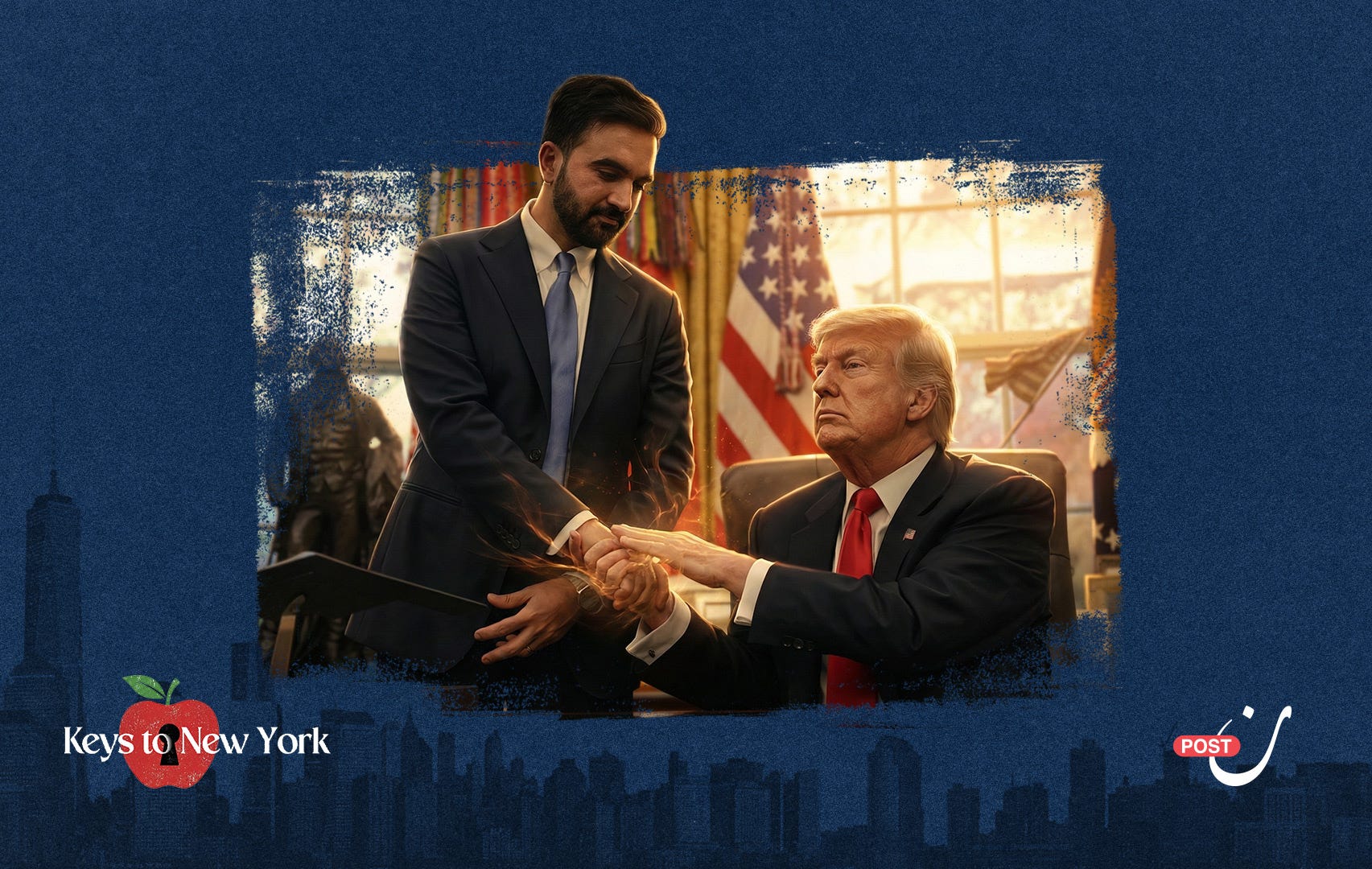
For months leading up to New York City’s mayoral election, tension defined the relationship between its winning candidate, Zohran Mamdani, and the Washington establishment especially Donald Trump. The mutual accusations and war of words dominated front pages and captured widespread attention not merely as signs of a growing rift in American politics, but as an ominous precursor to a looming clash between the nation’s capital and its economic powerhouse.
Should this confrontation erupt, the ramifications could extend far beyond Washington and New York, threatening the broader security and economic stability of the United States.
Trump, rallying behind Andrew Cuomo the former New York governor and staunch ally of the city’s pro-Israel elite launched into full attack mode. He accused Mamdani of “communism,” extremism, and advancing dangerous socialist ideas.
At various points, Trump threatened to revoke Mamdani’s U.S. citizenship, which would disqualify him from office, and to cut federal funding to New York City, one of the largest beneficiaries of federal aid, if the progressive front-runner were elected.
Can Trump Stop Mamdani?
How much does New York rely on federal funds, and can they be legally cut off? What alternatives does Mamdani have? How will he confront a hostile federal government? And what about New York’s contentious immigration policies, or the potential deployment of the National Guard? This article explores the various scenarios in what is shaping up to be a dramatic showdown between Mamdani and Trump and, behind them, the American political establishment.
Fiery Threats
As Mamdani edges closer to Gracie Mansion on Manhattan’s Upper East Side, Trump took to Truth Social to issue dire warnings. He predicted the “failure of the socialist experiment” in his beloved hometown and pledged to limit federal funding to the legal minimum. He encouraged voters to back Cuomo, insisting he would rather see a successful Democrat than a failed socialist at the helm. Trump reiterated the same threats in a “60 Minutes” interview on CBS News.
New York City primarily funds itself through local taxes, service fees, and non-tax revenues such as licensing and infrastructure. Federal funding accounts for only 6.4% of the city’s total budget.
The state government contributes billions to support city programs in education and health, while federal funds are largely directed toward nutrition, housing, and education. According to a report published on April 28, 2025, by New York State Comptroller Thomas DiNapoli, the state expects to require around $7.4 billion in federal support for its 2026 operating and capital budgets.
New York City has ambitious investment plans for 2026–2029 totaling $93 billion. These projects depend heavily on both state and federal backing.
The city’s most recent financial plan, released by the comptroller in November, projects an increase in federal funding needs to 8% approximately $8.6 billion of a total budget nearing $118 billion. Much of this money would go toward health, education, and social services, including shelters for the homeless and support for disadvantaged groups. The Temporary Assistance for Needy Families (TANF) program received the largest non-pandemic federal grant for fiscal years 2025 and 2026.
Though modest in percentage, federal funding plays a critical role in supporting New York’s most vulnerable. Mamdani’s ambitious agenda—to uplift these communities and make the city more affordable requires either federal backing or a viable replacement.
Can Federal Funds Be Cut?
The U.S. Constitution is clear about who controls federal spending. Under Article I, Section 9, funds may only be drawn from the Treasury through appropriations authorized by federal law. Article I, Section 8 empowers Congress not the president to levy taxes and decide how funds are spent, including federal allocations to states.
In short: the president cannot unilaterally withhold congressional appropriations. Doing so would be unconstitutional.
That said, presidents have historically used federal funding as leverage. In the 1970s, President Richard Nixon attempted to block funding for programs already approved by Congress. The courts rejected his arguments, reaffirming congressional power.
In response, Congress passed the Impoundment Control Act (ICA) of 1974. This law allows the president to delay, but not cancel, congressional funding for up to 45 days. After that, Congress must explicitly approve any continued freeze otherwise, the funding is automatically released.
Congress may impose conditional funding on states, but only if those conditions relate to the purpose of the funds and are not arbitrary or punitive. With Republicans currently holding majorities in both the House (220 seats) and Senate (53 seats), there is a real possibility of restrictive funding conditions being placed on New York.
These conditions, however, cannot be extreme or retaliatory. Any such measures would likely face legal challenges if seen as politically motivated attempts to punish Mamdani.
A Targeted Assault on New York
Trump’s antagonism toward New York City predates Mamdani’s rise. Even under the centrist, pro-Israel Mayor Eric Adams, the Trump administration implemented multiple freezes and cuts to federal funding.
Since Trump returned to office this January, his administration canceled a $34 million grant for counterterrorism efforts in the subway system, citing the city’s failure to comply with his immigration agenda. The city successfully challenged the decision in court, where the judge deemed it arbitrary and unconstitutional.
Similarly, an $80 million federal grant for shelters was withdrawn because the city housed undocumented immigrants. Adams filed another lawsuit, which is still pending.
Another $47 million grant for public schools was revoked over alleged non-compliance with the administration’s binary gender policies, ignoring the rights of trans and queer students. Once again, City Hall sued the federal government, and that case also remains in litigation.
The October 1st government shutdown triggered further cuts, including an $18 billion infrastructure freeze statewide. While the specific impact on NYC is unclear, DiNapoli estimates the city stands to lose $400 million in FY2025 and $135 million in FY2026.
The Search for Alternatives
Federal funding cuts especially to education, housing, and social services would force the city and state to compensate. This could mean slashing other programs, increasing taxes, or abandoning Mamdani’s promises of free buses, state-run grocery stores, rent freezes, and universal early childcare. These ambitious initiatives rely on multi-billion-dollar budgets that federal cuts would severely undermine.
Governor Kathy Hochul, a Democrat, maintains a delicate relationship with Trump. Unlike other Democratic governors, she has managed to strike agreements with him on key issues like counterterrorism funding and environmental projects thanks in part to Trump’s personal business interests in New York.
It’s unclear whether Hochul would risk that fragile détente to defend Mamdani. She is up for reelection in the upcoming midterms and may be hesitant to provoke the White House. Yet Mamdani controls the state’s most influential city and has broad support from constituencies Hochul will need. Aligning too closely with Trump could alienate her base.
The National Guard Threat
Trump’s tactics aren’t limited to funding. He has a history of deploying National Guard troops to cities with Democratic mayors, particularly those with sanctuary policies for undocumented immigrants. Cities like Washington, D.C., Portland, and Los Angeles have already witnessed this.
New York has yet to see National Guard deployment, but the threat looms. Trump has openly said he will “clean up” the city if Mamdani wins, using federal troops if necessary. Mamdani, like other mayors, has vowed to challenge any deployment in court.
Immigration enforcement adds another layer. New York, historically a safe haven for immigrants, does not cooperate with ICE. Trump has increased ICE activity in immigration courts, where agents have arrested hundreds attending routine hearings.
Mamdani, himself a Ugandan immigrant, is taking a tougher stance than his predecessor Adams, who cooperated with the administration. After federal bribery and fraud charges were dropped against Adams a move widely seen as political he resigned.
In contrast, Mamdani has declared that ICE and the National Guard are not welcome. He calls New York the city of immigrants built by them, governed by them and has threatened to arrest any ICE agents who violate city laws.
A Showdown on the Horizon
To counter Trump’s immigration crackdown, Mamdani is building a coalition that includes Governor Hochul and Attorney General Letitia James. While the mayor’s legal authority to block National Guard deployment is limited, he can mobilize public opinion and push the state government and civil society to act.
Other Democratic cities have done the same. Mayors in Chicago, Portland, and Oregon launched legal challenges against Trump’s use of federal troops. Mamdani can similarly empower citizens to document abuses and submit them to the Attorney General’s office, strengthening any legal case.
The president’s authority to deploy the Guard is tightly constrained. It applies only in extreme situations like rebellion or foreign invasion and does not extend to routine law enforcement. The courts are likely to reject such deployments in civil contexts.
Mamdani is also expanding the city’s legal resources. In a policy paper titled Confronting Trump, he announced plans to hire 200 new city attorneys to challenge federal overreach. He is also seeking alliances with Wall Street, much like San Francisco Mayor Daniel Lowry, who pressured Trump through tech industry leaders to scale back anti-immigration policies.
Democratic mayors across the country are responding similarly. Los Angeles Mayor Karen Bass staged symbolic protests in immigrant neighborhoods, while Chicago’s Brandon Johnson signed an executive order banning federal law enforcement from city properties.
Despite the cordial tone of their White House meeting in late November, a high-stakes clash appears imminent between Mamdani and Trump over immigration, federal funding, and the role of cities in national politics. Trump is unlikely to hold back in his campaign to derail the young, socialist immigrant now governing his hometown. But Mamdani, too, is preparing strategizing alliances, reinforcing legal defenses, and rallying the people who helped elect him.
The outcome of this confrontation will shape not only Mamdani’s fledgling administration but also the future of Trump’s approach to Democratic cities over the next three years. Its repercussions will be felt by millions of Americans.
