

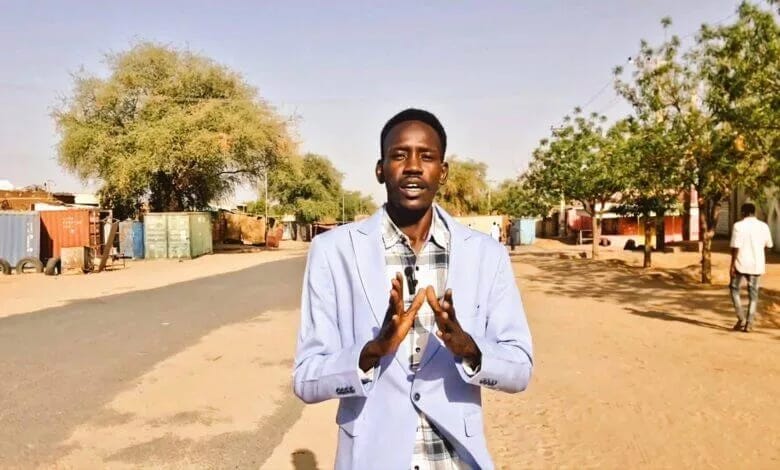
Khalid Ibrahim (a pseudonym), a journalist based in Zalingei, Central Darfur, must constantly change the satellite internet cafés he uses powered by Starlink to avoid detection by members of the Rapid Support Forces (RSF).
Ibrahim says he operates under false identities and avoids carrying equipment that could expose his profession. Instead, he often ventures out with just a pen and paper to conduct interviews with victims of abuses and local community leaders.
Occasionally, he inserts a memory card into the phone of the person he’s interviewing to collect photos, since he cannot risk carrying his own phone due to the RSF’s routine and aggressive phone checks at their checkpoints.
Like many of his colleagues, Ibrahim must rely on stringent personal security measures, chief among them absolute secrecy. In the absence of any institutional protection, and under the RSF’s iron grip on Darfur, even sources are being tracked down and interrogated for communicating with journalists.
Mounting Difficulties
Speaking to Noon Post, Ibrahim said being a journalist in Darfur today demands the ability to remain hidden, move quickly, communicate securely, and build personal relationships with sources. Revealing one’s professional identity, he warned, could lead to enforced disappearance.
He explained that the collapse of state institutions in Darfur including the judiciary has left RSF fighters enforcing their own version of the law. This has severely restricted access to information, pushing many journalists to focus their efforts on exposing human rights violations.
Currently, the RSF controls nearly all of Darfur, except for Tina, Kornoi, and Um Baru on the Chadian border, along with areas held by the Sudan Liberation Movement led by Abdel Wahid Mohamed al-Nur namely Jebel Marra and the locality of Tawila in North Darfur.
The conflict has decimated the region’s infrastructure, particularly communication networks, forcing residents to rely on satellite internet cafés offering Starlink access. These cafés charge by the hour and are often owned by RSF members or their affiliates. They are regularly inspected by RSF fighters, who scour phones for chats, voice messages, and videos.
Dealing Carefully with Sources
Ibrahim explained that he records information as a WhatsApp voice note at home before going to a café to send it to a colleague outside Darfur, who edits and deletes it immediately. Despite the risks, he insists exposing abuses is worth it.
Another journalist, currently based in North Darfur, told Noon Post that journalists face a litany of threats: murder, looting, abduction, intimidation, and arbitrary detention—all tactics used by the RSF and other armed groups.
He shared how an RSF crackdown forced him to be extremely cautious even with civil administration contacts. He cited the case of a tribal leader in Mellit who was arrested after his name appeared in a report first and last names reversed. He was held for hours, interrogated only about the identity of the journalist who had contacted him.
Due to this heavy surveillance in internet cafés, sources are now reluctant to speak out, fearing arrest. Journalists, too, are wary of digital tracking through the phones and apps they use to share stories, especially via public networks that are far from secure.
“Working as a journalist in North Darfur requires constant vigilance,” he added. “You have to avoid public appearances, claim to be in another profession, and sometimes even go undercover while doing your job.” He stressed the need for journalists to upgrade their safety protocols encrypting messages, hiding files inside inconspicuous media, and using stealthy apps.
The RSF detains people simply for having images or videos of the army or its allies on their phones or for posting troop movements on social media.
Powerless to Intervene
Websites like Sudan Tribune, Darfur24, Ayin, and Jabraka News rely on correspondents who operate in a deeply hostile environment. These reporters are the last line of defense against impunity. Some have paid a heavy price, while others remain behind bars.
One illustrative case is that of journalist Muammar Ibrahim, who was arrested in humiliating fashion while leaving El Fasher after the RSF took over the city on October 26, 2025. He was later paraded beside an RSF spokesperson and visibly treated with contempt just a glimpse of the violence journalists face.
Sudan’s state news agency reported the killing of its El Fasher bureau chief, Taj al-Sir Mohamed Suleiman, in his home by RSF fighters. Meanwhile, the Committee to Protect Journalists reported 13 journalists missing and at least three female reporters raped during the recent assault on El Fasher. Muammar remains in RSF custody for referring to them as a “militia” in a post on X.
Sudanese Journalists Syndicate head Abdel Moneim Abu Idris told Noon Post that journalists face such grave threats that merely revealing their profession is a danger, in violation of international humanitarian law. He noted that 33 journalists have been killed in the conflict so far 17 of them in Darfur.
Four remain missing, and two are detained by the RSF. “These roadblocks make it nearly impossible to uncover the truth,” he said.
The Syndicate reached out to the International Committee of the Red Cross to help evacuate journalists and secure the release of detainees, but received no response. The ICRC said it requires approval from both the army and the RSF approval that hasn’t been granted. In the meantime, the Syndicate has launched a solidarity campaign.
With the RSF fragmented into rogue groups operating without centralized command and the absence of any governing authority capable of enforcing decisions the Syndicate is effectively powerless to protect journalists on the ground.
The Last Line
Nyala, now declared the RSF’s capital under its parallel administration, is the most heavily militarized and securitized city in Darfur. One journalist there says he uses a charcoal trading business as cover to continue reporting on human rights violations.
He buys charcoal from displacement camps and villages, bringing it into Nyala. This cover has helped him build a wide network of contacts. However, he warned that even local communities can become hostile if they feel threatened by journalistic exposure.
Despite charcoal trading being profitable, he insists on continuing his work as a journalist. To him, documenting atrocities is a duty a way to ensure the world doesn’t forget the suffering of Darfur’s people amid a culture of impunity.
For 22 years, Darfur has been the epicenter of continuous conflict involving a complex web of actors from rebels to armed factions. This reality has granted perpetrators a shield against justice, especially with the total collapse of law enforcement institutions since the current war erupted.
In response, the RSF has tried to fill the void by establishing its own loyalist police forces and makeshift courts led by tribal elders, who place militia interests above all else.
This makes the work of journalists documenting war crimes and abuses not only dangerous but essential. In many ways, they are the final civilian bulwark standing between truth and oblivion, now that activists and human rights defenders have either fled or been silenced.
